November 15, 2015:
Weirdly, five years after trying—and failing—to find an audience for my video-game writing, I suddenly have an audience: video-game developers and execs.
I know. I’m shocked too.
For years, I tried appealing to gamers. They didn’t care for it. Too nerdy. Too out there. Most gamers don’t think about the broader business implications of the Steam ecosystem. But you know who does? The people who put their entire livelihood on Steam and hand over 30% every time a sale hits. They care a lot.
Do I have insider access? No. What I do have is a career split between start-ups and finance, plus a lifetime of gaming, plus the habit of looking up who makes the games I play and following what they do. Turns out that combo resonates with the people actually building this stuff.
And here’s the other thing I’ve learned: my so-called “wild moonshot ideas” only seem wild to gamers because gamers usually want the same thing they already have. Ask a console gamer what they want and they’ll say a more powerful console. Ask a PC gamer and they’ll say a more powerful PC.
But to me, video games are a testing ground for bigger ideas in tech. Consciously or not, society has decided that any world-changing technology must first be validated through play.
Anyway, with all that in mind, let’s talk about four games I bought 10 years ago.
Enclave
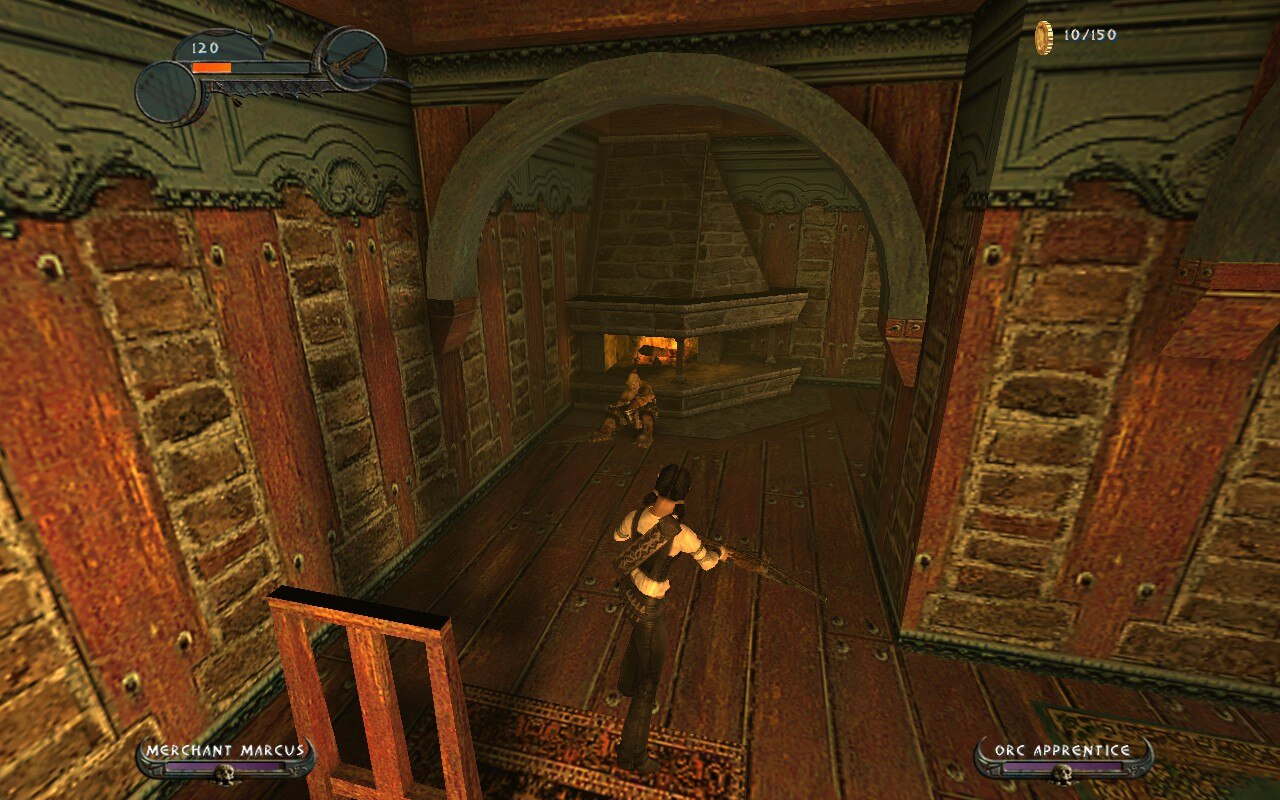
An action RPG that, though imperfect, I keep coming back to because I love the style—and it still looks amazing even on modern hardware.
Enclave is one of those early-2000s curiosities that should have faded into the ether, but somehow didn’t. Starbreeze—yes, the same Starbreeze that later gave us Riddick and The Darkness—built this grim, high-contrast medieval world for the original Xbox in 2002, then pushed it to PC in 2003. On paper, it’s a straightforward, mission-based hack-and-slash. In practice, it’s a time capsule of when “dark fantasy” meant brooding skies, impossible stone keeps, and music from Gustaf Grefberg that sounded like it belonged in a much bigger game.
The premise is simple but clever: choose Light or choose Dark, and the campaign missions actually change. You’re not just picking a faction palette; you’re playing different characters, different classes, different gear, different perspectives. Modern games talk a big game about meaningful choice. Enclave delivered it 20 years ago in the most blunt, early-Xbox way possible.
The combat? Yeah, it’s clunky. Sometimes you swing like you’re underwater. Ranged classes feel better, magic is fun, but melee can get downright crunchy in a way that isn’t always intentional. And the progression is as linear as it gets: finish mission, earn gold, buy gear, repeat. There’s no open world, no stat trees, no branching story except the Light/Dark split. It’s more arcade-RPG than RPG-RPG.
But here’s the thing: the style is phenomenal. Enclave had no right looking this good in 2002, and the fact that it still pops on modern systems—even before the 2023 Enclave HD re-release—says everything. The art direction is that classic “only the Xbox could do this” era, with chunky geometry, moody lighting, and a world that feels like Diablo got shoved into a heavy-metal album cover.
And the legacy is weirdly rich. It got a PAL-only Wii port in 2012. It got Mac and Linux support later. It even got a full console remaster in 2023 from Ziggurat and Sickhead Games. Hell, it almost got a full-blown sequel—Enclave II—with co-op, multiplayer, mocap animation, and a new lead, before publisher drama nuked it in 2003. There was enough ambition under the hood that parts of the cancelled sequel even leaked into other games (Knights of the Temple).
Yet despite all that history, Enclave never became a household name. It’s a AA game that lived long enough to get resurrected multiple times because people like me keep being drawn back to it. It’s rough around the edges, often unforgiving, occasionally janky—but it has personality, confidence, and a sense of worldbuilding that’s way outsized for its budget.
I forgive the clunky combat. I forgive the linearity. Because every time I boot it up, Light or Dark, Enclave reminds me of a time when action RPGs weren’t trying to be loot treadmills or 200-hour epics. They were just trying to hit you with atmosphere, challenge, and a little bit of metal-album theatrics.
And for me? That’s enough to keep coming back.
Gorky 17
Gorky 17 is one of those late-90s oddities that shouldn’t work, yet somehow absolutely does. A Polish-made tactical RPG set in a ruined “secret city” where NATO sends a Canadian commando team to investigate grotesque bio-hybrids? That’s certainly a vibe. But then you mix in that distinctly 90s post-Soviet aesthetic—cracked concrete, rusted metal, Cold War paranoia still humming in the background—and the whole thing becomes strangely magnetic.
This isn’t an RPG where you mash attack and drift into a comfy grind. Combat is pure turn-based chess: fixed encounter maps, movement limits, orthogonal vs diagonal weapon arcs, and a simple rule that keeps tension high—if one squad member dies, it’s over. No save-scumming your way through a sloppy fight. Every misstep hurts. And because they shoved survival-horror pacing into a tactical grid system, even basic encounters feel like you’re one bullet away from disaster.
The structure is split: real-time exploration on grimy streets and abandoned buildings, then hard cuts to grid combat the moment something awful lunges at you. It’s X-COM meets point-and-click adventure. It shouldn’t work, but it really does.
And yes, the voice acting is gloriously over-the-top. Everyone sounds like they’re doing a stage play inside a metal shipping container. But that was the norm in the 90s, and honestly, it’s part of the charm. Combine that with a moody soundtrack from Adam Skorupa—the same guy who later scored The Witcher—and you’ve got a cult classic atmosphere from a team that was basically Poland’s PC-gaming vanguard.
If you dig deep cuts, the Gorky series is a whole mess of genre pivots. There’s a stealth-action prequel (Gorky Zero), then an action-shooter sequel (Aurora Watching) that got renamed Soldier Elite in North America, complete with altered character names because publishers couldn’t help themselves. Gorky 17 remains the standout because it’s the one entry that fully commits to being weird, tactical, unforgiving, and memorable.
And that’s exactly why it sticks. It's not mere nostalgia bait and it isn’t comfortable. It’s a snapshot of a very specific era—PC developers experimenting like mad, Polish studios swinging big, and tactical RPGs allowed to be punishing without apology.
Definitely memorable.
Earth 2150: The Moon Project
I’ve never been able to get this to run well, but the entire Earth 2150 Trilogy was re-released—and I own that, so I’ll review it when the time comes.
Anomaly: Warzone Earth
A reverse tower defense game. I wish I liked it more. The presentation is more than nice—11 bit studios clearly poured talent into this thing—but for whatever reason, and despite multiple attempts to force myself into enjoying it, it just doesn’t land for me.
Which is bizarre, because on paper Anomaly: Warzone Earth should be exactly my thing. This is the original “tower-offense” game, the one that flips the genre on its head and asks you to guide a convoy into the meat grinder. You’re the commander of the 14th Platoon, marching through alien “anomalies” in Baghdad and Tokyo. Instead of placing turrets, you’re plotting routes on a tactical map, buying armored vehicles, upgrading them, and dropping abilities like Smoke, Repair, Decoy, and Airstrike at the perfect moment. It’s clever. It’s polished. And it’s historically important enough that Apple gave it a Design Award in 2011.
And yet… I bounce off it every time.
The core issue is that everything feels slightly indirect. You’re not attacking towers so much as babysitting your convoy, nudging its path and sprinkling abilities as you jog around the battlefield as this little Commander avatar. On PC and console, that Commander is a real gameplay element, picking up ability drops and running into danger. On mobile, 11 bit removed him entirely and streamlined the controls, which honestly might have been the right call because the original version never quite nails the rhythm. It’s like the game keeps promising intensity but delivers a politely measured jog instead of a sprint.
The structure is tight, the tech is solid—the game was the studio’s first project on their newly built engine—and the cross-platform ambitions were impressive for 2011. PC, Mac, mobile, XBLA, PSN. They even had Tokyo-exclusive missions on PC while the mobile versions got retuned for touch. The whole thing is a fascinating window into early 2010s indie ambition.
But ambition doesn’t automatically translate into fun.
And that’s the real heartache here. Anomaly: Warzone Earth is absolutely a milestone. It kicked off a whole series: Anomaly Korea, Anomaly 2 with its crazy asymmetrical multiplayer mode, and Anomaly Defenders flipping the whole thing back into traditional tower defense. It proved 11 bit wasn’t just another Eastern European indie—they were a studio with range, which later became obvious when they pivoted hard into This War of Mine and Frostpunk.
I respect the game. I admire the game. I even recommend the game to people who want to experience the “origin point” of tower-offense design.
But I don’t like the game.
And that stings a bit, because I tried. Multiple times. Across multiple platforms. It just never clicked for me. Maybe it’s the pacing. Maybe it’s the indirectness. Maybe tower-offense is one of those ideas that looks smarter in theory than in practice.
Whatever the reason, Anomaly: Warzone Earth is a beautiful, influential, historically important RTS experiment. I’m glad it exists. I’m glad it succeeded.
I just wish I enjoyed playing it.
 undefined