Last year I finished working my way through all the Best Picture winners.
Uncategorized
28
Posts
2
Posters
0
Views
-
Friendly Persuasion (1956)
An absolute lost classic, and it's a shame it took me 48 years to come across it. It managed to be an actually fairly nuanced examination of pacifism, seen through the lens of a Quaker community whose values are being tested by the US civil war. Really just a charming slice of life at first, it very effectively builds up fully human characters whose moral conflicts can be deeply felt when the war finally arrives. For a product of the studio system at the height of their blandness, it almost manages to be profound.
La Dolce Vita (1960)
Somehow I'd never actually watched this before. Some absolutely beautiful shots, but one of those movies where everyone is kind of terrible, and I just want them all to go away. But it was amusing to remember halfway through that the sleazy photographer being named Paparazzo wasn't a bit on the nose, it's the origin of that term!
-
 undefined oblomov@sociale.network shared this topic on
-
La Dolce Vita (1960)
Somehow I'd never actually watched this before. Some absolutely beautiful shots, but one of those movies where everyone is kind of terrible, and I just want them all to go away. But it was amusing to remember halfway through that the sleazy photographer being named Paparazzo wasn't a bit on the nose, it's the origin of that term!
Viridiana (1961)
I hadn't watched a Luis Buñuel film in a very long time, but my impression remains much the same. Weirdly intense, a bit too busy dealing with the director's issues with religion to be fully coherent, left me feeling icky. I guess maybe it was edgy and shocking at one point, but not in any interesting way to my jaded 2025 eyes.
-
Viridiana (1961)
I hadn't watched a Luis Buñuel film in a very long time, but my impression remains much the same. Weirdly intense, a bit too busy dealing with the director's issues with religion to be fully coherent, left me feeling icky. I guess maybe it was edgy and shocking at one point, but not in any interesting way to my jaded 2025 eyes.
The Leopard (1963)
A gorgeous, lush historical production about the unification of Italy, a period of history I didn't know much about. And still don't, because that mostly happens off screen and is just kind of offhandedly mentioned now and then. Staring Burt Lancaster, who apparently did all his lines in English and just got dubbed into Italian? Anyway, I didn't hate it, and it was very pretty to look at. But my sympathy for a prince who is super sad because of the tackiness of the rising middle class is a bit limited.
-
The Leopard (1963)
A gorgeous, lush historical production about the unification of Italy, a period of history I didn't know much about. And still don't, because that mostly happens off screen and is just kind of offhandedly mentioned now and then. Staring Burt Lancaster, who apparently did all his lines in English and just got dubbed into Italian? Anyway, I didn't hate it, and it was very pretty to look at. But my sympathy for a prince who is super sad because of the tackiness of the rising middle class is a bit limited.
The Given Word (1962)
Based on the logline ("A devout Christian makes a vow to Saint Barbara after she saves his donkey, but everyone misunderstands his intentions. Will he keep his promise?"), I wasn't really looking forward to this one. But it was so much weirder and more visceral than I expected, I'm very glad I watched it. And maybe the first portrayal of capoeira in film? Still not sure if I liked it, exactly, but I bet I keep thinking about it.
-
The Given Word (1962)
Based on the logline ("A devout Christian makes a vow to Saint Barbara after she saves his donkey, but everyone misunderstands his intentions. Will he keep his promise?"), I wasn't really looking forward to this one. But it was so much weirder and more visceral than I expected, I'm very glad I watched it. And maybe the first portrayal of capoeira in film? Still not sure if I liked it, exactly, but I bet I keep thinking about it.
The Knack... and How to Get It (1965)
I feared this was going to be repulsive pickup artist bullshit, and it very much was. And much of it was the kind of wacky 60s comedy I don't much like. But it did do some very interesting things with language, throwing sentence fragments around in almost incomprehensible, staccato bursts. And there were elements that reminded me a lot more of If...., one of my favorite films, a lot more than I expected. But I'm having to squint a lot to say anything positive about it, and I'm not sure why I'm bothering.
-
The Knack... and How to Get It (1965)
I feared this was going to be repulsive pickup artist bullshit, and it very much was. And much of it was the kind of wacky 60s comedy I don't much like. But it did do some very interesting things with language, throwing sentence fragments around in almost incomprehensible, staccato bursts. And there were elements that reminded me a lot more of If...., one of my favorite films, a lot more than I expected. But I'm having to squint a lot to say anything positive about it, and I'm not sure why I'm bothering.
The Go-Between (1971)
I liked this well enough, but I must have been more tired than I realized because I completely failed to realize there were interspersed scenes set 50 years after the main action until WAY too late in the movie. So I spent a lot of it being confused why I'd seen cars and a television set, yet someone had referred to "the war" and meant the Boer War! Though, reading the plot summary on Wikipedia, I think maybe you just needed to have read the book to understand everything that was happening.
-
The Go-Between (1971)
I liked this well enough, but I must have been more tired than I realized because I completely failed to realize there were interspersed scenes set 50 years after the main action until WAY too late in the movie. So I spent a lot of it being confused why I'd seen cars and a television set, yet someone had referred to "the war" and meant the Boer War! Though, reading the plot summary on Wikipedia, I think maybe you just needed to have read the book to understand everything that was happening.
The Mattei Affair (1972)
Learning about Italian history is an emerging theme of this project. We're into the gritty 70s now, and this movie pairs nicely with The Conversation, which would win the Palme d'Or two years later. Quite enjoyable, though it does suffer some from the inherent problem of biopics -- how do you turn a life into a well-formed narrative, and not just a sequence of events?
-
The Mattei Affair (1972)
Learning about Italian history is an emerging theme of this project. We're into the gritty 70s now, and this movie pairs nicely with The Conversation, which would win the Palme d'Or two years later. Quite enjoyable, though it does suffer some from the inherent problem of biopics -- how do you turn a life into a well-formed narrative, and not just a sequence of events?
The Hireling (1973)
It didn't help that I was watching this on a random youtube of dubious pedigree and worse encoding quality, but I found this to be an oppressive, claustrophobic movie. Which was at least in part the intention, I think, but being outside of British class anxieties, it didn't really speak to me. Like how the failure mode of clever is asshole, the failure mode of 70s grit is mildly repulsed boredom.
-
The Hireling (1973)
It didn't help that I was watching this on a random youtube of dubious pedigree and worse encoding quality, but I found this to be an oppressive, claustrophobic movie. Which was at least in part the intention, I think, but being outside of British class anxieties, it didn't really speak to me. Like how the failure mode of clever is asshole, the failure mode of 70s grit is mildly repulsed boredom.
Scarecrow (1973)
Pure 70s grit with Gene Hackman and Al Pacino in a movie that I ended up liking a lot more than I expected to. I sometimes have trouble getting into rambling, episodic plots, but the nuances of their performances and the development of the relationship between them was really captivating. The abrupt ending hit particularly hard.
-
Scarecrow (1973)
Pure 70s grit with Gene Hackman and Al Pacino in a movie that I ended up liking a lot more than I expected to. I sometimes have trouble getting into rambling, episodic plots, but the nuances of their performances and the development of the relationship between them was really captivating. The abrupt ending hit particularly hard.
The Long Absence (1961)
Jumping back in time a bit here as physical media for the unstreamable ones final arrive. Slow, subtle and heartbreaking. The unresolved ending felt fully justified as a way to put us in the mindspace of the protagonist, and not just a gimmick. Definitely underrated.
-
The Long Absence (1961)
Jumping back in time a bit here as physical media for the unstreamable ones final arrive. Slow, subtle and heartbreaking. The unresolved ending felt fully justified as a way to put us in the mindspace of the protagonist, and not just a gimmick. Definitely underrated.
Padre Padrone (1977)
Brutal child abuse in Sardinia. Also a surprising amount of bestiality. All within a framing device that Wes Anderson might have filmed. Fascinating, but not exactly enjoyable.
-
Padre Padrone (1977)
Brutal child abuse in Sardinia. Also a surprising amount of bestiality. All within a framing device that Wes Anderson might have filmed. Fascinating, but not exactly enjoyable.
The Birds, the Bees and the Italians (1966)
Another one I had to wait for physical media to arrive in order to watch. And now I own a copy of a vile movie about vile people doing vile things that I will definitely never watch again. Blech.
-
The Birds, the Bees and the Italians (1966)
Another one I had to wait for physical media to arrive in order to watch. And now I own a copy of a vile movie about vile people doing vile things that I will definitely never watch again. Blech.
Chronicle of the Years of Fire (1975)
An understated epic on the lead up to the Algerian war for independence, seen through the eyes of a peasant who gets increasingly more involved as tensions escalate. Sadly I was watching a low quality scan with fairly bad captions, but it was still enthralling.
-
Chronicle of the Years of Fire (1975)
An understated epic on the lead up to the Algerian war for independence, seen through the eyes of a peasant who gets increasingly more involved as tensions escalate. Sadly I was watching a low quality scan with fairly bad captions, but it was still enthralling.
A Man and a Woman (1966)
Charming and vibe-y. One of those minor works that have an oversized emotional impact, by just doing the basic stuff super well. I kept trying to figure out what the significance of the sections filmed in color vs BW was, but like If...., I now see it was arbitrarily driven by the budget.
I'm now over 50% done with the Palme d'Or list! (Having started at about 30&.) It's going much faster than I expected, but having a list of movies to pull from has proven to be very convenient when combined with the new and exciting forms of insomnia I've been exploring.
-
A Man and a Woman (1966)
Charming and vibe-y. One of those minor works that have an oversized emotional impact, by just doing the basic stuff super well. I kept trying to figure out what the significance of the sections filmed in color vs BW was, but like If...., I now see it was arbitrarily driven by the budget.
I'm now over 50% done with the Palme d'Or list! (Having started at about 30&.) It's going much faster than I expected, but having a list of movies to pull from has proven to be very convenient when combined with the new and exciting forms of insomnia I've been exploring.
The Working Class Goes to Heaven (1971)
A messy but interesting film. Bonus: it featured lots of machining, though much of that was more of a cautionary tale when it comes to shop safety.
This one proved elusive, as it's not available for streaming, but luckily Scarecrow, the one big (really big!) rental store left in town, had a copy. Except the first time I carelessly grabbed the Blu-Ray instead of the DVD, and my region-free player is DVD only. Whoops. I'm enjoying going to the rental store after brunch as part of my normal Saturday routine, though. I think I'll keep doing that, even when everything on the docket is available streaming. Gods know that Google and Amazon don't need any more of my money.
-
The Working Class Goes to Heaven (1971)
A messy but interesting film. Bonus: it featured lots of machining, though much of that was more of a cautionary tale when it comes to shop safety.
This one proved elusive, as it's not available for streaming, but luckily Scarecrow, the one big (really big!) rental store left in town, had a copy. Except the first time I carelessly grabbed the Blu-Ray instead of the DVD, and my region-free player is DVD only. Whoops. I'm enjoying going to the rental store after brunch as part of my normal Saturday routine, though. I think I'll keep doing that, even when everything on the docket is available streaming. Gods know that Google and Amazon don't need any more of my money.
Man of Iron (1981)
An powerful, riveting portrayal of a spineless journalist sent to dig up dirt on the leader of a strike in communist Poland. It manages a delicate combination of being simultaneously optimistic and pessimistic. Pretty amazing that it got made at all, it just squeaked through during a short window of lax censorship following the events being portrayed in the movie. It's a sequel to Man of Marble, focusing on the father of the strike leader, and I think I'll have to watch that one too.
-
Man of Iron (1981)
An powerful, riveting portrayal of a spineless journalist sent to dig up dirt on the leader of a strike in communist Poland. It manages a delicate combination of being simultaneously optimistic and pessimistic. Pretty amazing that it got made at all, it just squeaked through during a short window of lax censorship following the events being portrayed in the movie. It's a sequel to Man of Marble, focusing on the father of the strike leader, and I think I'll have to watch that one too.
The Tree of Wooden Clogs (1978)
A meditative, almost languid slice of life of late 19th century Lombard peasants. I found it surprisingly gripping -- I think because the cinematography was an amazing balancing act of being entirely understated and naturalistic while still somehow making every frame look like the work of an old master.
-
The Tree of Wooden Clogs (1978)
A meditative, almost languid slice of life of late 19th century Lombard peasants. I found it surprisingly gripping -- I think because the cinematography was an amazing balancing act of being entirely understated and naturalistic while still somehow making every frame look like the work of an old master.
The Tin Drum (1979)
A very strange movie, with some incredibly uncomfortable scenes. There was a surrealism to it I liked, but it never quite leaned into that. There were some sweeping historical epic elements that I also liked, but it couldn't really commit to those either. There was a holy fool, and I love holy fools, but he isn't used very well. I dunno. Maybe don't put 11 year old actors in explicit sex scenes, even if they are playing a 16 year old?
Anyway, I'm now done with the 1970s.
-
The Tin Drum (1979)
A very strange movie, with some incredibly uncomfortable scenes. There was a surrealism to it I liked, but it never quite leaned into that. There were some sweeping historical epic elements that I also liked, but it couldn't really commit to those either. There was a holy fool, and I love holy fools, but he isn't used very well. I dunno. Maybe don't put 11 year old actors in explicit sex scenes, even if they are playing a 16 year old?
Anyway, I'm now done with the 1970s.
Missing (1982)
Jack Lemmon tries to uncover what happened to his son who was disappeared in the Chilean coup, slowly realizing the extent of the US involvement and how naive his trust in his own government was. Intense and searingly painful at times. Lemmon really didn't get enough credit as a dramatic actor, because he was absolutely brilliant in this.
Oh, and since there was some surprise expressed that we still have a real video store in Seattle, here is it (minus a few rooms behind the camera) in all its glory. I'm so glad we've managed to keep it open this long -- and hopefully the tide is turning on physical media enough that maybe it can survive someday without fundraisers.
-
Missing (1982)
Jack Lemmon tries to uncover what happened to his son who was disappeared in the Chilean coup, slowly realizing the extent of the US involvement and how naive his trust in his own government was. Intense and searingly painful at times. Lemmon really didn't get enough credit as a dramatic actor, because he was absolutely brilliant in this.
Oh, and since there was some surprise expressed that we still have a real video store in Seattle, here is it (minus a few rooms behind the camera) in all its glory. I'm so glad we've managed to keep it open this long -- and hopefully the tide is turning on physical media enough that maybe it can survive someday without fundraisers.
The Ballad of Narayama (1983)
There are themes of being reconciled with death, and the inexorable cycle of life, but really, this is about how brutal life as a peasant was. There is also some symbolism going on with snakes that I didn't understand.
Also, this is the first time I've seen subtitles offer verbose cultural explanations outside of anime fansubs.

Gli ultimi otto messaggi ricevuti dalla Federazione
-
@mau @aitech Insomma io credo che noi nati dagli anni 60 in poi -io dell'80- e abbiamo visto crescere l'informatica, abbiamo una responsabilità enorme. Siamo in mezzo e sta a noi con più conoscenza, educare chi non ce l'ha. E non è vero che basta RTFM, perché noi ancora possiamo trovare gli strumenti. Gli altri più anziani e più giovani, che vivono l'informatica in modo più passivo, non ce la fanno.
-
for the Director-General you can compose a parody of arguably most famous patter song in Pirates of Penzance
-
@stefano For the hosting and cappuccino 🙂
-
@Jgbird majestic as fuck
-
When I was home over Christmas, I was digging through some of my dad’s baseball memorabilia when I came across a copy of the Washington Post from March 7, 1999: “Printing Revolution Spurs New Look,” the lead headline read. The paper was such an incredible artifact that I took photos of each of its pages.
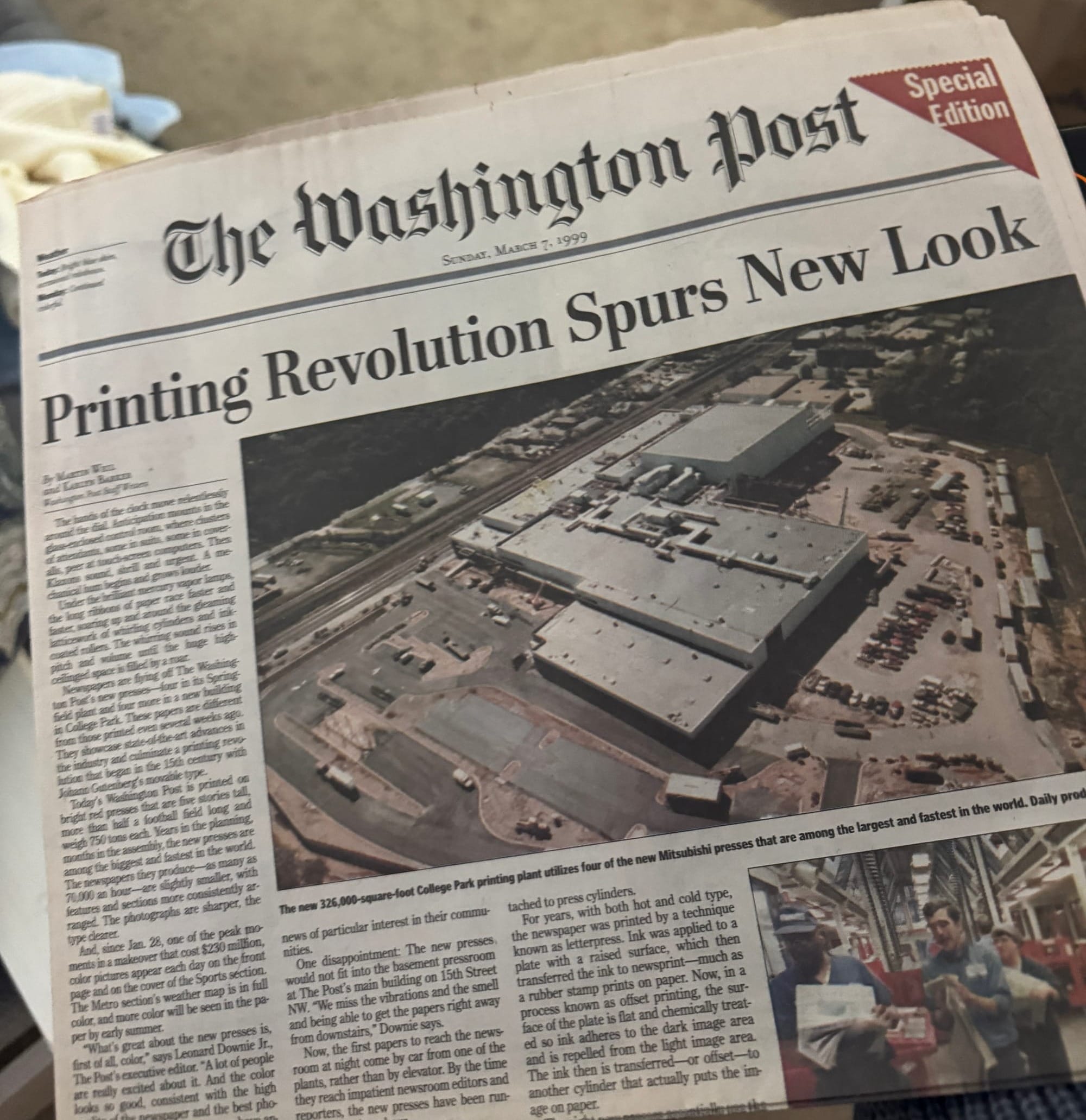
The paper was a “special edition” printed to commemorate the opening of its College Park, Maryland printing press, where my dad worked for years. This special edition was presumably one of the first papers that came off those presses. It was an almost unimaginably optimistic time for the journalism business: “Newspapers are flying off the Washington Post’s new presses—four in its Springfield plant and four more in a new building in College Park,” the article read. “These papers are different from those printed even several weeks ago. They showcase state-of-the-art advances in the industry and culminate a printing revolution that began in the 15th century on Johann Gutenberg’s moveable type.” In a photo, the publisher of The Post, Donald Graham, posed with a stack of “some of the first color papers at College Park.”
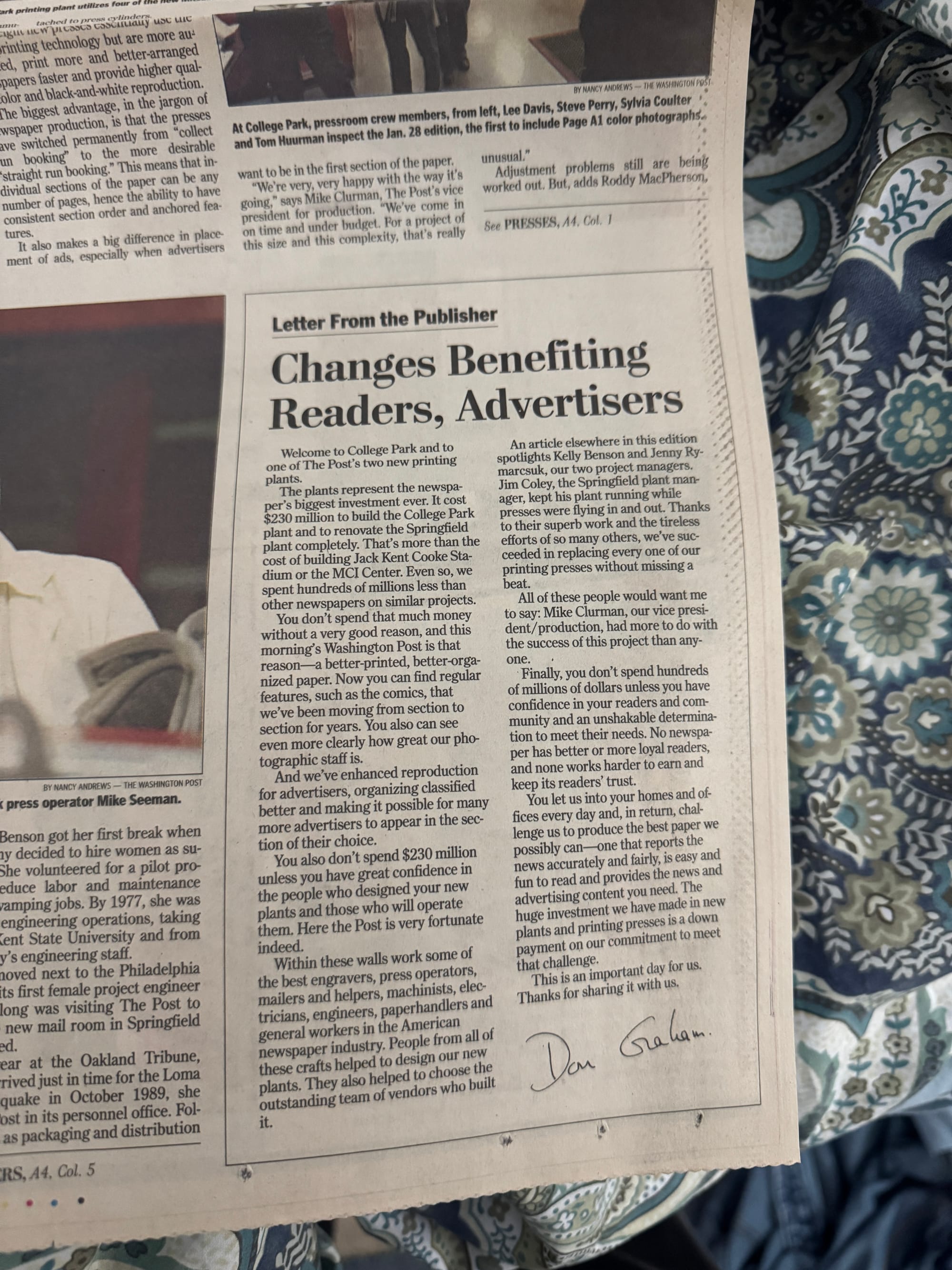
An info box called “Things to Know” explained that The Post printed 800,000 copies on weekdays and 1.1 million copies on Sundays. In a letter from the publisher titled “Changes Benefiting Readers, Advertisers,” Graham wrote that the new printing plant was “the newspaper’s biggest investment ever” and cost $230 million. “You don’t spend that much money without a very good reason, and this morning’s Washington Post is that reason—a better printed, better-organized paper,” he wrote. “Within these walls work some of the best engravers, press operators, mailers and helpers, machinists, electricians, engineers, paper handlers, and general workers in the American newspaper industry […] you don’t spend hundreds of millions of dollars unless you have confidence in your readers and community and an unshakeable determination to meet their needs. No newspaper has better or more loyal readers, and none works harder to earn and keep its readers’ trust.”
You know the rest of the story. Graham eventually sold the newspaper to Jeff Bezos, one of the world’s richest men, for a little more than The Post paid for those printing presses. In the short term, Bezos invested in the paper but has appeared to have lost interest in employing large numbers of good journalists, at least some of whom reported aggressively on his various businesses. On Wednesday the Post laid off hundreds of journalists, which destroyed entire sections of the newspaper, including much of its foreign bureau coverage, and gutted many of its sections.
I already mined my dad’s history at The Washington Post for an article about how Bezos was killing the paper that I wrote back in 2024. When people ask me why I became a journalist, “my dad printed the Washington Post” is always the first thing I mention. But it goes a bit deeper than that.
One of my first internships in college was at Washington Post Express, the free daily paper that was handed out on the Metro that at the time operated out of an office in Virginia away from the main Washington Post newsroom alongside washingtonpost.com. These all operated somewhat separately from the regular newspaper for what were, in retrospect, obviously misguided business reasons. And I majored in journalism at the University of Maryland, where I took a sportswriting class with George Solomon, who was the longtime editor of the paper’s legendary sports section, which was unceremoniously killed Wednesday. In Solomon’s class, we had to read All Those Mornings at the Post, written by the legendary sportswriter Shirley Povich. Every major Washington Post sportswriter came in to talk to our class at some point, which is one of the few things I actually remember from journalism school. The Washington Post has been a critical institution in my life and in the lives of millions of people who live in the D.C. area. “We lost something very, very big today,” Solomon said on Wednesday. “The owner of the newspaper is a very successful man, and he may see that he made a mistake.”
What we’re seeing, though, is not a mistake. Unlike the Graham family in the late 1990s, Jeff Bezos has no reason to try to make his newspaper better or to try to best serve its readers. The newspaper's finances are barely a rounding error compared to Bezos's wealth, but what its journalists do—accountability journalism about the rich and powerful—does not serve someone who is rich and powerful. The Washington Post and many of its reporters are no longer useful to Bezos, and so he has decided to get rid of them.
The Washington Post’s journalists, many of whom lost their jobs this week, have continued to do critical work, but Bezos has been systematically making the paper worse for years. Like other news outlets, they have suffered from regular cuts. Under Bezos, The Washington Post also announced plans to jam weird AI into the paper, refused to allow the paper to endorse a presidential candidate, and meddled with its opinion section, leading to mass subscriber cancellations. Jeff Bezos’s Washington Post no longer, as Graham wrote in his letter all those years ago, has an “unshakeable determination to meet [readers’] needs.”
As I wrote in that 2024 article called “the billionaire is the threat, not the solution,” the biggest threat to The Washington Post for years has been Bezos, not the difficulties of the news industry, The Post’s business model, the macroeconomy, or anything else. In the utterly psychotic letter to readers that spurred my article, Bezos wrote “you can see my wealth and business interests as a bulwark against intimidation, or you can see them as a web of conflicting interests.” You can also look at his ownership of The Post as what it actually is: completely irrelevant to his wealth, and an annoyance under an administration that demands fealty, bribes, and ritual sacrifices from businesses and major media companies. Bezos could fund The Washington Post well past his own death, but he clearly has zero interest in doing this. The news business is hard, but we simply cannot keep relying on the idea that journalism can be funded by billionaires whose personal interests are at direct odds with accountability work.
In our current kleptocracy, there is no need for a multibillionaire with tons of business before the government to invest in or have a media company focused on journalism about the administration or about the rich and powerful. The collateral damage is all of the good journalists who have lost their jobs, the legacy of the Washington Post, and the people of the Washington, D.C. metro area. Bezos has found an easier, faster way to get what he wants. The layoffs at The Post come just days after Amazon spent roughly the $75 million to release the Melania bribe documentary. You don’t spend that much money without a very good reason.
-
@deesajoe
Ah eccolo
https://sbroccogiocattoli.com/shop/no-action-figures/no-action-figure-sailor-moo/
-
@peterkotrcka thank you very very much!
-
New page of my scifi webcomic was released on Monday! Have you checked it out yet?
#webcomic #aliens #graphicnovel #leavingthecradle #spiderforest #comic #update #MastoArt