I'm unable to find any confirmation of that supposed $120M investment in Bluesky.
Uncategorized
6
Posts
3
Posters
1
Views
-
RE: https://toot.yosh.is/@yosh/116110218041250391
I'm unable to find any confirmation of that supposed $120M investment in Bluesky. There was a story in Business Insider in January 2025 saying they were seeking investment on a $700M valuation. Does anyone have a link to solid evidence?
-
RE: https://toot.yosh.is/@yosh/116110218041250391
I'm unable to find any confirmation of that supposed $120M investment in Bluesky. There was a story in Business Insider in January 2025 saying they were seeking investment on a $700M valuation. Does anyone have a link to solid evidence?
@timbray don't know of anything coming of that Jan 2025 story, no
crunchbase has 2022 and two 2024 rounds
tracxn only has the 2022 round
-
RE: https://toot.yosh.is/@yosh/116110218041250391
I'm unable to find any confirmation of that supposed $120M investment in Bluesky. There was a story in Business Insider in January 2025 saying they were seeking investment on a $700M valuation. Does anyone have a link to solid evidence?
i checked on it in january, and yes they did close that round. the investor is blockchain capital, i couldn't find any info on who the limited partners are.
http://scripting.com/2026/01/30.html#a153640
and i just asked chatgpt for a list of investors, and they say they have raised a bunch more since then.
https://chatgpt.com/share/699a097c-cf10-8012-bf42-af85fa85e1fe
-
i checked on it in january, and yes they did close that round. the investor is blockchain capital, i couldn't find any info on who the limited partners are.
http://scripting.com/2026/01/30.html#a153640
and i just asked chatgpt for a list of investors, and they say they have raised a bunch more since then.
https://chatgpt.com/share/699a097c-cf10-8012-bf42-af85fa85e1fe
@davew Not sure. There was an initial infusion from Twitter-that-was, then a $15M round from "Blockchain Capital". The post I was quoting was talking about $120M on $700M valuation, I still don't see anything public about that. I think your take in Scripting is spot on - we just don't know.
-
@davew Not sure. There was an initial infusion from Twitter-that-was, then a $15M round from "Blockchain Capital". The post I was quoting was talking about $120M on $700M valuation, I still don't see anything public about that. I think your take in Scripting is spot on - we just don't know.
tim, i never was able to find the valuation confirmed. i think there was a techcrunch story.
for all we know elon musk owns it.
-
@davew Not sure. There was an initial infusion from Twitter-that-was, then a $15M round from "Blockchain Capital". The post I was quoting was talking about $120M on $700M valuation, I still don't see anything public about that. I think your take in Scripting is spot on - we just don't know.
@timbray -- another one, they claim to be billionaire-proof but don't offer anything to back that up. i don't think they are. they fully control their users. no different from any other silo. twitter had an api too.



Gli ultimi otto messaggi ricevuti dalla Federazione
-
How the Intel 8087 FPU Knows Which Instructions to Execute
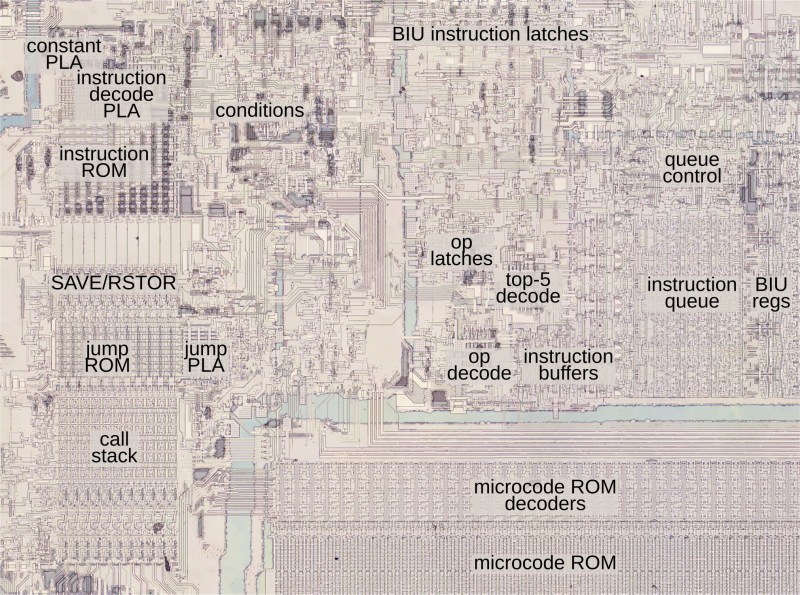
An interesting detail about the Intel 8087 floating point processor (FPU) is that it’s a co-processor that shares a bus with the 8086 or 8088 CPU and system memory, which means that somehow both the CPU and FPU need to know which instructions are intended for the FPU. Key to this are eight so-called ESCAPE opcodes that are assigned to the co-processor, as explained in a recent article by [Ken Shirriff].
The 8087 thus waits to see whether it sees these opcodes, but since it doesn’t have access to the CPU’s registers, sharing data has to occur via system memory. The address for this is calculated by the CPU and read from by the CPU, with this address registered by the FPU and stores for later use in its BIU register. From there the instruction can be fully decoded and executed.
This decoding is mostly done by the microcode engine, with conditional instructions like cos featuring circuitry that sprawls all over the IC. Explained in the article is how the microcode engine even knows how to begin this decoding process, considering the complexity of these instructions. The biggest limitation at the time was that even a 2 kB ROM was already quite large, which resulted in the 8087 using only 22 microcode entry points, using a combination of logic gates and PLAs to fully implement the entire ROM.
Only some instructions are directly implemented in hardware at the bus interface (BIU), which means that a lot depends on this microcode engine and the ROM for things to work half-way efficiently. This need to solve problems like e.g. fetching constants resulted in a similarly complex-but-transistor-saving approach for such cases.
Even if the 8087 architecture is convoluted and the ISA not well-regarded today, you absolutely have to respect the sheer engineering skills and out-of-the-box thinking of the 8087 project’s engineers.
-
@danjones000 @Matt_Noyes there are numbers in the world and you can use them to compare things to other things.
-
@danjones000 @Matt_Noyes read the rest of the thread. Adding in training gets us to about 0.0065kg CO2eq, although it's not clear if they count that in the original estimate.
-
@thisismissem would be good to know which URLs fail to resolve. It could be that NodeBB returned a 503 and that would lead to a failure in resolution. Just let me know next time it happens 😊
As for an intro banner, that's a neat idea. @baris@community.nodebb.org actually added something at the bottom of a topic, but it does make sense to add some AP specific text in the too.
-
Hacktivists tried to find a workaround to Discord’s age-verification software, Persona. Instead, they found its frontend exposed to the open internet, and that was just the beginning.
-
@mcc I so want this too. Moreover, I want some kind of standard/standardized compact/agreement/declaration/license that F/OSS projects individually could reference to declare that they agree with and enforce this stance: no "AI" contributions whatsoever. Have not yet found such a thing.
I agree that the distro level is the right place for this, but there's an argument to be made that it should go all the way down.
-
One thing for sure, I’ve got a fire under my butt to get out of 1password pretty quick.
-
@johnlehet Yes; I am attempting to describe the product sold as "AI code assistants" without using the word "AI". It did not occur to me that "code" was ambiguous/a pun when I made the post.