Uh oh.
Uncategorized
6
Posts
3
Posters
0
Views
-
Uh oh.
Matrix.org - Update on Native Matrix interoperability with WhatsApp
https://matrix.org/blog/2024/09/whatsapp-dma/
> Matrix, the open protocol for secure decentralised communications
-
Uh oh.
Matrix.org - Update on Native Matrix interoperability with WhatsApp
https://matrix.org/blog/2024/09/whatsapp-dma/
> Matrix, the open protocol for secure decentralised communications
Ma anche no.
-
Ma anche no.
@GustavinoBevilacqua però a te ti sto aspettando su xmpp @pierostrada
-
@GustavinoBevilacqua però a te ti sto aspettando su xmpp @pierostrada
@matz @GustavinoBevilacqua
Boh io dovrei essere
@pierostrada:matrix.orgColà.
Però Element va ok (credo) mentre Element X scassa ogni volta che non ha il fucking server delle notifiche.Ma dormo lo stesso, sebbene abbastanza stizzito.
-
@matz @GustavinoBevilacqua
Boh io dovrei essere
@pierostrada:matrix.orgColà.
Però Element va ok (credo) mentre Element X scassa ogni volta che non ha il fucking server delle notifiche.Ma dormo lo stesso, sebbene abbastanza stizzito.
@pierostrada @GustavinoBevilacqua non citavo matrix, che ho abbandonato, ma xmpp che nella sua ruvidezza preferisco
-
@pierostrada @GustavinoBevilacqua non citavo matrix, che ho abbandonato, ma xmpp che nella sua ruvidezza preferisco
@matz @GustavinoBevilacqua
Azz scusa cioè ok non è un'offesa: son proprio io che perdo colpi abbombazza.


Feed RSS
Gli ultimi otto messaggi ricevuti dalla Federazione
-
Shuluk: vento dal sud, sabbia tra gli ingranaggi. alcune riflessioni sulle repressioni degli ultimi mesi in sicilia.
@anarchia
Diffondiamo: Non dimentichiamoci che la repressione è una conseguenza (non sempre inevitabile) di territori che lottano, non il punto di partenza di speculazioni intrise di colonialismo. C’è chi dice che
-
Svizzera, respinto referendum per tassare i super-ricchi...
cosa fanno i ricchi per i poveri?
-
How To Design 3D Printed Pins that Won’t Break
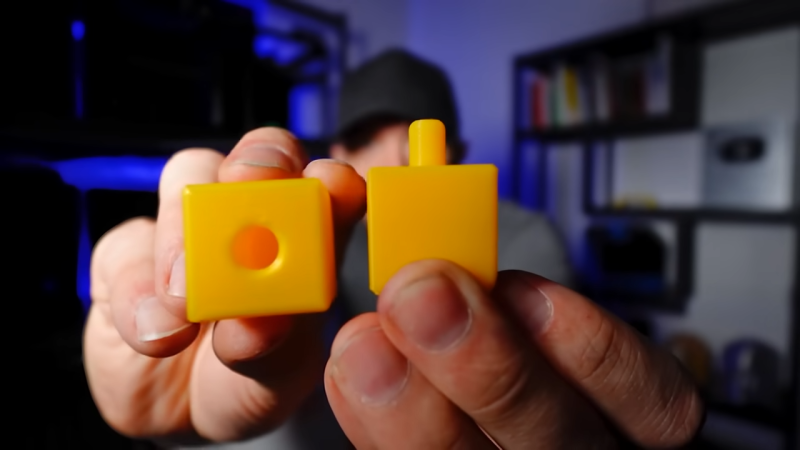
[Slant 3D] has a useful video explaining some thoughtful CAD techniques for designing 3D printed pins that don’t break and the concepts can be extended to similar features.
Sure, one can make pins stronger simply by upping infill density or increasing the number of perimeters, but those depend on having access to the slicer settings. If someone else is printing a part, that part’s designer has no actual control over these things. So how can one ensure sturdier pins without relying on specific print settings? [Slant 3D] covers two approaches.
The first approach includes making a pin thick, making it short (less leverage for stress), and adding a fillet to the sharp corner where the pin meets the rest of the part. Why? Because a rounded corner spreads stress out, compared to a sharp corner.
Microfeatures can ensure increased strength in a way that doesn’t depend on slicer settings.
Those are general best practices, but there’s even more that can be done with microfeatures. These are used to get increased strength as a side effect of how a 3D printer actually works when making a part.One type of microfeature is to give the pin a bunch of little cutouts, making the cross-section look like a gear instead of a circle. The little cutouts don’t affect how the pin works, but increase the surface area of each layer, making the part stronger.
A denser infill increases strength, too. Again, instead of relying on slicer settings, one can use microfeatures for a similar result. Small slots extending down through the pin (and going into the part itself) don’t affect how the part works, but make the part sturdier. Because of how filament-based 3D printing works, these sorts of features are more or less “free” and don’t rely on specific printer or slicer settings.
[Slant 3D] frequently shares design tips like this, often focused on designing parts that are easier and more reliable to print. For example, while printers are great at generating useful support structures, sometimes it’s better and easier in the long run to just design supports directly into the part.
-
@sinituulia I know @fabrixxm , it's not :D
(I was here to write “who needs AI, when you can nerdsnipe a friend who knows how to use gimp?”)
-
RE: https://yoota.it/nodebb-4-7-0-piu-federazione-e-anteprima-link-integrata/
Citiverse.it è già alla versione 4.7.0! 🔥
-
@fabrixxm @valhalla Looks familiar, the lack of pixels and the compression artefacts lead me to hope that it's an artisan crafted image manipulation and not AI!
-
uscendo da casa....
-
@matz @GustavinoBevilacqua
Azz scusa cioè ok non è un'offesa: son proprio io che perdo colpi abbombazza.