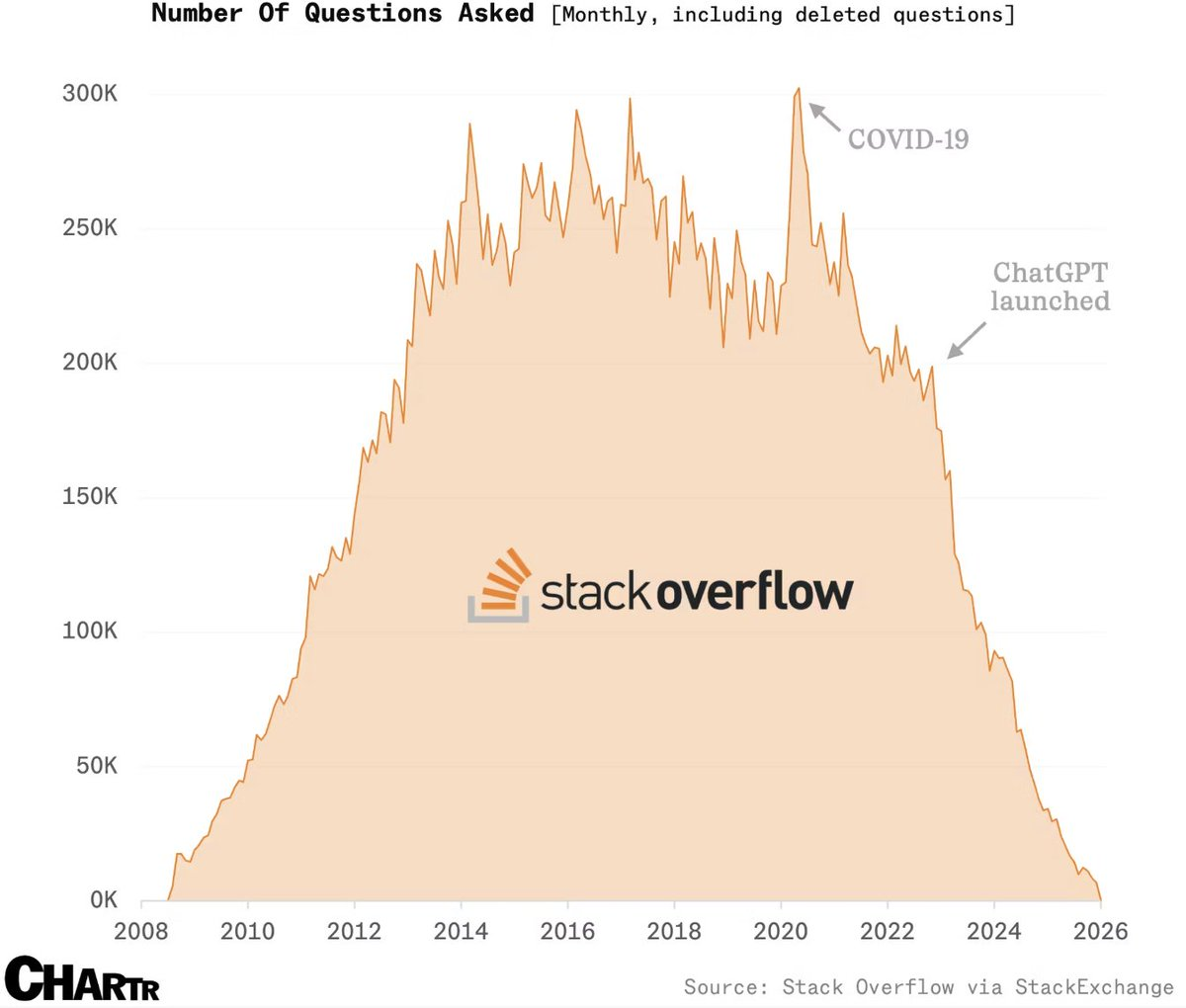
The rise and fall of Stack Overflow is a case in point of the parasitic nature of LLMs.
Uncategorized
19
Posts
12
Posters
0
Views
-
The rise and fall of Stack Overflow is a case in point of the parasitic nature of LLMs. LLMs feed their models on places like Stack Overflow to be useful to users, so users flock to them to avoid the eternal snarky comments and just get an answer to their problem right away. But this is a dead end. No new answers will be generated if no one uses Stack Overflow or similar places.
What goes for Stack Overflow goes essentially for the whole internet. Like a mold growing on food, consuming it, and dying once the food is gone - LLMs will kill large parts of the 'old' internet before long.
@collectifission
And I think LLMs killing large parts of the 'old' internet is what needs to happen. Firstly, because sometimes you just need to lose stuff to realize you need it. And secondly, the faster LLMs are driven to a dead end the better.At some point LLMs will become unable to produce correct answers (if they can do that even now) to questions relevant at that time, and it will turn into a great demand for human experts.
-
@bit @collectifission sites like StackOverflow thrived on people not knowing what they are doing asking questions to encourage people who know better and would not think to ask those questions to answer them, in the best way possible.
If the people leaving are the ones asking questions, the community makes no sense.
That's what is happening.
And ignoring the fact that LLMs can indeed answer questions for some people, will not solve that.That's overly idealistic.
Those questions people who know better wouldn't think to answer, not always, but often, are questions that shouldn't be asked in the first place. There is a better question, or a better solution that doesn't even require the answer to that question. But once that is pointed out, we get a little tantrum, and more memes about how mean SO community is.
Those people are leaving, not everyone. LLMs can answer those questions.
-
That's overly idealistic.
Those questions people who know better wouldn't think to answer, not always, but often, are questions that shouldn't be asked in the first place. There is a better question, or a better solution that doesn't even require the answer to that question. But once that is pointed out, we get a little tantrum, and more memes about how mean SO community is.
Those people are leaving, not everyone. LLMs can answer those questions.
@bit @collectifission the graph posted in the post above contradicts what you say.
-
@bit @collectifission the graph posted in the post above contradicts what you say.
lt is stark, but it's still just a graph about new questions. Though also depressing the traffic graph doesn't follow that one as closely.
https://observablehq.com/@ayhanfuat/the-fall-of-stack-overflow
-
The rise and fall of Stack Overflow is a case in point of the parasitic nature of LLMs. LLMs feed their models on places like Stack Overflow to be useful to users, so users flock to them to avoid the eternal snarky comments and just get an answer to their problem right away. But this is a dead end. No new answers will be generated if no one uses Stack Overflow or similar places.
What goes for Stack Overflow goes essentially for the whole internet. Like a mold growing on food, consuming it, and dying once the food is gone - LLMs will kill large parts of the 'old' internet before long.
@collectifission I agree that this is the whole problem. There is a platform opportunity here to develop healthy communities of interest, with diversity of expertise, where the most knowledgeable and skilled folk see the community benefit of teaching, and the more junior folk see the benefit in diligence, and the platform helps both ends of the spectrum to flourish. That platform is not LLM strip-mined text synthesis.
-
The rise and fall of Stack Overflow is a case in point of the parasitic nature of LLMs. LLMs feed their models on places like Stack Overflow to be useful to users, so users flock to them to avoid the eternal snarky comments and just get an answer to their problem right away. But this is a dead end. No new answers will be generated if no one uses Stack Overflow or similar places.
What goes for Stack Overflow goes essentially for the whole internet. Like a mold growing on food, consuming it, and dying once the food is gone - LLMs will kill large parts of the 'old' internet before long.
LLMs provide for frictionless relationships but anything meaningful requires friction. You don't learn w/o friction both knowledge wise and in terms of relationships.
This should raising alarm bells for LLMs companies b/c w/o sites like this they won't have the data they need. Experts were already fleeing open spaces to share the knowledge b/c it was being stolen but this is just devastating for all.
-
The rise and fall of Stack Overflow is a case in point of the parasitic nature of LLMs. LLMs feed their models on places like Stack Overflow to be useful to users, so users flock to them to avoid the eternal snarky comments and just get an answer to their problem right away. But this is a dead end. No new answers will be generated if no one uses Stack Overflow or similar places.
What goes for Stack Overflow goes essentially for the whole internet. Like a mold growing on food, consuming it, and dying once the food is gone - LLMs will kill large parts of the 'old' internet before long.
@collectifission how was the data for this graph collected and from where exactly? The cited source is... kinda vague 🤣
-
The rise and fall of Stack Overflow is a case in point of the parasitic nature of LLMs. LLMs feed their models on places like Stack Overflow to be useful to users, so users flock to them to avoid the eternal snarky comments and just get an answer to their problem right away. But this is a dead end. No new answers will be generated if no one uses Stack Overflow or similar places.
What goes for Stack Overflow goes essentially for the whole internet. Like a mold growing on food, consuming it, and dying once the food is gone - LLMs will kill large parts of the 'old' internet before long.
@collectifission The chart above shows StackOverflow was in steep decline before ChatGPT was even introduced.
Meanwhile, at the peak of StackOverflow back around 2014, one of the co-founders took what they learned about what worked and didn't work about building communities online and created Discourse. Here's the popularity of Discourse in Github Stars since launch.
Discourse remains popular today and does not have the reputation for toxicity that SO developed.
-
The rise and fall of Stack Overflow is a case in point of the parasitic nature of LLMs. LLMs feed their models on places like Stack Overflow to be useful to users, so users flock to them to avoid the eternal snarky comments and just get an answer to their problem right away. But this is a dead end. No new answers will be generated if no one uses Stack Overflow or similar places.
What goes for Stack Overflow goes essentially for the whole internet. Like a mold growing on food, consuming it, and dying once the food is gone - LLMs will kill large parts of the 'old' internet before long.
@collectifission Stack Overflow/Stack Exchange also started partnering with LLM companies about 20 months ago. I had been very active on one SE community, and quit right about then.
-
You probably searched, got linked there, read the answer, and moved on. No need to ask the question again. That's how it's supposed to be used. A lot of people didn't bother with that. They would string together some passable English asking for essentially someone else to search the trivial solution for them. Then they make memes about how mean the SO community is because they didn't indulge their laze asses.
Btw uBlock does a nice job blocking those cookie popups.
@bit @collectifission ah I see, I think. This is bad because in the future there won’t be new questions and when I search I won’t find the answers, right? But then… that means the people who formulated “good questions” also went to ChatGPT (or equivalent)… leaving a void of questions and a glut of experts. Does that sound about right?
Sorry, trying to wrap my mind around it.
-
 undefined filobus@sociale.network shared this topic on









Gli ultimi otto messaggi ricevuti dalla Federazione
-
@rysiek maybe he wants to invade Greenland so he can finally go to therapy on a budget. I'd expect therapy to be extremely expensive in the US compared to places with socialized medicine.
-
@LaVi bella riflessione. La penso anch'io così.
-
-
@aeva daylight and clear roads are nice for riding motorcycles
-
@khleedril I cunningly put the decorations on the cat tree. So she thought I'd gone to great effort to make something especially for her to play with. So she didn't play with it
-
Let's say you run a nonprofit animal shelter. And for some reason, some people feel you should be seeing hockey-stick growth, but the donations aren't covering it.
So you decide to start up a side-line of selling kittens for meat.
Then you will inevitably have someone stroking their chin and saying, "Yes, yes, but how could they afford to stay open if they weren't selling kitten deli slices?"
Some might say - maybe you aren't an animal shelter any more. Some might say.
https://jwz.org/b/yk2A
-
RE: https://chaos.social/@derPUPE/115894826052801889
This is @jtonline level tea hacking.
-
@EnigmaRotor not far from one of them…