I'm starting to understand why the two words "means testing" are so triggering over on Reddit:
Uncategorized
36
Posts
14
Posters
43
Views
-
@codinghorror@infosec.exchange means testing is the *reason* why the state is paying Equifax and Deloitte.
If means testing didn't exist, Equifax and Deloitte would not be paid to verify income.
And there's every indication that large swaths of the government are *happy* with this arrangement, because the purpose of means testing for those parties is to punish struggling Americans who are trying to get help. Inefficiency is acceptable to them if the system is punishing enough.
It is not accidental that means testing results in these inefficiencies (and the inefficiencies are not the primary problem anyway). The outcomes you're seeing are the natural result of forcing struggling Americans to prove that they deserve care.
This is the end-state of over-broad means testing. It will always be the end-state of over-broad means testing.
-
It is not accidental that means testing results in these inefficiencies (and the inefficiencies are not the primary problem anyway). The outcomes you're seeing are the natural result of forcing struggling Americans to prove that they deserve care.
This is the end-state of over-broad means testing. It will always be the end-state of over-broad means testing.
"Don't abolish means testing, reform it" makes about as much sense as the slogan does in other contexts.
The purpose of a system is what the system does. And means testing consistently leads to these outcomes - it is not a problem with one or two companies, it is a perverse incentive structure for the government that systematically leads to abuse and financial waste.
Equifax is just one particular manifestation of that outcome.
-
@codinghorror Having read your top profile post on favoring GMI over UBI I begin to see what you’re about but disagree unless it’s directly integrated into the tax system as a negative bottom income tax bracket, and everyone, and I mean everyone, is integrated into said tax system - which is an exceedingly hard sell - though I can see it being very useful as a transitional step toward universal income (which can be taxed right away again for those of us with more than we need.)
Meanwhile, means testing as currently executed remains punitively intrusive, expensive to administer, and typically enshrines rather than breaking down divisions between haves and have nots - just look at the intense pressure on many people experiencing disability to *divorce* simply to become eligible to access care which they aren’t considered poor enough to receive otherwise, but are still too poor to afford. The cliffs and mismatches are deliberate; politicians brag about them. It would be much simpler to run the risk of giving Jeff Bezos $15k once a year which he doesn’t need (which he’s earning every what, two seconds anyway?) and *ensure* we’ve covered every person who can’t keep the lights on or a roof overhead.
@cwicseolfor @codinghorror@infosec.exchange exactly - part of the reason why it's "worth it" for the government to pay Equifax so wastefully is because the service Equifax is providing is not efficiency, the point is to be a punitive gatekeeper in front of aid for struggling Americans.
Inefficiency is if anything a benefit to multiple political actors, who can use the cost of Equifax to justify slashing programs.
The end result: a program that dehumanizes people who need help - is intentional.
-
@cwicseolfor @codinghorror@infosec.exchange exactly - part of the reason why it's "worth it" for the government to pay Equifax so wastefully is because the service Equifax is providing is not efficiency, the point is to be a punitive gatekeeper in front of aid for struggling Americans.
Inefficiency is if anything a benefit to multiple political actors, who can use the cost of Equifax to justify slashing programs.
The end result: a program that dehumanizes people who need help - is intentional.
@cwicseolfor fixing this requires going after the root causes that *lead* to Equifax and Deloitte being in this position in the first place.
And the root cause that leads to them is means testing.
-
I'm starting to understand why the two words "means testing" are so triggering over on Reddit:
The "Means-Testing Industrial Complex": Private contractors like Deloitte and Equifax make billions running the eligibility systems for Medicaid and SNAP.
The Profit Incentive: In the business world, efficiency means "profit." For these contractors, complexity is profitable. The more complicated the eligibility rules, the more expensive the software and verification services they can sell to the state.
@codinghorror profit and cruelty are the point
-
I'm starting to understand why the two words "means testing" are so triggering over on Reddit:
The "Means-Testing Industrial Complex": Private contractors like Deloitte and Equifax make billions running the eligibility systems for Medicaid and SNAP.
The Profit Incentive: In the business world, efficiency means "profit." For these contractors, complexity is profitable. The more complicated the eligibility rules, the more expensive the software and verification services they can sell to the state.
@codinghorror just one of the reasons the U in UBI is so important.
-
 undefined oblomov@sociale.network shared this topic on
-
I'm starting to understand why the two words "means testing" are so triggering over on Reddit:
The "Means-Testing Industrial Complex": Private contractors like Deloitte and Equifax make billions running the eligibility systems for Medicaid and SNAP.
The Profit Incentive: In the business world, efficiency means "profit." For these contractors, complexity is profitable. The more complicated the eligibility rules, the more expensive the software and verification services they can sell to the state.
@codinghorror In the same way that insurance relies upon most of its clients never using it, and thus companies make it as convoluted as legally possible to make a claim. The system functionally makes it so they can claim people can receive aid, but only as few as legally possible do get it. Sometimes the cruelty is the point, and is also the profit. -
@codinghorror just one of the reasons the U in UBI is so important.
@aeischeid it's a liability. You'll give money to rich people over my dead body. I will do everything I can to stop that. The idea that it is "impossible" to build any kind of remotely efficient means testing is completely absurd. It's the "means testing industrial complex" that is the problem. So let's route around that damage
-
@codinghorror Means testing is by and large unnecessary if the tax system actually does its job and taxes people. I don't care if Jeff Bezos collects unemployment between gigs if the taxation system is fair because he'll pay for it anyway. But even if we don't reform taxation, is he (1) likely to ever claim it and (2) likely to make a dent in the cost of such programs?
Means testing may be extra bad in the American model, but that doesn't mean it's not at least somewhat bad in a normal model too. Having to prove you're poor is humiliating and adds extra bureaucracy at a time you're likely desperate.
(And as for your example, suppose you reformed the situation so Equifax was paid once... wouldn't they just charge 3x as much per check? Doesn't the bottom line ever enter the equation when companies are bidding for these kinds of contracts?)
@poundquerydotinfo Great! Explain to me exactly how we are gonna tax billionaires, with details, lay out a step by step plan of how this will actually happen. Because it ain't happening AT ALL right now, and the current regime seems EXTREMELY unlikely to do anything about that. Hell even with a winning ballot of Bernie, AOC, and every pet "progressive" Dem you can think of.. I highly doubt they could make the billionaire taxes happen in practice. I'd love to be proved wrong. Wake me up when I am. Otherwise, "actually taxing people/billionaires]" is just a fantasy that does severe harm by making people believe it is possible (it is not).
-
@codinghorror Having read your top profile post on favoring GMI over UBI I begin to see what you’re about but disagree unless it’s directly integrated into the tax system as a negative bottom income tax bracket, and everyone, and I mean everyone, is integrated into said tax system - which is an exceedingly hard sell - though I can see it being very useful as a transitional step toward universal income (which can be taxed right away again for those of us with more than we need.)
Meanwhile, means testing as currently executed remains punitively intrusive, expensive to administer, and typically enshrines rather than breaking down divisions between haves and have nots - just look at the intense pressure on many people experiencing disability to *divorce* simply to become eligible to access care which they aren’t considered poor enough to receive otherwise, but are still too poor to afford. The cliffs and mismatches are deliberate; politicians brag about them. It would be much simpler to run the risk of giving Jeff Bezos $15k once a year which he doesn’t need (which he’s earning every what, two seconds anyway?) and *ensure* we’ve covered every person who can’t keep the lights on or a roof overhead.
@cwicseolfor lol the "tax system" in this country is already so gutted as to be meaningless. It's the first thing the current regime did. Look up the details. Show me otherwise. I don't think you will be able to, but again, take it as a challenge: prove me wrong with recent facts and data. Because all the facts and data I've looked at recently say the same thing: maybe if you have a w-2, but for everyone richer than that, their effective tax rate is close to 0%
Meanwhile, means testing as currently executed remains punitively intrusive, expensive to administer
Then how is GiveDirectly able to do it for 90+ cents on the dollar, compared the government a 70+ cents on the dollar. (hint: politicians have to insist on wildly complex, massively expensive anti-fraud systems, otherwise one "welfare queen" can sink their political career forever) Why would we give money to people who are well off? That seems FAR more wasteful than building a simple means testing system... and GD has already done that. Look at the stats.
-
@codinghorror Maybe I’ve missed something in your rhetoric, but means testing is absolutely the enemy. It would be *cheaper* to universalize these benefits or just give them out to all comers than to continue to dissect and punish people for seeking help. The whole system is garbage, the credit scoring bastards just found a way to insert themselves as middlemen seeking additional profit and friction in a system designed to be performatively cruel & degrading.
@cwicseolfor data doesn't support that, though. You don't hate means testing. You hate the means testing industrial complex. and I agree, KILL THE MEANS TESTING INDUSTRIAL COMPLEX WITH EXTREME PREJUDICE.. and build something far simpler not perversely motivated to become as complex and arduous as possible to extract max dollars from governments
-
@aeischeid it's a liability. You'll give money to rich people over my dead body. I will do everything I can to stop that. The idea that it is "impossible" to build any kind of remotely efficient means testing is completely absurd. It's the "means testing industrial complex" that is the problem. So let's route around that damage
That’s a bit of a head-scratcher for me. Most proposed UBI systems’ design claw it back through tax so that people above a certain income effectively get little no benefit from it.
Meanwhile, means-testing *inevitably* becomes a tool of ideological control. You start with the best of intentions, but sooner or later someone says “you don’t deserve support if you live in a way I don’t approve of.” I live in the UK, and I would regard the recent political chaos around the child benefit cap as a perfect example. If you subtract the industrial parasites from the system, you’ll still have that problem to deal with.
-
@poundquerydotinfo Great! Explain to me exactly how we are gonna tax billionaires, with details, lay out a step by step plan of how this will actually happen. Because it ain't happening AT ALL right now, and the current regime seems EXTREMELY unlikely to do anything about that. Hell even with a winning ballot of Bernie, AOC, and every pet "progressive" Dem you can think of.. I highly doubt they could make the billionaire taxes happen in practice. I'd love to be proved wrong. Wake me up when I am. Otherwise, "actually taxing people/billionaires]" is just a fantasy that does severe harm by making people believe it is possible (it is not).
@codinghorror @poundquerydotinfo This is not hyperbole: if we don’t figure out how to tax billionaires (or find another way to slow their enrichment), democracy is going to die, and none of the impending ecosystem catastrophes will be prevented or even substantially ameliorated. The growth in their wealth and therefore power is breaking our societies. It’s the number one problem we have to solve, because we can’t solve anything else until we do.
-
@poundquerydotinfo Great! Explain to me exactly how we are gonna tax billionaires, with details, lay out a step by step plan of how this will actually happen. Because it ain't happening AT ALL right now, and the current regime seems EXTREMELY unlikely to do anything about that. Hell even with a winning ballot of Bernie, AOC, and every pet "progressive" Dem you can think of.. I highly doubt they could make the billionaire taxes happen in practice. I'd love to be proved wrong. Wake me up when I am. Otherwise, "actually taxing people/billionaires]" is just a fantasy that does severe harm by making people believe it is possible (it is not).
@codinghorror Lay out your plan for somehow removing corporate greed from government contracts then too!
Regardless, the first step is (1) abolish billionaires with massive wealth taxes or wealth distribution laws on > $1B wealth, and, more conventionally, (2) close income tax loopholes as they're discovered.
Is this hard? Of course. Is it possible? Until Reagan and Thatcher, it was normal. From 1945 to 1980 governments took successive, popular, steps to curb the accumulation of extreme amounts of wealth. With labour supporting governments repeatedly entering office, unions were given strengths and rights that also made a huge difference in ensuring corporate profits didn't go exclusively to the ultra wealthy groups that "owned" those companies.
This is all something we've done before. Sure, a billionaire will slip through the cracks, just as there were a few people worth $100M or more in 1980. But the thing is, you don't get that wealthy without leaving a paper trail.
And you know what causes more harm than saying this is possible? Saying it's all impossible and we need to just live with the fact Thiel, Musk, etc, will own the government forever more. It's clearly possible. It's been done before. It was an intentional policy choice to stop doing it. We need to start doing it again.
And this ultimately is a distraction from the fact means testing isn't bad because Equifax sucks, it's bad because it means people have to go through the humiliating task of proving they're poor until they're given benefits they're entitled to, at a time they're suffering enough stress and anxiety as it is. Somehow we've made unemployment and health benefits a punishment for losing your job. It shouldn't be that way. It doesn't need to be that way.
-
That’s a bit of a head-scratcher for me. Most proposed UBI systems’ design claw it back through tax so that people above a certain income effectively get little no benefit from it.
Meanwhile, means-testing *inevitably* becomes a tool of ideological control. You start with the best of intentions, but sooner or later someone says “you don’t deserve support if you live in a way I don’t approve of.” I live in the UK, and I would regard the recent political chaos around the child benefit cap as a perfect example. If you subtract the industrial parasites from the system, you’ll still have that problem to deal with.
@codinghorror @decoderwheel yeah, I think taxes that nullify the benefit don't count as means testing even though, in effect, they may be similar.
-
That’s a bit of a head-scratcher for me. Most proposed UBI systems’ design claw it back through tax so that people above a certain income effectively get little no benefit from it.
Meanwhile, means-testing *inevitably* becomes a tool of ideological control. You start with the best of intentions, but sooner or later someone says “you don’t deserve support if you live in a way I don’t approve of.” I live in the UK, and I would regard the recent political chaos around the child benefit cap as a perfect example. If you subtract the industrial parasites from the system, you’ll still have that problem to deal with.
@decoderwheel @aeischeid and how exactly are they "clawing it back" when billionaires pay 0% or quite close to 0% right now, today? How? Please explain it to me, break it down for me step by step, so I can understand how this can happen. Ref: https://infosec.exchange/@codinghorror/116034715309329431
-
@cwicseolfor data doesn't support that, though. You don't hate means testing. You hate the means testing industrial complex. and I agree, KILL THE MEANS TESTING INDUSTRIAL COMPLEX WITH EXTREME PREJUDICE.. and build something far simpler not perversely motivated to become as complex and arduous as possible to extract max dollars from governments
@cwicseolfor and whether you agree or not is ultimately irrelevant. We are already doing it, and will continue to do it, and we will bury politicians in valid scientific data showing FAR more efficient basic means testing IS possible, across dozens or hundreds of american counties running GMI programs, until they win elections on that platform. Or form a new country right here, that does. Whichever. Watch us do it. It'll be fun.
-
@cwicseolfor and whether you agree or not is ultimately irrelevant. We are already doing it, and will continue to do it, and we will bury politicians in valid scientific data showing FAR more efficient basic means testing IS possible, across dozens or hundreds of american counties running GMI programs, until they win elections on that platform. Or form a new country right here, that does. Whichever. Watch us do it. It'll be fun.
@codinghorror If your argument is that it would be better to means test without a profit motive than with one, on that much we can agree. If your argument is that means testing the poor and the vulnerable before providing them *survival necessities* is preferable to even marginally improving tax policy, and specifically bothering to pursue wealthy tax cheats - an endeavor well documented to return nine dollars for every dollar spent, an unbeatable ROI - in the face of wealth inequality rivaling Louis XVI’s France, such an objective is both shortsighted and morally vacuous. That you showed up to say more a day later *almost* protests too much, but I’d rather believe you’re honestly invested in your efforts than any other explanation.
We could do an immoral thing less poorly, but we can also do a moral thing with the very same investment. I’d be most interested in how these very efficient systems might be put to other use, such as means-testing the far, far smaller, more conspicuous pool of astronomically wealthy. They’re only too big to tax if we agree they are.
-
@aeischeid it's a liability. You'll give money to rich people over my dead body. I will do everything I can to stop that. The idea that it is "impossible" to build any kind of remotely efficient means testing is completely absurd. It's the "means testing industrial complex" that is the problem. So let's route around that damage
> "You'll give money to rich people over my dead body."
So you are opposed to bettering life for the bottom 90% of people because of the irrelevant blip it would provide for the top 10%?
> "The idea that it is "impossible" to build any kind of remotely efficient means testing is completely absurd."
Is it? And is efficiency the only metric by which such a system should be judged?
> "So let's route around that damage."
Yes, let's. By completely obviating it.
-
> "You'll give money to rich people over my dead body."
So you are opposed to bettering life for the bottom 90% of people because of the irrelevant blip it would provide for the top 10%?
> "The idea that it is "impossible" to build any kind of remotely efficient means testing is completely absurd."
Is it? And is efficiency the only metric by which such a system should be judged?
> "So let's route around that damage."
Yes, let's. By completely obviating it.
@codinghorror (And I say this knowing fairly well that another near-impossibility is getting something like UBI approved nationally. But it's not fully impossible. My country made means testing illegal for medical care in 1984. I got a "free" CT scan on saturday as a result, which was helpful for making sure I wasn't about to die.)







Feed RSS
Gli ultimi otto messaggi ricevuti dalla Federazione
-
@MissAemilia hard pass
-
@aeva but imagine if you had nvidia generate enhanced frames for you. You could sacrifice significant amounts of frame time to have them yassify your car for you at 240 totally real hz!
-
if i ever finish my racing game, the pitch practically writes itself. 4k 120 hz clean frames on most hardware, no bullshit.
-
Current* conditions near Chicago, IL:
-
You hear an angry drone.
-
Zip-Drive Emulator Puts Big Disks Back on LPT
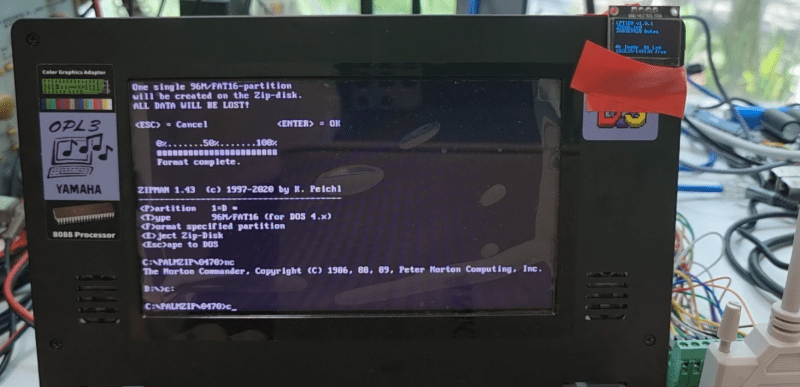
Iomega’s Zip drives filled an interesting niche back in the 1990s. A magnetic disk that was physically floppy-sized, but much larger in capacity– starting at 100 MB, and reaching 750 MB by the end–they never quite had universal appeal, but never really went away until flash memory chased them out of the marketplace in the early 2000s. While not everyone is going to miss them, some of us still think it’s a better form factor than having a USB stick awkwardly protruding from a computer, or microSD cards that are barely large enough to see with the naked eye. [Minh Danh] is one of those who still has affection for Zip drives, and when his parallel port Zip 100 drive started to give up the ghost last year, he decided to do something bold: reverse engineer it, and produce an emulator. First software, and then in hardware.
It’s not the prettiest-ever prototype, but lots of great things start with a mess of wires.
The first was to create a virtual zip drive that could run on a virtual machine and be accessed with DOS or Windows up to XP. The next task was to move that functionality onto a microcontroller to create something like a GoTek floppy emulator for LPT Zip drives that he’s calling the LPT100. Yes, Zip drives were built for APATI, SCSI, FireWire and USB, too, but [Minh]’s was on the parallel port and that’s what he wanted to replace, so the LPT interface is what set out to recreate.It works, too, though took more guts than was expected– the 8-bit PIC18F4680 he started with just wasn’t up to the task. He moved up to a 32-bit PIC, the PIC32MZ2048EFH144 to be specific, which proved adaquate when testing with his Book 8088, a new DOS PC from 2023. Iomega’s official driver won’t run on an 8088, but the PALMZIP utility does and was able to transfer files, though only at the slow nibble rate due to limitations with the Book8088’s LPT hardware. Watch it in action below.
Alas, moving up to the Pocket386, it seemed the PIC just could not keep up. [Minh] says he’s thinking of moving to the faster Teensy 4.1, which sounds like a good idea. Considering the Teensy can be configured to serve as a drop-in replacement for a 68000, bit-banging the bus at 7.8 MHz, we’d think it should handle anything a parallel port can throw at it.
Thanks to [Minh Danh] for the tip!
-
Onda anomala: “imbottigliati” nella plastica. intervista a luca martinelli sul mercato dell’acqua minerale
@anarchia
“Onda Anomala”- Notizie eventi movimenti dal clima che cambia, la trasmissione quindicinale di Radio Onda d’Urto all’interno della casetta degli attrezzi del martedi pomeriggio alle 18.45 in replica il mercoledi in apertura