Le persone più impegnate e senza tempo libero che conosco sono i pensionati
Uncategorized
4
Posts
2
Posters
2
Views
-
Le persone più impegnate e senza tempo libero che conosco sono i pensionati
-
Le persone più impegnate e senza tempo libero che conosco sono i pensionati
Vero, me lo hanno confermato molti pensionati.
-
Vero, me lo hanno confermato molti pensionati.
@GustavinoBevilacqua hanno trovato il tempo di risponderti? 😂
-
@GustavinoBevilacqua hanno trovato il tempo di risponderti? 😂
Durante la pausa degli operai del cantiere 😄
-
 undefined filobus@sociale.network shared this topic on
 undefined oblomov@sociale.network shared this topic on

Gli ultimi otto messaggi ricevuti dalla Federazione
-
A Voltage Regulator Before Electronics
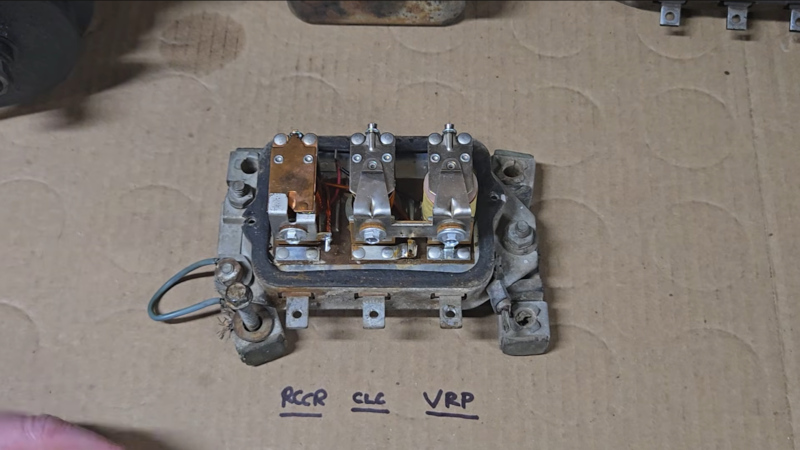
Did you ever wonder how the mechanical voltage regulator — that big black box wired up to the generator on a car from the ’60s or before — worked? [Jonelsonster] has some answers.
For most people in 2026 an old car perhaps means one from the 20th century, now that vehicles from the 1990s and 2000s have become the beloved jalopies of sallow youths with a liking for older cars and a low budget. But even a 1990s vehicle is modern in terms of its technology, because a computer controls the show. It has electronic fuel injection (EFI), anti-lock braking system (ABS), closed loop emissions control, and the like.
Go back in time to the 1970s, and you’ll find minimal electronics in the average car. The ABS is gone, and the closest thing you might find to EFI is an electronic ignition where the points in the distributor have been replaced with a simple transistor. Perhaps an electronic voltage regulator on the alternator. Much earlier than that and everything was mechanical, be that the ignition, or that regulator.
The video below the break has a pair of units, it seems from 1940s tractors. They would have had a DC generator, a spinning coil with a commutator and brushes, in a magnetic field provided by another coil. These things weren’t particularly powerful by today’s standards and sometimes their charging could be a little lackluster, but they did work. We get to see how, as he lifts the lid off to reveal what look like a set of relays.
We’re shown the functions of each of the three coils with the aid of a lab power supply; we have a reverse current relay that disconnects the generator if the battery tries to power it, an over-current relay that disconnects the field coil if the current is too high, and an over-voltage relay that does the same for voltage. The regulating comes down to the magnetic characteristics, and while it’s crude, it does the job.
We remember European devices with two coils and no field terminal, but the principle is the same. There is never a dull moment when you own an all mechanical car.
-
Il naufragio dell’Utopia
@anarchia
di Bruno Lai. Quella del transatlantico Utopia è una delle tragedie più strazianti della marina mercantile di fine Ottocento, spesso dimenticata rispetto al Titanic, ma carica di un impatto emotivo e simbolico enorme, soprattutto per la storia dell’emigrazione italiana Naufragio...Vedi l'articolo
https://www.rivoluzioneanarchica.it/il-naufragio-dellutopia/
-
-
I miei pensieri sul referendum sulla giustizia
@politica - E perché io andrò a votare e voterò NO, per ragioni diverse da quelle che si sentono dire in giro.
-
@evan Seconded! Yes, yes, yes, yes, yes! Banksy's identity is Not The Point!
We're gawping at the spirit of his art. Not a name.
-
-
-
@evan
That sounds exactly like something Banksy might say… 🤔