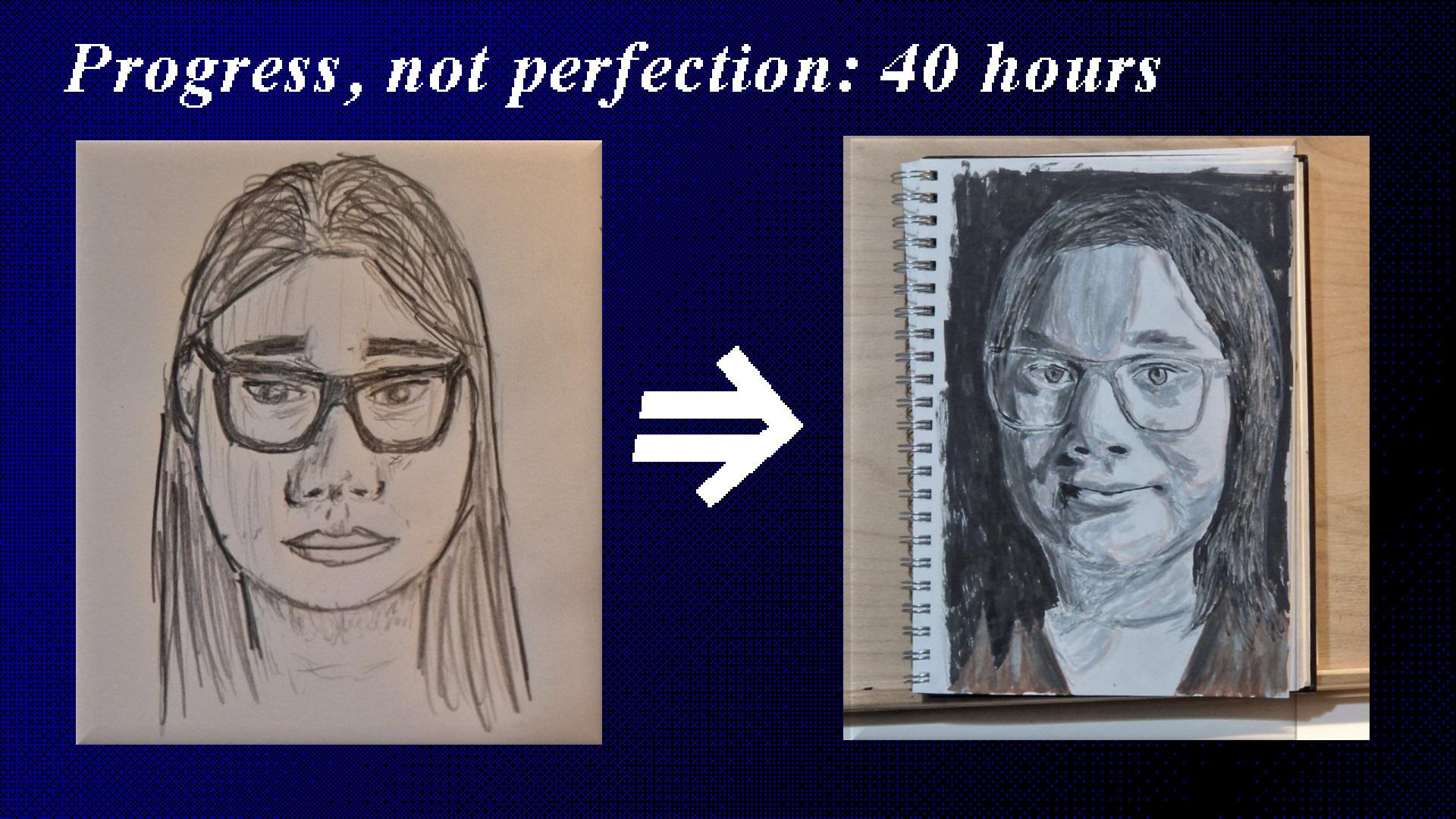
I wrote ~5000 words on what 40 hours of studying drawing can do.
Uncategorized
30
Posts
2
Posters
15
Views
-
@nina_kali_nina ok done with dinner, I have more thoughts on your post, maybe you will find some of them useful.
Some technical advice for pushing your drawing further:
I recommend experimenting with charcoal and conte chalk when you sketch. You'll be able to do more subtle gradients and more striking dynamic range, and a pink pearl eraser or a kneaded rubber eraser will lift it back up just fine if you don't like a mark, just like pencil.
@nina_kali_nina second, I noticed you are fond of the outline. In observational drawing, it is a good exercise to try to avoid drawing any outlines beyond light contour lines used for planning out sketches. This will look more naturalistic, because real life does not have outlines.
-
@nina_kali_nina second, I noticed you are fond of the outline. In observational drawing, it is a good exercise to try to avoid drawing any outlines beyond light contour lines used for planning out sketches. This will look more naturalistic, because real life does not have outlines.
@nina_kali_nina third, there is nothing correct about point perspective. it's a geometric convenience for planning out technically impressive works, but it is not optically accurate, nor is it how our brains process what our eyes see (it's so much weirder, I have some interesting reading to point you toward on that, but I can't seem to find it at the moment). there's also "zero-point" perspective which is generally more useful for naturalistic drawing when you are away from architecture
-
@nina_kali_nina third, there is nothing correct about point perspective. it's a geometric convenience for planning out technically impressive works, but it is not optically accurate, nor is it how our brains process what our eyes see (it's so much weirder, I have some interesting reading to point you toward on that, but I can't seem to find it at the moment). there's also "zero-point" perspective which is generally more useful for naturalistic drawing when you are away from architecture
@nina_kali_nina four, next time you go to an art museum, bring your sketch book and draw pictures of the art. I don't know if this is obvious or not, but you will not get in trouble for drawing in an art museum. If you see something that grabs you about the art, try to pin it down with a quick technical study.
-
@nina_kali_nina four, next time you go to an art museum, bring your sketch book and draw pictures of the art. I don't know if this is obvious or not, but you will not get in trouble for drawing in an art museum. If you see something that grabs you about the art, try to pin it down with a quick technical study.
@nina_kali_nina five, unfiltered objective reality is a fantasy. all art with no exceptions (even photography) is fundamentally contaminated by the subjective judgements and interpretation of the artist. this is, in my opinion, is a wondrous gift, because art allows us to see the world through another's eyes.
consider these two portraits of Charles Robert Leslie by two different professional artists who were contemporaries:
-
@nina_kali_nina five, unfiltered objective reality is a fantasy. all art with no exceptions (even photography) is fundamentally contaminated by the subjective judgements and interpretation of the artist. this is, in my opinion, is a wondrous gift, because art allows us to see the world through another's eyes.
consider these two portraits of Charles Robert Leslie by two different professional artists who were contemporaries:
@nina_kali_nina six, it is important to remember that the western tradition of making Correct Art developed due to a significant commercial aspect that is not there anymore: extraordinarily wealthy individuals and the church commissioned expensive objects for a variety of reasons ranging from propaganda and practical to entertainment. Many of these works that are credited to old masters were actually made by teams of people.
-
@nina_kali_nina six, it is important to remember that the western tradition of making Correct Art developed due to a significant commercial aspect that is not there anymore: extraordinarily wealthy individuals and the church commissioned expensive objects for a variety of reasons ranging from propaganda and practical to entertainment. Many of these works that are credited to old masters were actually made by teams of people.
@nina_kali_nina it is certainly possible to learn those techniques and apply them as an individual, but I think it is a bit like being dazzled by a video game and confusing the technical and creative power of a few dozen people for the work of a solo individual. Anything is possible with enough time and support.
-
@nina_kali_nina it is certainly possible to learn those techniques and apply them as an individual, but I think it is a bit like being dazzled by a video game and confusing the technical and creative power of a few dozen people for the work of a solo individual. Anything is possible with enough time and support.
@nina_kali_nina however the western tradition of art is a cultural anomaly, and contemporary western art in particular struggles with it because when you strip away all the whims of rich people and all the catholicism, what exactly is left? we are left to piece together our own cultural identity from the margins. for the majority of human history people did not make art like this, and did not have this existential problem
-
@nina_kali_nina however the western tradition of art is a cultural anomaly, and contemporary western art in particular struggles with it because when you strip away all the whims of rich people and all the catholicism, what exactly is left? we are left to piece together our own cultural identity from the margins. for the majority of human history people did not make art like this, and did not have this existential problem
@nina_kali_nina which is why Modern art is Like That
-
@nina_kali_nina which is why Modern art is Like That
@nina_kali_nina and I guess one last thing, because I can't help it, a great deal of learning observational drawing (as you've already been hard at work doing) is re-learning how to see the world, and developing the ability to deconstruct what you see into shapes and color that. This is also a process of training your mind's eye, as the visual deconstruction is a kind of second sight that you see in tandem with your real vision.
-
@nina_kali_nina and I guess one last thing, because I can't help it, a great deal of learning observational drawing (as you've already been hard at work doing) is re-learning how to see the world, and developing the ability to deconstruct what you see into shapes and color that. This is also a process of training your mind's eye, as the visual deconstruction is a kind of second sight that you see in tandem with your real vision.
@nina_kali_nina drawing from observation and from your imagination are not mutually exclusive, it is often the case that you imagine the forms you want to draw in isolation so you can draw them. As you practice observational drawing, you can develop a symbolic repertoire of forms that can aid you at more effective observational drawing, and is also a transferable skill to drawing from memory and/or imagination.
-
@nina_kali_nina drawing from observation and from your imagination are not mutually exclusive, it is often the case that you imagine the forms you want to draw in isolation so you can draw them. As you practice observational drawing, you can develop a symbolic repertoire of forms that can aid you at more effective observational drawing, and is also a transferable skill to drawing from memory and/or imagination.
@nina_kali_nina anyway, I hope some of this was interesting, and thank you for giving me this space to ramble passionately about the act of creating pictures
-
@nina_kali_nina anyway, I hope some of this was interesting, and thank you for giving me this space to ramble passionately about the act of creating pictures
@nina_kali_nina oh one last thing, you've already been doing it but keep doing it: regular practice is the most important thing, and looking at lots of art and deconstructing it is the other most important thing.
-
@nina_kali_nina oh one last thing, you've already been doing it but keep doing it: regular practice is the most important thing, and looking at lots of art and deconstructing it is the other most important thing.
@nina_kali_nina it doesn't really matter what you practice, your skills will sharpen so long as you keep thinking deeply about what you are making and you make a lot of it

Gli ultimi otto messaggi ricevuti dalla Federazione
-
⚠️ SCAM ALERT
strangers on the internet will sometimes lie to you to trick you in a variety of exciting and clever ways
DO NOT BE FOOLED BY THEIR GUILE
-
@Uilebheist già vuole silurare il capo della FED per metterci uno dei suoi incompetenti servi.
-
@Paoblog @francina1909 Quelli che sono nelle basi USA vanno arrestati come immigranti illegali. Poi deportati.
-
@francina1909 Se aspettiamo un'altra settimana magari licenziano le guardie perché "costano troppo" e "tanto l'AI sorveglia meglio".
-
@lritter they're a great audience 😌
-
Larry complains more than any person I have ever seen, but he seems to have stood his ground when the bears started raising a ruckus near his camp. I guess we'll see how he feels about it in the morning.
Mary Kate maybe got her shit together a little bit and made a decent shelter? She's having a real hard time with that ax, though. They are not going to convince me she's a trained survivalist, and is she building a fire shelter with a plastic tarp on top?
-
In Canada hanno Carney (😍), noi in EU dovremmo avere Draghi.
Sì lo so sono una romantica idealista, ma mi piacciono le capacità, la preparazione, le competenze. Cose ormai perdute nella politica italiana, ad ogni livello.
-
@anthroposamu thank you for letting know; i'll keep nova without updating.