The cruelty is the point.
Uncategorized
75
Posts
44
Posters
336
Views

-
The cruelty is the point.
it's either this, or sell my plasma.
-
@raganwald @pluralistic You know, I watch a lot of movies - I watched almost 300 movies last year. I also watch a lot of bad movies for fun. I went to a screening of Cats and I enjoyed myself - there were impromptu audience “burlesque” performances to the music.
I think that would be the only scenario where I could see myself watching this movie - an underground cinema with an audience that is there to mock it.
It needs a double feature with something very anti-fascist like IngloriousBasterds
@renata I call for someone to "What's Up, Tiger Lily?" Melania: Drop both the soundtrack and the dialogue, overdub the entire thing as an absurd comedy.
-
@raganwald Their sycophantic obligations require they provide pictures of packed theaters to keep someone in a good mood.
@CDubbs These are people who take pictures of protests and claim they are pictures of Trump supporters at his inauguration. I don't think they would bother paying people to go when Grok can fill a theatre with CSAM waifs.
-
@raganwald a nice dark room, a comfy chair, no loud explosions. Sounds like being paid to have a nap.
Yes bring earplugs and a sleep mask.
-
The cruelty is the point.
@raganwald *sigh* found this on the ad on Craigslist just now.
I hope a *lot* of the people who responded to the ad did so with the plan of claiming the tickets and then not showing up. I really, really hope so. -
@raganwald @pluralistic You know, I watch a lot of movies - I watched almost 300 movies last year. I also watch a lot of bad movies for fun. I went to a screening of Cats and I enjoyed myself - there were impromptu audience “burlesque” performances to the music.
I think that would be the only scenario where I could see myself watching this movie - an underground cinema with an audience that is there to mock it.
It needs a double feature with something very anti-fascist like IngloriousBasterds
@renata @raganwald @pluralistic
This needs a special MST3K Cinematic Titanic treatment -
@raganwald One possible source of this is a craigslist posting actually claiming to pay people to attend the show, with your entry fee payed.
-
Yes bring earplugs and a sleep mask.
@Phosphenes @fak @raganwald
Unfortunately ICE will be seating you
https://youtube.com/shorts/23_wsxjNQbY -
@Phosphenes @fak @raganwald
Unfortunately ICE will be seating you
https://youtube.com/shorts/23_wsxjNQbY -
@raganwald
does free + 50 bucks mean that they pay you for that? and just 50$?@lowlevel @raganwald Yeah, that seems like the right interpretation here. $50 but you have to actually attend the showing entirely.
They do seem the kind of people to do something like this to fill seats, but I'd still bet on it being some rando thinks it's funny. They're correct.
-
The cruelty is the point.
@raganwald Torture is outlawed for a reason.
-
@raganwald I predict a vast number of empty seats at many theaters when they show this film.
@EndicottAuthor @raganwald
"Just one ticket has been sold for the first 3.10pm screening on Friday at its flagship Islington branch in London, while two have been booked for 6pm."
https://www.theguardian.com/us-news/2026/jan/26/melania-trump-documentary-uk-cinemas-vue-soft-sales -
The cruelty is the point.
@raganwald Nonetheless, if this indeed is a legit offering, it might make sense to notify some homeless who might enjoy warming up for an hour, serve a free meal (e.g. hot soup) in the cinema auditorium, and offer complementary ear-plugs.
-
The cruelty is the point.
@raganwald I heard they hired snipers to make sure people stay in their seats
-
The cruelty is the point.
@raganwald naw, walk the fuck out. What, is the popcorn kid gonna stop you?
-
I think it's more "paid to attend" this movie. They can't make you watch it.
Bring a book. Better yet a boombox from last century.
@troy_frizzell @beanface42 @raganwald
They'll be deploying that Black Mirror tech that forces everyone to watch
https://www.reddit.com/r/blackmirror/comments/k5fo5d/resume_viewing/ -
The cruelty is the point.
@raganwald 😱 ..Oh dear, if this film is good at scaring people away, will it be used to disperse all protest marches in the future? ...I foresee terrible things. 😆 😜
-
@raganwald I heard they hired snipers to make sure people stay in their seats
@Noortjevee @raganwald
And a giant doll at the front will track everyone's eye gaze
https://squid-game.fandom.com/wiki/Young-hee -
The cruelty is the point.
Go, claim your $50... remain seated the entire movie.
But... treat the movie as if it was a screening of the Rocky Horror Picture Show.
Every time she comes on screen, or her name is said... Yell out 'SLUT!'
Everytime you see Trumplethinskin or hear his name mentioned... shout 'PEDO!!!'
Malicious compliance.
-
The cruelty is the point.
@raganwald Don't forget to take in a paper bag full of moths. Release them when the show starts. They will naturally fly into the light to obscure the film for everyone else.


















Feed RSS
Gli ultimi otto messaggi ricevuti dalla Federazione
-
@bagder Very good state of the art report about LLM plagiarism. Yeah, that's a difficult problem.
-
-
questo genere di persone, che sono qui perché si sentono st🪿zzo, danneggiano il fediverso allontanando gente che potrebbe riguadagnare libertà e socialità.
-
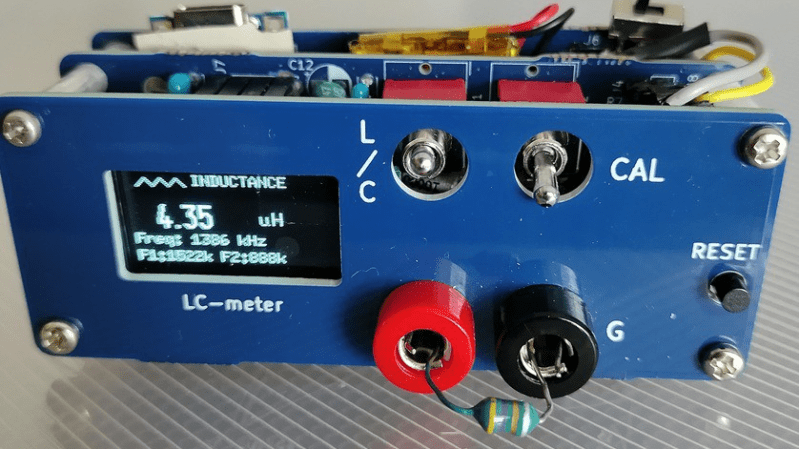
Building an LC Meter with a Franklin Oscillator
Although it dates back to the early days of the Marconi Company in the 1920s, the Franklin oscillator has remained a relatively obscure circuit, its memory mostly kept alive by ham radio operators who prize its high stability at higher frequencies. At the core of the circuit is an LC tank circuit, a fact which [nobcha] used to build quite a precise LC meter.
The meter is built around two parts: the Franklin oscillator, which resonates at a frequency defined by its inductance and capacitance, and an Arduino which counts the frequency of the signal. In operation, the Arduino measures the frequency of the original LC circuit, then measures again after another element (capacitor or inductor) has been added to the circuit. By measuring how much the resonant frequency changes, it’s possible to determine the value of the new element.
Before operation, the meter must be calibrated with a known reference capacitor to determine the values of the base LC circuit. In one iteration of the design, this was done automatically using a relay, while in a later version a manual switch connects the reference capacitor. Because the meter measures frequency differences and not absolute values, it minimizes parasitic effects. In testing, it was capable of measuring inductances as low as 0.1 µH.
We’ve seen a few homebrew LC meters here, some battery-powered and some rather professional.
-
@Zambunny Attenta alla madre sciamana.
-
@francommit non è strano: un semplice utente non può installare su un pc aziendale i software che gli passano per la testa
-
@grabbi_it è come chiedere di smettere di finanziare le aziende del fossile mentre si usa una macchina a benzina. La prima cosa la fai per convinzione, la seconda per convenienza. Non sono abbastanza santo da vivere in totale coerenza con le mie convinzioni…