"The Revigator was intended to add radioactivity (radon) to drinking water.
Uncategorized
30
Posts
25
Posters
0
Views
-
@liilliil @jalefkowit The noble gases are not srictly "inert". Individual atoms have a very stable electron structure, so they don't normally feel the need to swap or share electrons with other elements. But most can sometimes do so, and all do dissolve in fluids - see eg
https://www.sciencedirect.com/science/article/pii/S0265931X16304556
or for other noble gases:
https://www.sciencedirect.com/science/article/pii/S0304420318303037
@FaithfullJohn @jalefkowit
0.01 mol/(kg*bar) — how much is that in tangible terms? -
 undefined oblomov@sociale.network shared this topic
-
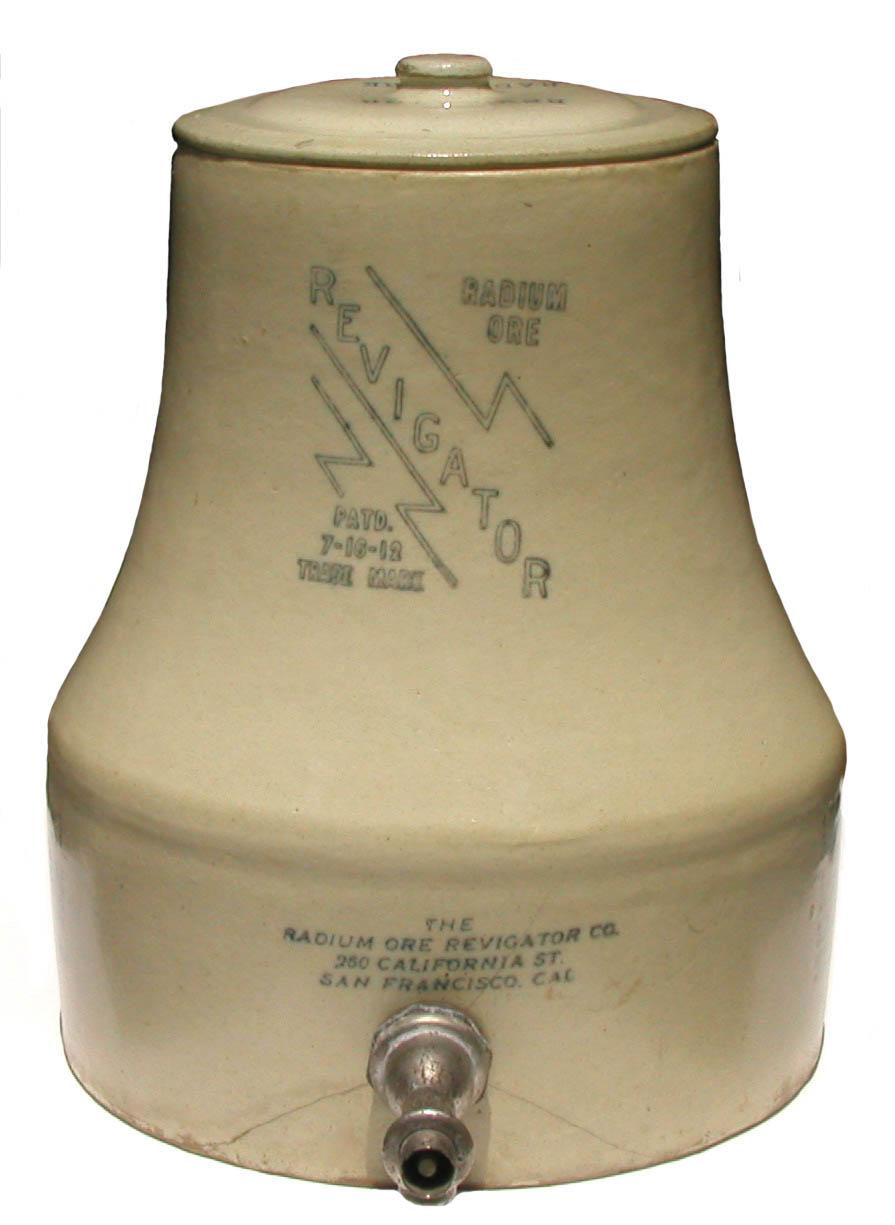
"The Revigator was intended to add radioactivity (radon) to drinking water. Water without radioactivity was 'devoid of its life element.'
The glazed ceramic body of the jar has a porous lining that incorporated uranium ore. Water placed inside the jar would absorb the radon released by decay of the radium in the ore.
Advertised as 'an original radium ore patented water crock,' it sold in the hundreds of thousands between 1924 and 1930."
@jalefkowit I'm surprised HHS isn't mandating their use.
-
"The Revigator was intended to add radioactivity (radon) to drinking water. Water without radioactivity was 'devoid of its life element.'
The glazed ceramic body of the jar has a porous lining that incorporated uranium ore. Water placed inside the jar would absorb the radon released by decay of the radium in the ore.
Advertised as 'an original radium ore patented water crock,' it sold in the hundreds of thousands between 1924 and 1930."
@jalefkowit I'd drink that.
-
"The Revigator was intended to add radioactivity (radon) to drinking water. Water without radioactivity was 'devoid of its life element.'
The glazed ceramic body of the jar has a porous lining that incorporated uranium ore. Water placed inside the jar would absorb the radon released by decay of the radium in the ore.
Advertised as 'an original radium ore patented water crock,' it sold in the hundreds of thousands between 1924 and 1930."
@jalefkowit seeya later, revigator [takes a massive swig]
-
@jalefkowit I always thought radon was an inert element. How can it be absorbed?
@liilliil @jalefkowit it's a noble gas, and therefore chemically inert, but it is still radioactive
-
"The Revigator was intended to add radioactivity (radon) to drinking water. Water without radioactivity was 'devoid of its life element.'
The glazed ceramic body of the jar has a porous lining that incorporated uranium ore. Water placed inside the jar would absorb the radon released by decay of the radium in the ore.
Advertised as 'an original radium ore patented water crock,' it sold in the hundreds of thousands between 1924 and 1930."
@jalefkowit The Oak Ridge Museum of Radiation and Radioactivity is great! The "Torbena Jars" are similar to the Revigator, and the online catalogue provides lots of similarly excellent/horrifying background info 🤯 😱
https://orau.org/health-physics-museum/collection/radioactive-quack-cures/jars/torbena-jar.html
-
"The Revigator was intended to add radioactivity (radon) to drinking water. Water without radioactivity was 'devoid of its life element.'
The glazed ceramic body of the jar has a porous lining that incorporated uranium ore. Water placed inside the jar would absorb the radon released by decay of the radium in the ore.
Advertised as 'an original radium ore patented water crock,' it sold in the hundreds of thousands between 1924 and 1930."
@jalefkowit watch, we're gonna see this in the nhs postings next week
-
"The Revigator was intended to add radioactivity (radon) to drinking water. Water without radioactivity was 'devoid of its life element.'
The glazed ceramic body of the jar has a porous lining that incorporated uranium ore. Water placed inside the jar would absorb the radon released by decay of the radium in the ore.
Advertised as 'an original radium ore patented water crock,' it sold in the hundreds of thousands between 1924 and 1930."
-
"The Revigator was intended to add radioactivity (radon) to drinking water. Water without radioactivity was 'devoid of its life element.'
The glazed ceramic body of the jar has a porous lining that incorporated uranium ore. Water placed inside the jar would absorb the radon released by decay of the radium in the ore.
Advertised as 'an original radium ore patented water crock,' it sold in the hundreds of thousands between 1924 and 1930."
@jalefkowit look if you’re not using the Revigator you’re going to be left behind. A Revigator won’t take your job but someone using a Revigator to enhance their vital energies will take it
-
@jalefkowit look if you’re not using the Revigator you’re going to be left behind. A Revigator won’t take your job but someone using a Revigator to enhance their vital energies will take it
@jalefkowit “in the hundreds of thousands” jesus christ. somebody needs to put the manufacturers on a wikipedia list of serial killers or something
-
@jalefkowit “in the hundreds of thousands” jesus christ. somebody needs to put the manufacturers on a wikipedia list of serial killers or something
@glyph @jalefkowit List of Oh My God Please Do Not Do That
-
@glyph @jalefkowit List of Oh My God Please Do Not Do That
@SnoopJ @jalefkowit This list is incomplete: you can help by for fuck’s sake just NOT doing that









Gli ultimi otto messaggi ricevuti dalla Federazione
-
@Otttoz il mio ci sarà, speriamo che alla fine capisca.
-
RobertoRedSox (@robertoredsox.bsky.social)
https://bsky.app/profile/robertoredsox.bsky.social/post/3mf5juzx3zs2w
> Nel tentativo di analizzarmi da solo, anche per risparmiare la parcella dello psicologo: “nella mia vita sono così ribelle, rompicoglioni e bastian contrario che mi ritrovo a fotografare questa cosa, istintivamente, così senza senso, giusto per fare il contrario. Anche se non c’entra un cavolo 😬
-
Morti senza disturbare, l'ultima strage (oscurata) nel Mediterraneo - Articolo21
https://www.articolo21.org/2026/02/morti-senza-disturbare-lultima-strage-oscurata-nel-mediterraneo/
> Sono in tutto 13, per il momento, i cadaveri senza nome ritrovati a riva o sulle spiagge di Calabria e Sicilia. Potrebbero diventare 14 o anche di più. Impossibile saperlo adesso. Morti senza disturbare. Morti mentre i titoli principali dei telegiornali erano dedicati ad un comico che si è ritirato da Sanremo. In queste ore […]
-
@Fulvio_952 capirebbe solo da una valanga di NO al referendum
-
@Yaku Spero lo conduca il Gabibbo
-
-
Microsoft keeps reinstalling Copilot, so I found a way to rip it out of Windows for good
https://www.howtogeek.com/how-to-rip-out-copilot-from-windows-11/
> You can get rid of all those stubborn AI components for better privacy and performance.
-
Ecco, direi che a qualcuno hanno chiesto, e non sono le banche. Il cosplayer lo sa?
Decreto bollette, spunta l’aumento Irap di 2 punti percentuali per chi produce energia e gas https://www.ilsole24ore.com/art/decreto-bollette-spunta-l-aumento-irap-2-punti-percentuali-chi-produce-energia-e-gas-AIvfKhTB