@nazokiyoubinbou @Viss Exactly
Uncategorized
1.4k
Posts
383
Posters
1.5k
Views
-
@Viss
We can hope. -
@Viss we can only wish.
-
@Viss we can only wish.
@technoid_ well im confident nobody will DO ANYTHING about it.. but realize it.. yes
-
@Viss Winner of FIFA Peace Prize, let’s not forget that!
-
@Viss Winner of FIFA Peace Prize, let’s not forget that!
-
@suzannealdrich @0xtero shits gonna get more expensive
-
@suzannealdrich @0xtero shits gonna get more expensive
@Viss
But we can easily start manufacturing and growing those things here in the Good Ol’ US of A!Wait, what, no? You’re saying the labor force would need to be trained, you don’t have any of the specialized equipment or the intricate supply chain setup, the climate doesn’t support growing those crops at scale, and nobody wants to invest in US manufacturing startup when economic instability from tariffs threatens the whole operation’s existence? Well you don’t say.
-
@Viss
But we can easily start manufacturing and growing those things here in the Good Ol’ US of A!Wait, what, no? You’re saying the labor force would need to be trained, you don’t have any of the specialized equipment or the intricate supply chain setup, the climate doesn’t support growing those crops at scale, and nobody wants to invest in US manufacturing startup when economic instability from tariffs threatens the whole operation’s existence? Well you don’t say.
@suzannealdrich @0xtero
wwwwwwwwwwwwEeeelp -
@Viss
But we can easily start manufacturing and growing those things here in the Good Ol’ US of A!Wait, what, no? You’re saying the labor force would need to be trained, you don’t have any of the specialized equipment or the intricate supply chain setup, the climate doesn’t support growing those crops at scale, and nobody wants to invest in US manufacturing startup when economic instability from tariffs threatens the whole operation’s existence? Well you don’t say.
@suzannealdrich @Viss this is a complete surprise! These highly advanced concepts must have blindsided the govAI_grok instance that is responsible for Making America(s) Great Again. No one could have foreseen this. The only solution is to annex Greenland next and fly the Danish Royal Family out of the country.
-
@Viss seems as good a time as any to remind readers of the cool shit some yo-yos are doing to move those refrigerators
https://nham.co.uk/2026/01/nham-hereby-annunciates-mtv-nham-mixtape-18/
@h2onolan @Viss Also, @TIBtv @tibtvnowplayingbot Has a 24/7 hour random stream of all sorts of musicians and creators. I love it.
-
@Viss This is a more honorable send-off than 2035 deserved.
-
@Viss omg.
did you see this? -
@Viss
I knew of the site but not the pewpew map. It works even on mobile??
Edit; ehhh, polymarket? As in the gambling / crypto stuff? Ahhh fuuuu...
-
@hrbrmstr @Viss Sent this to some folks earlier today who also brought it up.
Endless Thread by WBUR did an episode about this, and it is not a reliable source.
Episode webpage: https://www.wbur.org/endlessthread/2025/06/26/pentagon-pizza-index-us-military-action
-
@Viss omg.
did you see this? -
@Viss
I knew of the site but not the pewpew map. It works even on mobile??Edit; ehhh, polymarket? As in the gambling / crypto stuff? Ahhh fuuuu...
@Aprazeth gambling on everything. and regular cash too
-
@Aprazeth gambling on everything. and regular cash too
@Viss
Well, another one for the blackhole then... That idea of retiring into the woods is really starting to look more and more appealing -
@Viss
Thanks, I broke mine -
@Viss honestly lately, I’d like to trade mine in
-
@Viss honestly lately, I’d like to trade mine in
@petrillic yeah same










Feed RSS
Gli ultimi otto messaggi ricevuti dalla Federazione
-
#parle Par🇮🇹le n°1524 3/6
🟨🟨🟨⬛⬛
⬛🟩🟨🟨🟩
🟩🟩🟩🟩🟩
-
@lproven A few years ago I called Vodafone Italy's support for enquiring about something. Before I could fully explain what I needed, the operator noticed I'm a longtime customer and cut by a bit my fiber monthly fee.
Some time later I called again for an unrelated issue and, again, a different operator noticed I'm a longtime customer and cut the fiber fee a bit more.
-
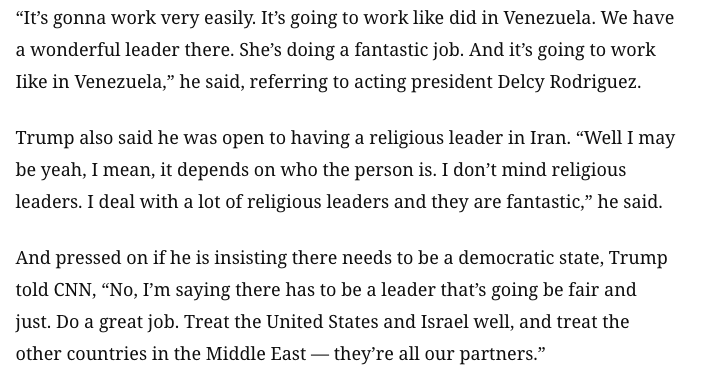
L'importante è pagare, è la sintesi del discorso. E soprattutto potrà dire ai suoi MAGA lobotomizzati che lui non ha esportato la democrazia e loro potranno ruttare di gioia
Trump tells CNN he’s not worried whether Iran becomes a democratic state
https://www.cnn.com/2026/03/06/politics/trump-interview-iran-cuba-dana-bash
-
-
@_nico_piro_ raitelefasciomelonitaliana
-
YOU JUST REVEIVED
This post is dedicated to the nameless Vodafone employee watching over me and my family and blessing us with an abundance of free minutes.
-
@davew @timkmak
-
The same for me.