Designing a CPU for Native BASIC
Uncategorized
1
Posts
1
Posters
0
Views
-
Designing a CPU for Native BASIC
Over the years there have been a few CPUs designed to directly run a high-level programming language, the most common approach being to build a physical manifestation of a portable code virtual machine. An example might be the experimental Java processors which implemented the JVM. Similarly, in 1976 Itty Bitty Computers released an implementation of Tiny BASIC which used a simple virtual machine, and to celebrate 50 years of Tiny BASIC, [Zoltan Pekic] designed a CPU that mirrors that VM.
The CPU was created within a Digilent Anvyl board, and the VHDL file is freely available. The microcode mapping ROM was generated by a microcode compiler, also written by [Zoltan]. The original design could execute all of the 40 instructions included in the reference implementation of Tiny BASIC; later iterations extended it a bit more. To benchmark its performance, [Zoltan] set the clock rate on the development board equal to those of various other retrocomputers, then compared the times each took to calculate the prime numbers under 1000 using the same Tiny BASIC program. The BASIC CPU outperformed all of them except for Digital Microsystems’ HEX29.
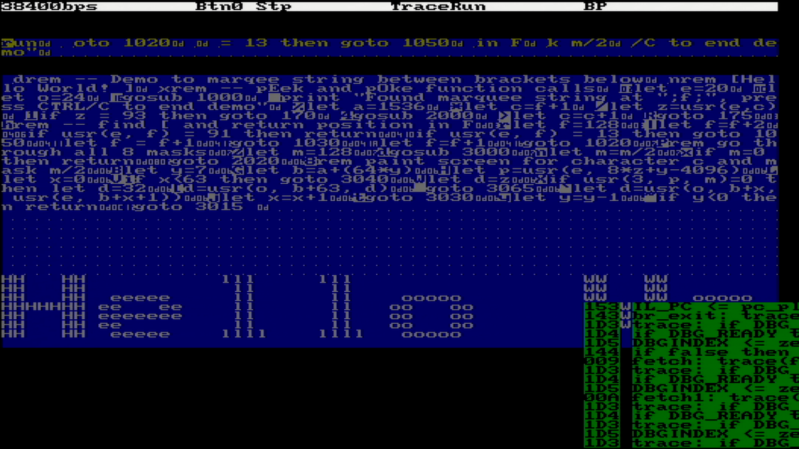
The next step was to add a number of performance optimizations, including a GOTO cache and better use of parallel operations. [Zoltan] then wrote a “Hello World” demo, which can be seen below, and extended the dialect of Tiny BASIC with FOR loops, INPUT statements, multiple LET statements, the modulo operator, and more. Finally, he also extended the CPU from 16-bit to 32-bit to be able to run an additional benchmark, on which it once again outperformed retrocomputers with comparable clock speeds.
We’ve previously seen [Zoltan]’s work with FPGAs, whether it’s giving one a cassette interface or using one to directly access a CPU’s memory bus. BASIC has always been a cross-platform pioneer, once even to the extent of creating a free national standard.
youtube.com/embed/Gqw1EIlatDk?…

Feed RSS
Gli ultimi otto messaggi ricevuti dalla Federazione
-
STOP REWRITING PERFECTLY GOOD C IN RUST
STOP REWRITING PERFECTLY GOOD C IN RUST STOP REWRITING PERFECTLY GOOD C IN RUST STOP REWRITING PERFECTLY GOOD C IN RUST STOP REWRITING PERFECTLY GOOD C IN RUST STOP REWRITING PERFECTLY GOOD C IN RUST FUCK YOU FUCK YOU FUCK YOU. FUCK YOU AND YOUR FUCKING MODERN-ASS PLATFORMS, SOME OF US CARE ABOUT THINGS THAT AREN'T YOUR AMD RYZEN DESKTOP OR YOUR FAKE-ASS POWER9 BOX THAT DOESN'T EVEN RUN SLOF OR IN BIG-ENDIAN MODE
-
@ni Hi. Co-author of ActivityPub here. Private distribution has always been a goal.
-
@strypey @nelfan@gotosocial.social @benpate @ni @swf @sovtechfund @bonfire
First, there's a document on possible integration models, which explains why this model was used.
https://swicg.github.io/activitypub-e2ee/integration-models.html
Second, bridgeability is a user story for the spec. I'd love to see encrypted messages cross bridges. MLS could help make that happen.
-
in the spirit of the holiday season: fedi uses activities like gift wrap. they unwrap them to get at the side effects inside, then discard them. activitypub is for publishing activities, so it's like gifting someone gift wrap. if they unwrap it, they get nothing. the gift wrap is the gift itself. the type of gift wrap you use says something all by itself. but a lot of people don't appreciate gift wrap. if you gifted someone gift wrap they might be confused and not understand it.
-
welp. the certbot program now no longer works on SPARC, because like many needlessly rewritten things that exist now, it now depends on something written in fucking rust. for fuck sake.
-
@cmconseils ❤️
-
I'm so fucking sad
-
Quizzino della domenica: Il terzo giorno di Natale
@matematica - Riuscite a scoprire quali sono i sei numeri che mi ha dato il mio vero amore?