Lead Acid Battery Upgraded to Lithium Iron Phosphate
Uncategorized
1
Posts
1
Posters
0
Views
-
Lead Acid Battery Upgraded to Lithium Iron Phosphate
Lithium batteries have taken over as the primary battery chemistry from applications ranging from consumer electronics to electric vehicles and all kinds of other things in between. But the standard lithium ion battery has a few downsides, namely issues operating at temperature extremes. Lead acid solves some of these problems but has much lower energy density, and if you want to split the difference with your own battery you’ll need to build your own lithium iron phosphate (LiFePO4) pack.
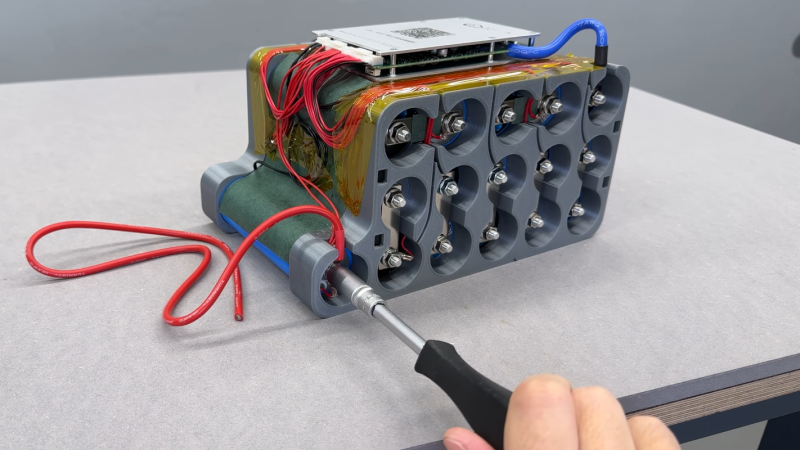
[Well Done Tips] is building this specific type of battery because the lead acid battery in his electric ATV is on the decline. He’s using cylindrical cells that resemble an 18650 battery but are much larger. Beyond the size, though, many of the design principles from building 18650 battery packs are similar, with the exception that these have screw terminals so that bus bars can be easily attached and don’t require spot welding.
With the pack assembled using 3D printed parts, a battery management system is installed with the balance wires cleverly routed through the prints and attached to the bus bars. The only problem [Well Done Tips] had was not realizing that LiFePO4 batteries’ voltages settle a bit after being fully charged, which meant that he didn’t properly calculate the final voltage of his pack and had to add a cell, bringing his original 15S1P battery up to 16S1P and the correct 54V at full charge.
LiFePO4 has a few other upsides compared to lithium ion as well, including that it delivers almost full power until it’s at about 20% charge. It’s not quite as energy dense but compared to the lead-acid battery he was using is a huge improvement, and is one of the reasons we’ve seen them taking over various other EV conversions as well.
youtube.com/embed/l-nkiqVb0J8?…

Gli ultimi otto messaggi ricevuti dalla Federazione
-
@shoofle woooooooooo
-
I convitati di pietra (libro)
@libri - Se accettate la suspension of disbelief, un bel romanzo.
-
300 whistles heading for suburban Minneapolis in the morning.
-
So. About that heated rivalry, huh.
-
"Some days the work is speaking.
Some days the work is listening.
Today feels like listening.
We’ll speak again
when the words know where to land."Ekosi.
-
Dave is looking awfully slim starting out. I don't think he learned the BMI lesson. He probably does deserve another shot, though.
Oh, Nicole is back, too. She was great.
The good news is I don't think there will be any temptation to build a boat. It looks like there will be a river and plains, maybe? No oceans to call out to them.
-
Polymer Skins That Change Color and Texture When Exposed to Water
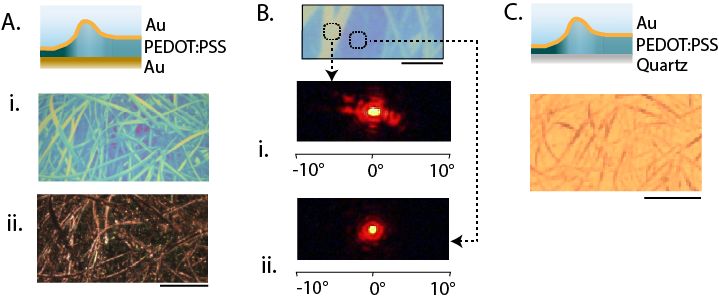
Researchers at Stanford University recently came up with an interesting way (Phys.org summary) to create patterns and colors that emerge when a polymer is exposed to water. Although the paper itself is sadly paywalled with no preprint available, it’s fairly easily summarized and illustrated with details from the Supplementary Data section. The polymer used is poly(3,4-ethylenedioxythiophene) polystyrene sulfonate (PEDOT:PSS), which when exposed to an electron beam (electron-beam lithography) undergoes certain changes that become apparent when said water is added.
The polymer is hygroscopic, but the electron beam modifies the extent to which a specific area swells up, thus making it possible to create patterns that depend on the amount of electron beam exposure. In order to ‘colorize’ the polymer, complex cavities are created that modify the angular distribution of light, as illustrated in the top image from the Supplemental Data docx file.
By varying the concentration of IPA versus water, the intermediate swelling states can be controlled. Although this sounds pretty advanced, if you look at the supplementary videos that are already sped up a lot, you can see that it is a very slow process. Compared to an octopus and kin whose ability to alter their own skin texture and coloring is legendary and directly controlled by their nervous system, this isn’t quite in the same ballpark yet, even if it’s pretty cool to watch.
-
She is the one I think most deserved a second shot at it. And, I guess the producers agree, since she's the first one they introduced.
I don't get why Britt is back. I mean, I liked him OK, but he was a tough guy and was out pretty quick.
Randy!? They brought barefoot Randy back? Now they're just being silly.