🏚️
Uncategorized
58
Posts
51
Posters
136
Views
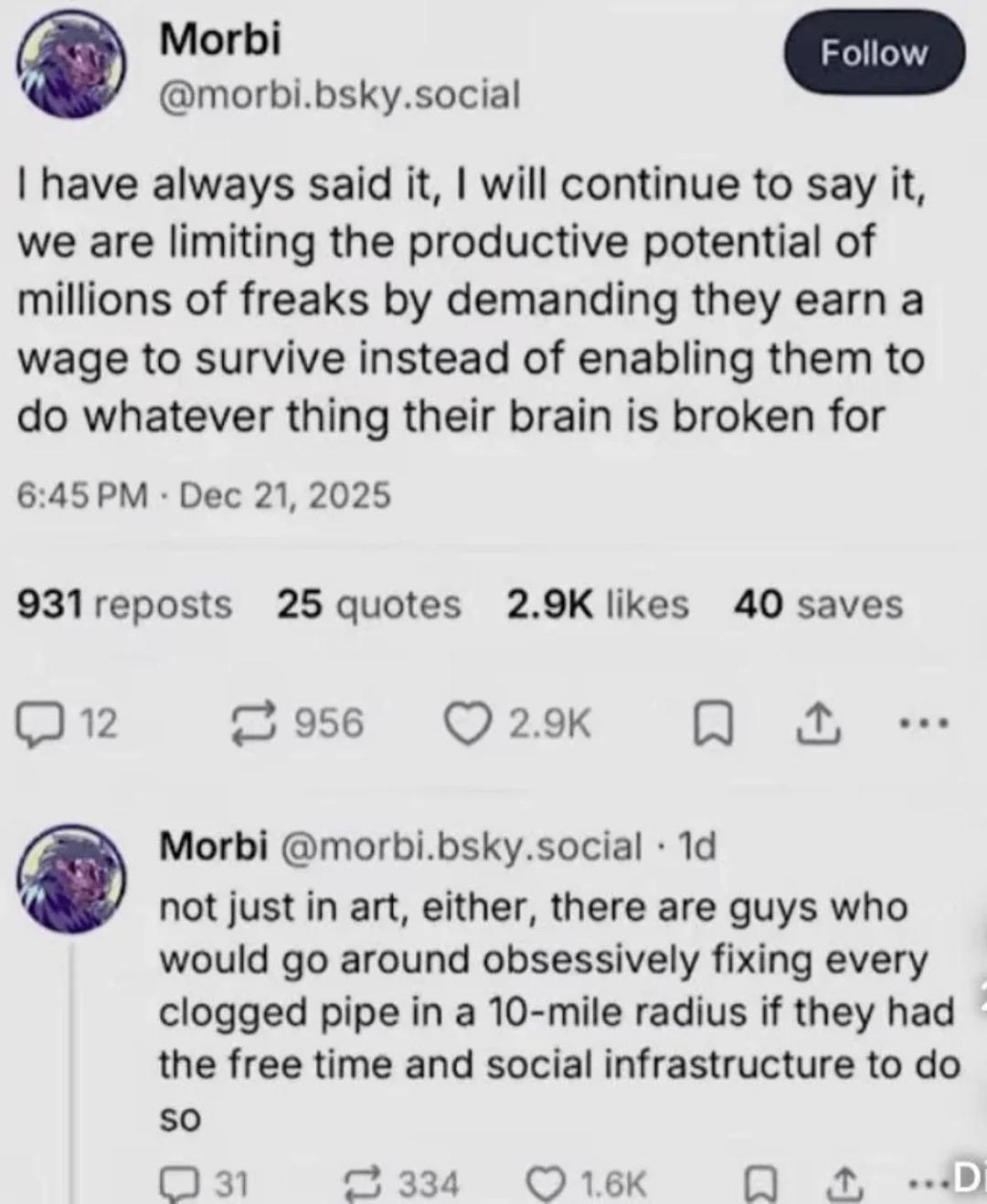
-
@ShadowJonathan
I'd love to bounce around like a roomba and fix things as I went -
@AnachronistJohn @ShadowJonathan This reminds me of David Graeber's Bullshit Jobs theory. Jobs which are useful (shit jobs) don't get paid because the people doing them are supposed to live on the warm glow of doing actually useful things with their lives. Meanwhile the jobs with pay don't help anyone and don't need to exist (i.e. are bullshit jobs)
@sitcom_nemesis @AnachronistJohn @ShadowJonathan I would love to go back to working in a factory as a lowly grunt worker and blogging about it. Wish I could afford to do it.
-
@ShadowJonathan@tech.lgbt that's why we need freak polycule communities to help eachother with our basic needs to be able to quadruple the freakyness of earth
-
@ShadowJonathan
* it me * -
@ShadowJonathan I actually had a though once that it'd be cool to be responsible for a small community. Not in the administrative sense mind you, but in the janitorial sense. I'd go around fixing, replacing and upgrading things all day and never need therapy again in my life. Could have a simple network too. Setup with a firewall and some IDS, maybe a honeypot, protecting the normies that'd live there from baddies. Go and oil some hinges after killing a printer. Basic janitor stuff.
-
@ShadowJonathan true, if i wasn't forced to work in a company, i would go to every single home to make their cyber higiene top noch, this would allow a sharp reduction of easy hack, and scam.
but i need to live like anyone so i have my work and make this reduction possible only for my company.
Sad but the whole system is built like this, and it's killing the evolution rate.
i'm pretty sure if we give money to it many of our problem would disapear (like the population issue).
-
@ShadowJonathan In fact, there are guys who will go around obsessively fixing every clogged heating pipe in a 10-mile radius out of spite against the system that tries to stop them.
-
@ShadowJonathan 100% this.
-
@AnachronistJohn @ShadowJonathan This reminds me of David Graeber's Bullshit Jobs theory. Jobs which are useful (shit jobs) don't get paid because the people doing them are supposed to live on the warm glow of doing actually useful things with their lives. Meanwhile the jobs with pay don't help anyone and don't need to exist (i.e. are bullshit jobs)
@AnachronistJohn @ShadowJonathan @sitcom_nemesis
My favorite job ever: driving for Jefferson Lines - scheduled motorcoach service.Getting mostly poor people where they needed to go. Actually helping people.
What job was I doing when we went almost bankrupt? Yup. Same job.
-
@ShadowJonathan i still randomly get favs on a comment i posted on bsky forever ago:
"who's going to make the trains run on time:
- someone who's in it for the money
- an autistic train guy"
...it might have been in response to this very screenshot being posted there too, come to think of it... -
@occurrent @ShadowJonathan and I'd invite you in
-
@ShadowJonathan
I would go from town to town evangelizing instant runoff voting. Then I might wax poetic about growing wine grapes without fungicide. -
@occurrent @ShadowJonathan and I'd invite you in
brb making a beeline for your most neglected closet or garage corner.
-
@ShadowJonathan This is rather like those code libraries or repositories I hear about sometimes, where half the internet is built on this thing, and it's just one person in obscurity, obsessively keeping it updated, in their own time, with no compensation or recognition.
-
@ShadowJonathan I had one friend who bought a headlight polishing kit and he honestly went around and cleaned up all of his neighbors' old headlights. I believe this is absolutely true.
-
@ShadowJonathan I feel this in my soul. If I didn't need to work for a living every computer in a 30 block radius would be fixed and kids would have free coding lessons.
-
@ShadowJonathan this is so fucking true. Source: am one of those freaks
@ArcMother me 2!!!
-
Walking out of the bathroom at a house party and going up to the host to say "you know how the handle on your toilet jiggled a bit and needed to be held in just the right way to flush? It's fixed now." is one of my favorite things.
@gbargoud @ShadowJonathan I've found my people!!!
-
@ShadowJonathan We don’t have such system yet because for each million of freaks there’s a billion of normies who will abuse & scam the shit out of it 😬
-
Walking out of the bathroom at a house party and going up to the host to say "you know how the handle on your toilet jiggled a bit and needed to be held in just the right way to flush? It's fixed now." is one of my favorite things.
@gbargoud @ShadowJonathan I would replace so many flappers!



















Feed RSS
Gli ultimi otto messaggi ricevuti dalla Federazione
-
@julian@fietkau.social oh I think you and I know that's fluff.
-
@eniko On a day where I have an alarm set, the alarm is on the far side of the room so I have to get out of bed to turn it off, and there is no snooze, and no way for me to sleep though it. At that point I'm out of bed and shambling around.
On days where I have no alarm, I wake up at 10:00 (almost spookily to the minute) and get out of bed pretty much immediately.
-
-
@julian@activitypub.space Is Bluesky working on bringing back small online communities with a sense of local scale and place? Or is this just some marketing fluff? I'd thought their goal was one giant round table that encompasses everyone on the planet.
A cynical read of “minus the Comic Sans font” would be that on Bluesky, all communities look the same. Wouldn't want to risk subverting the corporate branding. 🙃
-
Anche questa settimana porto in giro le presentazioni di Assalto alle piattaforme e i concerti:
Giovedì - BOLOGNINA, Eretica Circolo di quartiere (dalle 19)
Venerdì - TRIESTE, Casa delle culture (dalle 19:30)
Sabato - MILANO, LUMe Occupato (dalle 17).Ci vediamo nel mondo fisico?
-
-
@alsivx È una custom rom.
-
@eniko Get up, take the dogs out, feed them and the cat, make a coffee, get stuff out for my wife’s breakfast, take my meds, then go muck around on my laptop while I drink coffee.