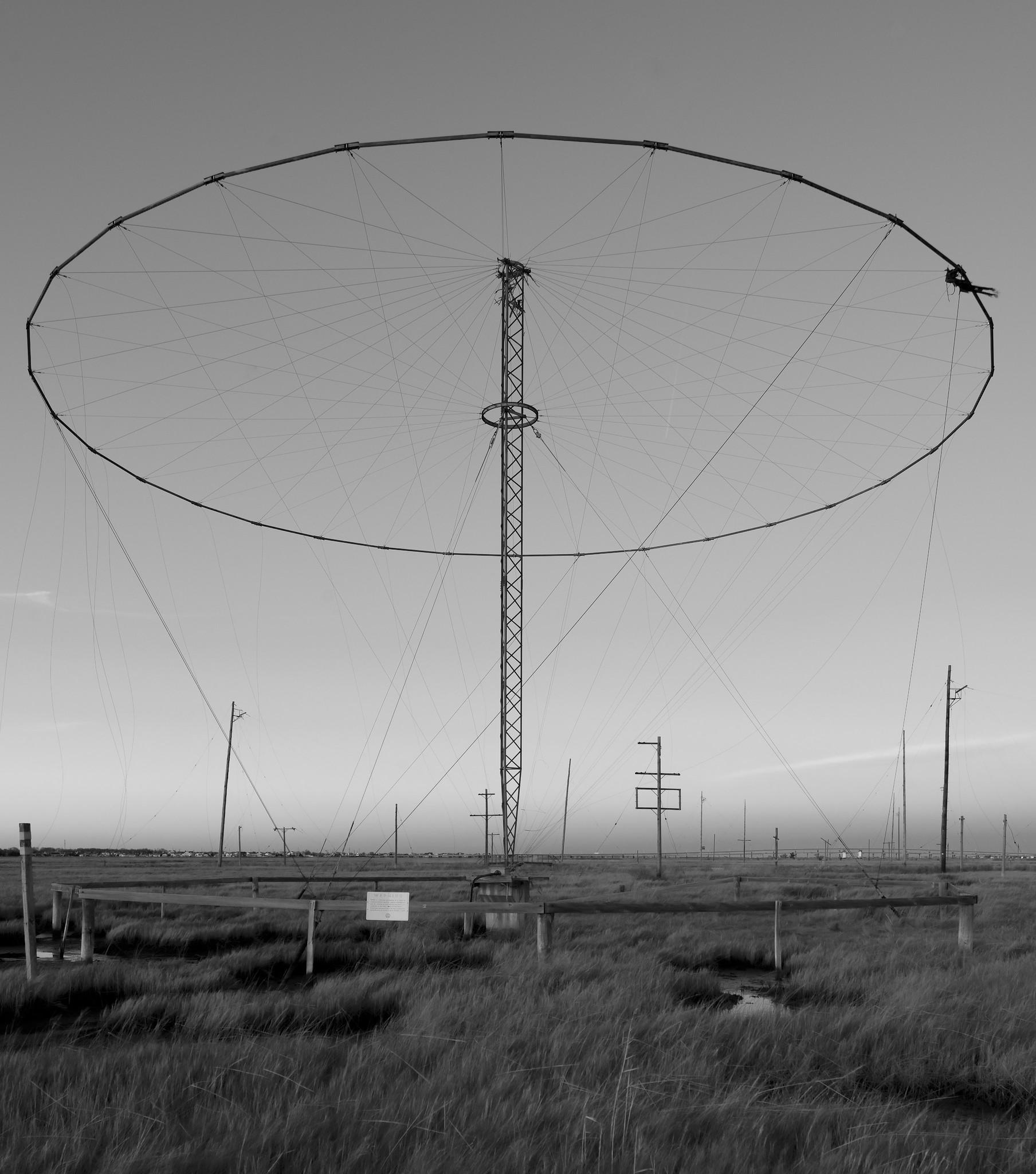
Shortwave "Discone" Antenna, AT&T High Seas Transmitter Site, Ocean Gate, NJ, 2009.
Uncategorized
16
Posts
9
Posters
5
Views
-
Captured with a DSLR and a 24mm shifting lens.
During the 20th century, AT&T operated a shortwave "radiotelephone" service for vessels on the high seas. Ships could contact an operator, who could connect them with any landline telephone number they wished.
The North Atlantic station, callsign WOO, occupied expansive transmit and receive "antenna farms" in marshlands near the shore in central New Jersey.
Rendered obsolete by satellites, the service ceased operation on November 9, 1999.
@mattblaze That is so interesting. Thanks for posting.
-
Shortwave "Discone" Antenna, AT&T High Seas Transmitter Site, Ocean Gate, NJ, 2009.
All the pixels, none of the risk of sea sickness or scurvy, at https://www.flickr.com/photos/mattblaze/4141766569
@mattblaze
Burn, baby burn! Discone inferno! Burn, baby burn.... -
 undefined oblomov@sociale.network shared this topic on
-
Shortwave "Discone" Antenna, AT&T High Seas Transmitter Site, Ocean Gate, NJ, 2009.
All the pixels, none of the risk of sea sickness or scurvy, at https://www.flickr.com/photos/mattblaze/4141766569
@mattblaze That's pretty amazing. Were you ever there on a windy day? I'm wondering if they moved about very much...
-
Captured with a DSLR and a 24mm shifting lens.
During the 20th century, AT&T operated a shortwave "radiotelephone" service for vessels on the high seas. Ships could contact an operator, who could connect them with any landline telephone number they wished.
The North Atlantic station, callsign WOO, occupied expansive transmit and receive "antenna farms" in marshlands near the shore in central New Jersey.
Rendered obsolete by satellites, the service ceased operation on November 9, 1999.
@mattblaze
Had a SSB license as crew on a sailing yacht in the Caribbean, ‘71. You called on the radio and were asked your location in latitude & longitude. They focused an antenna on that location and then placed your telephone call, 2,100 miles away.
Used LORAN and another radio system that gave a bearing from counting dots and dash tones with headphones in ‘65, as return crew from Bermuda. -
I should note that while the site (and its cousins) had a number of large discone antennas like this one, they were mostly there as backups in case the main antennas (which included truly massive wire rhombics oriented toward various oceanic regions) or transmitter combiners failed.
The old Bell System did not mess around.
@mattblaze nice shot! Shifting lens to counter keystone distortion?
-
Shortwave "Discone" Antenna, AT&T High Seas Transmitter Site, Ocean Gate, NJ, 2009.
All the pixels, none of the risk of sea sickness or scurvy, at https://www.flickr.com/photos/mattblaze/4141766569
@mattblaze Not sure off the top of my head what the name for that type of antenna is, but it’s not a discone—there’s no cone. A discone involves a radiating disk, then a cone with its apex at the center of the disk as the counterpoise.
Still really neat history.
-
@mattblaze Not sure off the top of my head what the name for that type of antenna is, but it’s not a discone—there’s no cone. A discone involves a radiating disk, then a cone with its apex at the center of the disk as the counterpoise.
Still really neat history.
@bob_zim It’s a discone.
The tip of the conical section is at the base of the tower (from the ring). The “disc” is the buried ground system.
-
@bob_zim It’s a discone.
The tip of the conical section is at the base of the tower (from the ring). The “disc” is the buried ground system.
@mattblaze Huh. I think this is the first I’ve even heard of oriented that way. So the suspended ring is just to hold the counterpoise?
Seems like the guy wires would interfere too much for such a system to be usable. I guess that’s why they’re running at weird angles rather than directly to the closest segment of the ring.
-
@mattblaze Huh. I think this is the first I’ve even heard of oriented that way. So the suspended ring is just to hold the counterpoise?
Seems like the guy wires would interfere too much for such a system to be usable. I guess that’s why they’re running at weird angles rather than directly to the closest segment of the ring.
@bob_zim This is a pretty standard design for lower frequency discone antennas used in commercial facilities. The guy wires have to be insulated, as I recall.
The military uses a version that’s oriented more like a familiar VHF/UHF discone, which they call a “disc-cage”. It’s a more complex design, because the entire base of the conical has to be isolated from ground.
Discones are basically half of a biconical dipole.
-
I should note that while the site (and its cousins) had a number of large discone antennas like this one, they were mostly there as backups in case the main antennas (which included truly massive wire rhombics oriented toward various oceanic regions) or transmitter combiners failed.
The old Bell System did not mess around.
@mattblaze I got to tour the USCG Middletown, CA LORAN facility before it was decommissioned. Fascinating older technology.






Gli ultimi otto messaggi ricevuti dalla Federazione
-
@hikingdude wait I wasn't aware that some VPS providers didn't allow the creation of snapshots. Really? 😩
-
@bianot Mi piacerebbe molto, ma per imparare dovrei andare in un posto dove si pratica e:
1) non ne ho uno vicino a casa
2) vorrei non spendere soldi(detto questo, è una vita che vorrei iniziare a praticarlo)
-
@snow OT ricordo che qualche anno addietro, c'era un programma per windows che metteva in collegamento le radioline pmr446. Ricordo che con mezzo watt ho parlato da Courmayeur a Napoli.
-
Make it shitty!
Geniale questo video del Norwegian Consumer Council che analizza il fenomeno dell'#enshittification.
In fondo è proprio così: si creano servizi digitali che all'inizio sono gratuiti o a pochissimo costo, sono utili, belli ma man mano per poter restare si peggiorano - non nel senso che diventano brutti - ma per avere servizi essenziale bisogna pagare.
-
@informapirata se non avessi messo il link ci varei pure creduto.
Signore e signori benvenuti nel Circo delle Pantegane.
-
@soatok @rusty__shackleford you're absolutely right
-
@cwebber @rusty__shackleford The "spell out the acronyms used in the filenames" part does gesture suggestively towards "AI"
The heel-turn on me allegedly not contacting them without an "You're absolutely right!" tells me that, even if it is AI, they at least edited the sycophancy out of it.
-
Macron avvia il più grande cambiamento nucleare europeo dalla Guerra Fredda
Il presidente francese ha infranto decenni di tabù nucleari francesi, promettendo di aumentare il numero di testate e rendendo esplicito il ruolo della Francia nella sicurezza europea e ha indicato le minacce provenienti da Russia e Cina, nonché il cambiamento delle priorità di difesa degli Stati Uniti, come ragioni dell'accumulo di armi atomiche.
https://www.politico.eu/article/macron-announces-increase-in-number-of-frances-nuclear-warheads/