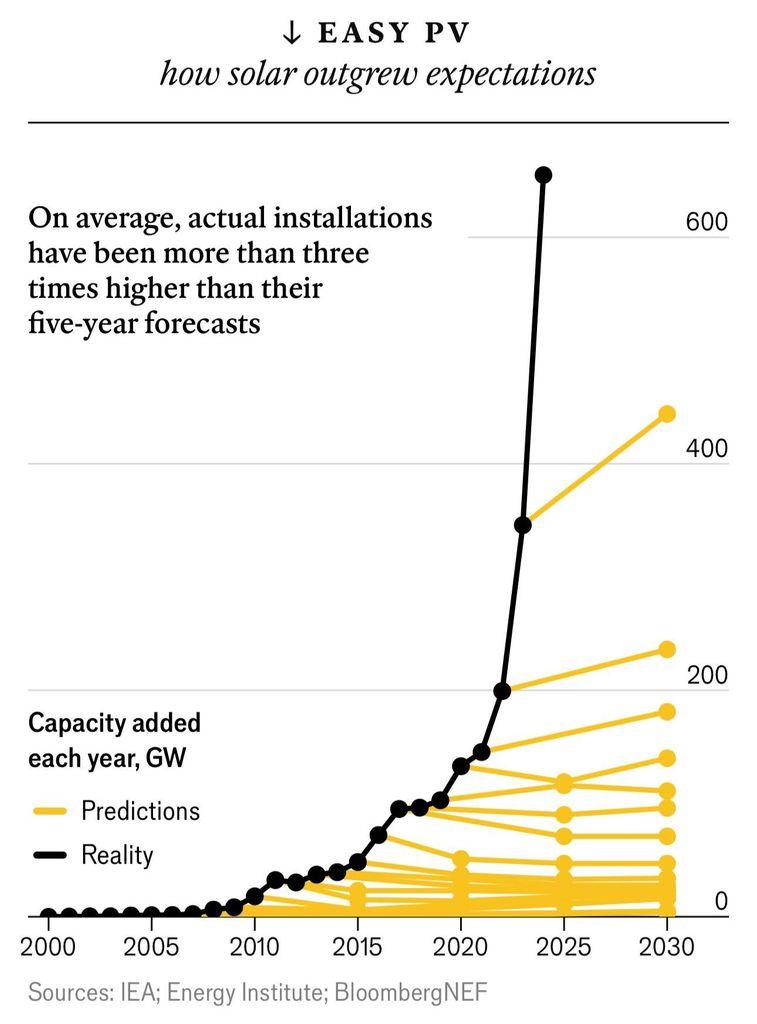
The world’s solar capacity reached 1,419 gigawatts in 2023, way beyond any predictions.
Uncategorized
57
Posts
29
Posters
0
Views
-
@infobeautiful A basic trend curve would have given a better prediction.
@aanee @infobeautiful while I'm 100% on board with you directionally, I suppose the counter argument would be that exponential growth has to tap out eventually, is just a question of when it turns into an S-curve.
-
@aanee @infobeautiful while I'm 100% on board with you directionally, I suppose the counter argument would be that exponential growth has to tap out eventually, is just a question of when it turns into an S-curve.
@tartley @infobeautiful True enough, but I still think the expectations in the graph are extremely pessimistic.
-
@aanee @infobeautiful while I'm 100% on board with you directionally, I suppose the counter argument would be that exponential growth has to tap out eventually, is just a question of when it turns into an S-curve.
@tartley @aanee @infobeautiful that's what the predictions assumed. But nobody expected the Chinese inquisition.
-
 undefined cwebber@social.coop shared this topic
-
@tartley @infobeautiful True enough, but I still think the expectations in the graph are extremely pessimistic.
@aanee @infobeautiful oh yes, you are absolutely right! Extremely well funded and insidious thumbs on the scales from the fossil fuel lobby.
-
The world’s solar capacity reached 1,419 gigawatts in 2023, way beyond any predictions. 1 gigawatt = power for a medium sized city
Soon this will need a log scale…
-
@aanee @infobeautiful while I'm 100% on board with you directionally, I suppose the counter argument would be that exponential growth has to tap out eventually, is just a question of when it turns into an S-curve.
@tartley @aanee @infobeautiful It will turn into an S-curve sometime after the full electrification of Africa, South and South-East Asia and Latin America.
-
@martin ??? Solar plus wind plus batteries provide power for free, reducing need for fossil fuel dependence by 80% or 100% in some places, what's not to like?
@Jonathan Hartley Nope. You need 100% backup(from about 50% of Ren share). Fossil backup.
That's why it's not cheap. and will not be. Never.
#^https://en.wikipedia.org/wiki/Dunkelflaute -
@infobeautiful This might explain why I'm reading about prices of PV electricity sold to the grid plummeting (as there is barely any storage capacity).
@dzwiedziu @infobeautiful storage capacity is artifically restrained. We have the tech to store electricity cheap and with a one-time low investment and minimal maintenance sosts, we have the millenia old tech to store heat, yet more and more legislatures are -lobbied- bribed to make cheap perpetual solutions illegal.
-
@dzwiedziu @infobeautiful storage capacity is artifically restrained. We have the tech to store electricity cheap and with a one-time low investment and minimal maintenance sosts, we have the millenia old tech to store heat, yet more and more legislatures are -lobbied- bribed to make cheap perpetual solutions illegal.
@ohir
[citation needed] -
@ohir
[citation needed]@dzwiedziu @infobeautiful are you asking about "lobbying" efforts (this would be R 2023/1542 and Digital Battery Passport kicking in next year). The whole regulations only skim non-patentable technologies, like lead-acid batteries. These can be operational for millenia, due to their simple chemistry. The only maintenance that must be done is on-site processing of sulfated battery plates. Something that once upon a time (1950-1990) was being done on the massive scale in Central/East Europe countries. Then lobbied country's legislative can bar mid-sized installations as unable to met the EU demands (tried recently in Poland afair).
-
The world’s solar capacity reached 1,419 gigawatts in 2023, way beyond any predictions. 1 gigawatt = power for a medium sized city
@infobeautiful The opposite of
-
@aanee @infobeautiful while I'm 100% on board with you directionally, I suppose the counter argument would be that exponential growth has to tap out eventually, is just a question of when it turns into an S-curve.
@tartley @aanee @infobeautiful Well, what would be a limitting factors that would make it more expensive/more difficult to keep expanding solar?
=> running out of physical space to build panels on:
Yes but this isn't happening anytime soon and we would have beaten current world energy production well before that point is reached=> running out or raw materials:
Plenty of time until then too, and recycling older panels could help too. -
The world’s solar capacity reached 1,419 gigawatts in 2023, way beyond any predictions. 1 gigawatt = power for a medium sized city
war and conflict is unfortunately a likely major contributor to this, though I'm glad the shift is happening
just look at what happened to Cuba lately, without fuel the society goes to a standstill, they desperately need more green tech and everyone will know that unless they also make the shift, the unpredictability of fossil fuel politics may hit them hard at some point, adding to all the other existing arguments to shift
-
@aanee @infobeautiful while I'm 100% on board with you directionally, I suppose the counter argument would be that exponential growth has to tap out eventually, is just a question of when it turns into an S-curve.
@tartley The Total Addressable Market of solar panels is anywhere that can have a reasonable ROI on a solar panel given local electricity demand. As panels get cheaper they become economical in cloudier places.
-
@tartley @aanee @infobeautiful Well, what would be a limitting factors that would make it more expensive/more difficult to keep expanding solar?
=> running out of physical space to build panels on:
Yes but this isn't happening anytime soon and we would have beaten current world energy production well before that point is reached=> running out or raw materials:
Plenty of time until then too, and recycling older panels could help too.@dryak @aanee @infobeautiful I totally agree. I suppose the black-pilled establishment energy industry might expect another limiting factor would be running out of loony environmentalists to sell them too, if they could only sway public opinion sufficiently. But I agree with you, they were holding back the tide.
-
@Jonathan Hartley Nope. You need 100% backup(from about 50% of Ren share). Fossil backup.
That's why it's not cheap. and will not be. Never.
#^https://en.wikipedia.org/wiki/Dunkelflaute@martin you might need access to 100% backup while still being able to reduce your need for fossil generated energy by a majority amount - those aren't incompatible.
-
@dzwiedziu @infobeautiful are you asking about "lobbying" efforts (this would be R 2023/1542 and Digital Battery Passport kicking in next year). The whole regulations only skim non-patentable technologies, like lead-acid batteries. These can be operational for millenia, due to their simple chemistry. The only maintenance that must be done is on-site processing of sulfated battery plates. Something that once upon a time (1950-1990) was being done on the massive scale in Central/East Europe countries. Then lobbied country's legislative can bar mid-sized installations as unable to met the EU demands (tried recently in Poland afair).
@ohir
So you're saying that to solve energy and heat storage we need sites that will have large amounts of a poisonous, bio-accumulative heavy metal working in an highly hazardous acid, and all that working within daily deep-cycling, on an industrial scale, plus constant industrial-scale recycling, and that it will be cheap and safe?Yeah, no citations (not counting regulation existing alone) means I'll pass.
-
@tartley @aanee @infobeautiful Well, what would be a limitting factors that would make it more expensive/more difficult to keep expanding solar?
=> running out of physical space to build panels on:
Yes but this isn't happening anytime soon and we would have beaten current world energy production well before that point is reached=> running out or raw materials:
Plenty of time until then too, and recycling older panels could help too.@TechConnectify has a take on that: https://youtu.be/KtQ9nt2ZeGM
-
The world’s solar capacity reached 1,419 gigawatts in 2023, way beyond any predictions. 1 gigawatt = power for a medium sized city
@infobeautiful More than enough to power a DeLorean back to the future :)
-
@infobeautiful the IEA is famous for denying what cannot be denied until the very last minute.
@infobeautiful the IEA is traditionally very nuclear friendly and of course aware that solar and wind are pushing nuclear from „expensive but with enough subsidies and imperialism it might work“ into „are you ducking nuts?!?“ territory















Gli ultimi otto messaggi ricevuti dalla Federazione
-
-
#Trump: "divulgheremo importanti informazioni governative su #UFO e alieni". Han trovato anche quelli negli Epstein files?
-
Le mettiamo le sanzioni?
Date una letttura alla Dichiarazione Sovranità Digitale Europea: Italia sottoscrive il documento con gli altri Stati membri sul sito governativo innovazione.gov.it; e notate questo passaggio che toglie ogni dubbio:"In questo quadro, viene riconosciuto anche il ruolo delle soluzioni open source, purché rispettino elevati standard di sicurezza informatica e siano integrate, ove necessa
https://monodes.com/predaelli/2026/02/22/le-mettiamo-le-sanzioni/
#Ethics
-
@frascari oh no ho combinato un guaio
-
@frascari
......piace!
-
Android diventerà una piattaforma bloccata
Android diventerà una piattaforma bloccata!!!Nell’agosto 2025 Google ha annunciato ↗ che a partire da settembre 2026 non sarà più possibile sviluppare applicazioni per la piattaforma Android senza prima registrarsi centralmente presso Google. Questa registrazione richiederà di:
Pagare una commissione a Google
Accettare i termini e le co
https://monodes.com/predaelli/2026/02/22/android-diventera-una-piattaforma-bloccata/
#Ethics
-
@oloturia oddio in realtà no, ma ora che sto leggendo cos’é la teiera di Russell mi hai fatto venire voglia di cambiare la storia 😱
-
@frascari OMG è la teiera di Russell? L'hanno finalmente trovata?