(From a Berlin diary, 2016)
Uncategorized
1
Posts
1
Posters
10
Views
-
(From a Berlin diary, 2016)
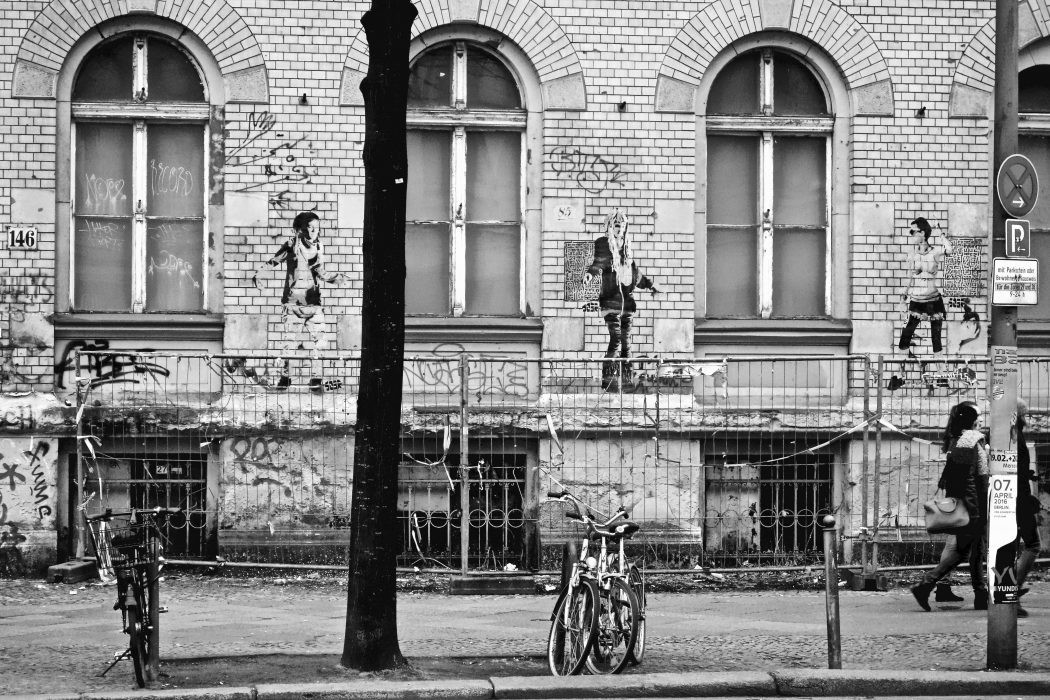
Fehrbelliner Strasse intersects the indefinite, porous border between the old East Berlin neighbourhoods of Mitte and Prenzlauer Berg. Forming a T with the sloping green space of Volkspark am Weinbergweg, the street is lined with pretty late 19th-century altbauten that had survived artillery and aerial bombardment at the end of World War II, and featureless mid-20th-century apartment blocks. I use the street sometimes as a short cut to a favourite café on Prenzlauer Berg’s wide main street, Schönhauser Allee. A block or so west of the park, there are two bike shops, on opposite sides of the street; outside both, disorderly ranks of shiny, new Dutch, Belgian and English road and utility bikes are arrayed along the sidewalks.
It was within one of these ranks that, not so long ago, on a hot, mid-summer afternoon, I came across a Dutch-built Gazelle 3-speed transportfiets. I wasn’t looking for a bike but it caught my eye. All-black, with 28-inch wheels and steel cargo racks installed front and back, it was big, utilitarian-looking and sturdy. A sales-person urged me to try it out. Nervous, unsteady on the saddle, I pedalled it along the sidewalk to the end of the block. It was all I could do not to topple over. I bought it on the spot.
The bike became my point of access to a city that, to my embarrassment, I had explored hardly at all in the three and a half years I’d lived here.
I was fifty-nine years old when I first arrived in Berlin. Overweight, with chronic reactive arthritis and a bad heart, I relied on a battered black aluminium cane with a wide rubber ferrule to stay on my feet. It made me look even older and more disabled than I was. There was no question then of me taking up cycling: I couldn’t even lift my leg over the modest obstruction of the top tube of my wife’s ‘step through’ Dutch bike, let alone lift myself onto the saddle. I was well above the recommended weight limit for the frame.
Four months ago, I was diagnosed with diabetes mellitus. It was serious enough for the doctor to warn me that I was not only at increased risk of heart failure and stroke but my kidneys and pancreas might already be packing up. As well as medication, I had to undertake an immediate, radical change of lifestyle and diet.
I gave up sugar, starch (including rice, corn and potatoes), dairy products, all processed foods, red meat, fruit juices, alcohol, and caffeine. I increased my intake of unprocessed grains, legumes, fresh fruit and vegetables. I drank nothing but water – lots of water – and forced myself to walk three kilometres every day. Within three weeks, I’d lost ten kilos. Within another month, I had lost ten kilos more and dropped two sizes of jeans. My head was clearer than it had been in a decade and I no longer used a cane.
Now I cycle.
I was tentative at first, tracing random routes through the streets north of Torstrasse, at the perimeter of what was once the ‘death zone’ on the eastern side of the city’s dividing wall, now parkland and newly developed apartment blocks, as I mastered the basics of cycling after an hiatus of more than a decade. But it wasn’t long before I extended my range to several kilometres in all directions, joining informal pelotons of morning commuters south down Rosenthaler Strasse to Hackescher Markt, or escaping traffic on a long, tree-shaded bike lane north on Gartenstrasse, past the Wall memorial park and the walled green space and cemetery of Park am Nordbahnhof, to the Turkish neighbourhoods in Wedding; sometimes, I ventured westwards across the Spree, to the forested pathways and small lakes of Tiergarten, or criss-crossed river bridges as I pushed southwards to Kreuzberg and Neukölln. I made it a point to ride slowly, to be curious, pulling off the road occasionally into the open courtyard of an altbau, an ‘art squat’ or a university campus. I ignored ‘no go’ warnings to pedal through cemeteries, private parks and abandoned industrial states or tow-paths atop narrow, red-brick-banked canals. I delved into cobbled laneways that ended up in dead ends.
Mostly I cycle alone, sometimes with family or friends. But each journey is part of a conscious process in which, maybe for the first time in my life, I am trying to lay claim to a city, to become more than a temporary interloper, a traveller passing through – to make some piece of it my own. I’ve started to record the journey, in words and photographs, so I don’t forget.
-
 undefined oblomov@sociale.network shared this topic on

Feed RSS
Gli ultimi otto messaggi ricevuti dalla Federazione
-
Gioia tauro: al porto reggino 5 container in procinto di partire per israele. intervista alla giornalista linda maggiori
@anarchia
“5 container carichi di materiale bellico starebbero per partire verso Israele” dal porto di Gioia Tauro (Reggio Calabria). A dirlo un articolo della giornalista Linda Maggiori pubblicato su
-
Gli arroganti non sono sciocchi
Non confondeteli, è l'arroganza che li fa comportare da sciocchi, e quello che l'arroganza fa. Ma se c'è arroganza è quello quello che sono
La morte toglie le maschere, e nudi si vede tutto
Senza più niente a nasconderli, nessun posto dove scappare
Compagni d'inferno si vede quel che siete
Il condannato ride del nuovo arrivato che si finge innocente
-
Solo il modesto si salverà, non l'arrogante
E non c'è che arroganza dovunque
-
Avete voluto la fine del mondo
Senza sapere cosa avrebbe significato
-
Chi protegge gli innocenti se il lupo è salito in alto?
Chi lo ferma ora
Lo sapete che il lupo caccia per primi i cuccioli, e voi glieli avete consegnati?
-
@psf
Man did you get that right.
-
-
L'unica cosa che posso fare è trovare quella voce che mi ha condannato e mi vuole fuori di lì
Ascoltare piano il sussurro che porta alla luce
O alla fine