@qrper mentioned in his recent video how some hams like to make antennas.
Uncategorized
2
Posts
1
Posters
6
Views
-
@qrper mentioned in his recent video how some hams like to make antennas.
Guilty as charged.
It was only last night that I finished my new linked dipole. But sometimes I want to operate with a vertical. Putting radials on the ground has worked pretty well on North Carolina Piedmont clay, but on dry sand near the beach, they acted like tuned radials, and the antenna performance was terrible, except on the 20m band they were cut for, because the dry sand wasn't conductive.
Now I want to be able to set up an elevated vertical with elevated radials, field-tunable for multiple bands.
My thought is to tune the vertical for SWR with the antenna on the ground, then move it up to an elevated base (I have a tripod for this) and elevate radials.
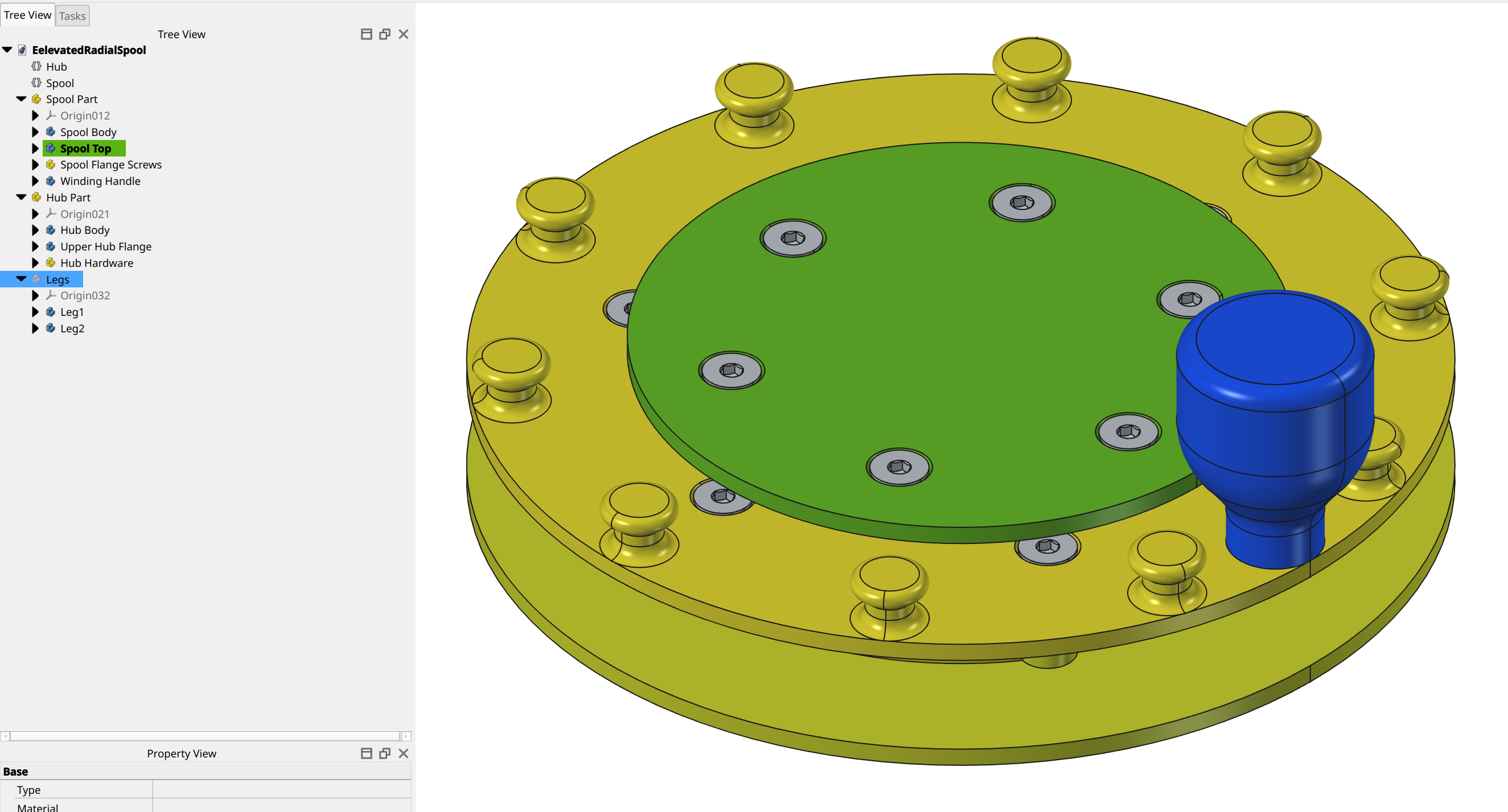
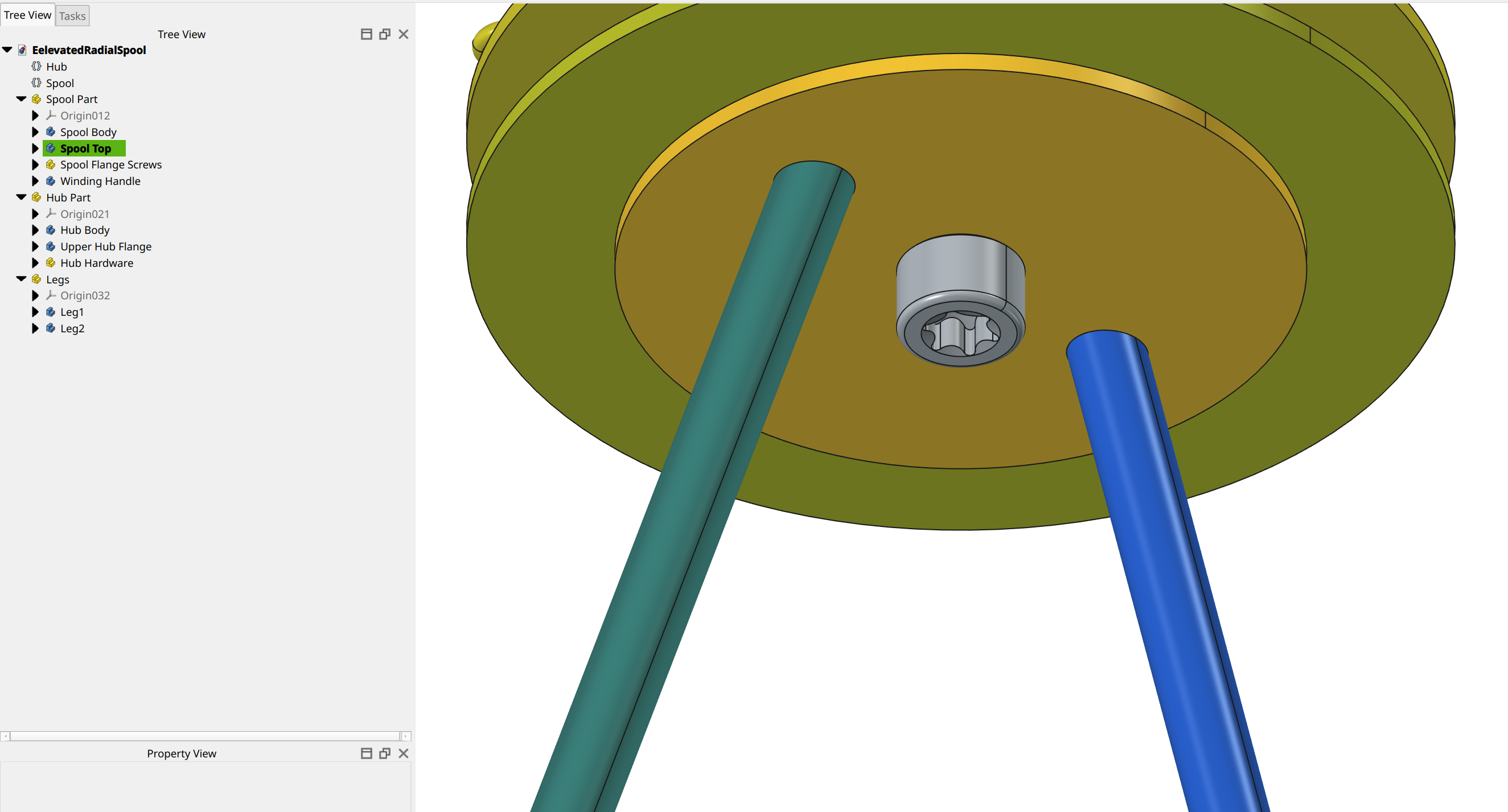
My current idea is a spool with knobs on top. Wrap wire around the spool and pay it out to the right length for the band, then loop it around one of the knobs to hold it in place. Two driveway markers underneath act as legs.
How are two legs stable? Tensegrity!
Make the whole contraption lean away from the antenna, and hang a little weight from underneath, with the radials in tension.
Five 3d-printed parts, fourteen screws, and two driveway markers per elevated radial. Heat-shrink printed labels marking the right spot on the wire for each band, or maybe even the top and bottom of large bands so that I can tune. Maybe other labels for if I move the vertical element up a lot higher and deploy radials down like a discone, in which case the radial lengths will have to be different. I could imagine just two of these for normal mostly horizontal deployment, but three or four for a portable discone.
I expect that would make for an efficient vertical antenna setup that will work over any ground and not require any stakes or other ground fixtures, just maybe a few weights on the tripod if it's windy, and some light weights (dual-purpose my arborist throw bags? borrow local rocks?) pulling out the radials.
-
@qrper mentioned in his recent video how some hams like to make antennas.
Guilty as charged.
It was only last night that I finished my new linked dipole. But sometimes I want to operate with a vertical. Putting radials on the ground has worked pretty well on North Carolina Piedmont clay, but on dry sand near the beach, they acted like tuned radials, and the antenna performance was terrible, except on the 20m band they were cut for, because the dry sand wasn't conductive.
Now I want to be able to set up an elevated vertical with elevated radials, field-tunable for multiple bands.
My thought is to tune the vertical for SWR with the antenna on the ground, then move it up to an elevated base (I have a tripod for this) and elevate radials.
My current idea is a spool with knobs on top. Wrap wire around the spool and pay it out to the right length for the band, then loop it around one of the knobs to hold it in place. Two driveway markers underneath act as legs.
How are two legs stable? Tensegrity!
Make the whole contraption lean away from the antenna, and hang a little weight from underneath, with the radials in tension.
Five 3d-printed parts, fourteen screws, and two driveway markers per elevated radial. Heat-shrink printed labels marking the right spot on the wire for each band, or maybe even the top and bottom of large bands so that I can tune. Maybe other labels for if I move the vertical element up a lot higher and deploy radials down like a discone, in which case the radial lengths will have to be different. I could imagine just two of these for normal mostly horizontal deployment, but three or four for a portable discone.
I expect that would make for an efficient vertical antenna setup that will work over any ground and not require any stakes or other ground fixtures, just maybe a few weights on the tripod if it's windy, and some light weights (dual-purpose my arborist throw bags? borrow local rocks?) pulling out the radials.
The prototype worked well enough that I'll proceed on to another iteration. Leaning it out with two legs held up by the radial wire worked well, and the little knobs on the top of the spool to hold the wire in place work fine. I'll made them a touch larger to be more robust, but the concept works.
I want to be able to fit 12m of wire on the spool, because I want radials that work well as flat radials on 40m, which might take up to 28%λ instead of the nominal ¼λ which would be appropriate in the "discone" setup with 45° radials. However, with this wire, 8m barely fits on this spool. So I need to add a generous allowance for more wire.
I need a handle for the hub at the bottom so that I can wind it up with the legs removed. It's unwieldy with two 6' long fiberglass stakes.
According to DJØIP, 1 elevated, tuned radial is roughly equivalent to 8 ground radials. Two of these should give me the performance of 16 ground radials. According to his table, I can expect 3.76dB gain over my usual 4 radials on the ground, or even more if I'm using a shortened antenna.
With these just leaning, if someone inadvertently walks into my bright pink wire, they'll probably just knock over the leaning posts, which is unlikely to cause a big problem. I'll probably use bullet connectors for the other end of the wire so that they can pop out and not knock the antenna over.
-
 undefined oblomov@sociale.network shared this topic on

Gli ultimi otto messaggi ricevuti dalla Federazione
-
@theplaguedoc we routinely get sand from Sahara here and you can tell because the air turns yellow, but never seen it make rain red.
-
@oblomov Sand from the Sahara discolours the rain, apparently. At least, that's what they want us to think.
-
@theplaguedoc blood rain?
-
@paolabonacini @ju @Uilebheist ok ma gli elettori quanta coscienza ne hanno?
-
-
@ju ma quanto può funzionare? Poche sono le notizie in grado di oscurare quello che sta accadendo e la sua assenza è pesante. @Uilebheist
-
@Antonio1959 non guardo più Rai telefascio meloni italiana ma scommetto che hanno parlato di lei in entrambi i servizi
-
Today, I am doing a totally non-scientific, random poll of kids passing through the station.
The question: "What's your favourite train"The answers from the first hour are going to revolutionise the industry:
• "The Welsh one" (197)
• "I don't have one"
• "The one that's coming right now"
• "The ones in Nickelodeon Land"
• "That one with the blue door" (331)
• "The blue one"
• "185 x 2"