During production of Finding Nemo, we started using Linux boxes in addition to SGIs.Why?
Uncategorized
25
Posts
21
Posters
0
Views
-
During production of Finding Nemo, we started using Linux boxes in addition to SGIs.
Why?3D painting software we wrote for laying out coral was written in C++ using templates, and the debug info was too large for IRIX, but was debuggable on Linux.
Was this a 32 bit vs. 64 bit issue?
No.
IRIX reserved half the address space for the kernel, while Linux only did a quarter.
So on Linux, we had 3GB, and the symbols fit.
It was a 32 bit show, both machines had 4GB max.
Plenty for Finding Nemo.
This was a while ago, so forgive my foggy memory (I wrote a chapter of a popular Linux book that described this at the time):
I believe Linux started with the 2 GiB / 2 GiB split and also a direct map of all physical memory (all physical memory was mapped into the kernel’s VA space). This had a few advantages:
- You can tell apart user and kernel addresses by looking at the top bit.
- You can always pin a page and then use the result of the current translation to get a VA you can use for access anywhere in the kernel, not just threads associated with the current process.
By the early 2000s, machines with more than 2 GiB of physical memory were affordable by places running Linux and so the direct map had to go away. I think this work started with PAE. PAE meant you could have more physical memory than you had virtual, which made this much worse, so 32-bit kernels with PAE couldn’t use a direct map at all and had to allocate mappings to fill things into the kernel’s address space on demand, but gradually this became necessary for everyone (I think PAE was a compile-time option for the kernel for a while).
User processes grew memory requirements faster than the kernel, so there was a configuration option to choose where this split was. I’m not sure when Linux went to 3 GiB, but by the have enough physical memory for this to make sense you’re past the point where a direct map is feasible, so there are no downsides. I think it was possible to arrange the split the other way, which was useful for file servers and similar where you wanted a lot of memory for the buffer cache and very little for userspace.
Red Hat went further. They had kernel builds with a 4 GiB / 4 GiB split. Userspace got almost the full 32-bit address space and the syscall code switched to an entirely different page table on transition (meltdown mitigation later required a similar mechanism. Sensible ISAs have different page-table base registers for user and kernel space and make this easy. Sadly, x86 is not one of these). This was slow because every system call that took a pointer required the kernel to look up the address translation in the userspace page tables, map the relevant pages into its address space, and then copy. Even with caching, this was painful. Oh, and the trick of self-mapped page tables can’t be used in this configuration (and was covered by a Microsoft patent at the time).
64-bit kernels are much nicer for running 32-bit userspace because they can give the userspace process the entire low 4 GiB and map that into the kernel’s address space for use by top-half threads. This leads to a slightly odd situation that it’s possible to find 32-bit userspace programs that will run successfully only on 64-bit kernels.
-
How do I know this?
I was the project lead, although the best parts of it were written by my smarter collaborator Michael O’Brien (eventually SVP of R&D at Technicolor).
This story is *not* the 32 to 64 bit transition.
This is just us trying to get another GB of address space, where we leveraged the ongoing Linux port work w/alot of our own.
Now that I think about it, all the impactful work I’ve done in my career happened in 32 bits of address space.
4GB always seemed like a lot to me.
@Drwave I first browsed the web with 48 MiB of RAM. Nowadays there are plenty of websites whose resources would not fit in that amount of memory. Nevermind actually parsing & rendering them.
-
@dgriffinjones @androcat @Drwave Unbelievable, next you gonna tell that he was swimming as well… /s /j
-
@Bluedonkey totally agree.
But I tell this particular story because I expect folks today look at Finding Nemo (and the Pixar movies that preceded it) and don’t expect those were done on computers with less memory than pretty much every PC you can buy today.
@Drwave @Bluedonkey I was a kid when the movie came out (and saw it), and got to know a bit about computers of the day and older... so if you asked me about the memory, I'd be at least on the fence. But I will recall that my personal laptop in 2011 had 1 gigabyte and it was kind of reasonable.
-
@Bluedonkey totally agree.
But I tell this particular story because I expect folks today look at Finding Nemo (and the Pixar movies that preceded it) and don’t expect those were done on computers with less memory than pretty much every PC you can buy today.
@Drwave @Bluedonkey I would have had no idea about this if I didn't come across it. Reminds me of the statement that someone made that most car key fobs have more computing power than the Apollo moon missions (no clue about this statement validity)
-
 undefined oblomov@sociale.network shared this topic on






Gli ultimi otto messaggi ricevuti dalla Federazione
-
@aeva Huh, it must default to a really low version, which is why so many extensions say they're unsupported. Thanks so much! I'll go try it right away.
...
Yes, all extensions except ARB_vertex_program are now supported!
-
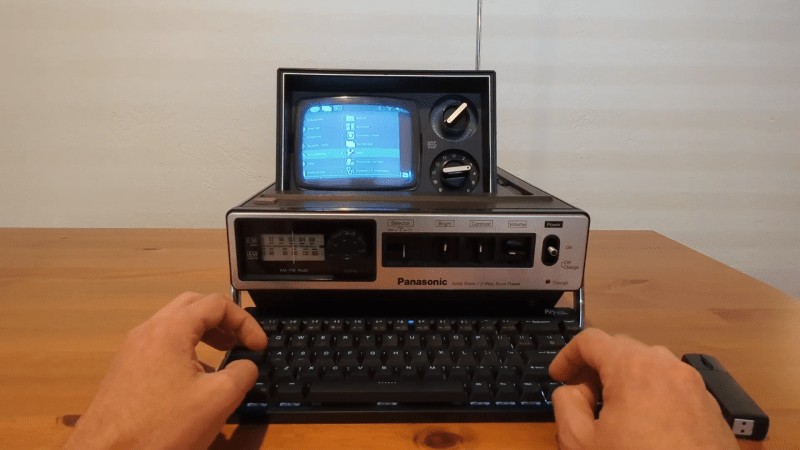
Portable CRT TV Becomes Retro Cyberdeck
These days, it’s pretty easy to slap together a single-board computer and a cheap LCD screen to whip up a cool cyberdeck fast. But what if you wanna go more retro? [Manu] found a portable TV straight out of the original Blade Runner film, and decided this would be the perfect base for a cyberdeck rocking a whole-ass CRT screen.
The build started with a Panasonic TR-545 television. Back in the day, it took many large batteries to power this thing up—no surprise given how power hungry CRTs are. This gave [Manu] a neat opportunity to sneak all the new cyberdeck hardware into the original battery tray, including a new lithium-ion battery pack that is much more compact than the original. A Raspberry Pi 5 is running the show, computer-wise, and it’s hooked up to an HDMI RF modulator that allows the video output signal to be hooked up to the TV’s original antenna input. It’s not the cleanest way to go, but it allowed [Manu] to make the mod entirely reversible. All the new hardware slots neatly into the repurposed battery tray, and can be removed quite easily without damage to this vintage specimen. Even the keyboard fits nicely into the setup, as [Manu] was able to find a suitable 60% layout foldable unit right off the shelf.
Check out the slide deck for more details on the build, but be warned—it’s a 241 MB PDF. Bonus points if you calculate what that would cost to store on a hard drive in 1979 when the Panasonic TR-545 was on the market. We’ve seen a similar build before, too, with a classic black & white Magnavox unit. If you like squinting at a tiny blurry screen, a CRT cyberdeck is absolutely the way to go. Just be warned that the other screenwriters at your local coffee shop will be more interested in your hardware than whatever you’re actually working on. Good luck with your next pitch all the same. Video after the break.
-
@landelare Can't blame OpenGL in this case. @aeva pointed out I missed an initialization function, in GTK not OpenGL, so it would have failed even if I used DirectX. Looks like the problem is me not reading the documentation correctly.
-
Software is so gigantic now, I feel like I'm back on dialup. Containers and npm are trying my patience.
-
Dalla parte del diritto all’abitare: brescia, ancora proteste nelle case popolari. nuova fase dell’agenzia per la casa
@anarchia
Dalla parte del diritto all’abitare, trasmissione quindicinale di Radio onda d’urto di informazione e approfondimento sulle lotte per la casa, contro sfratti, sgomberi e pignoramenti. In questa
-
Checked in at 튜링의사과 by @hongminhee@hollo.social
出튜
-
Istanti fatali (ebook)
@libri - C'è sempre un prima e un dopo per una scoperta matematica
-
아, 昨日이 春分이었구나.