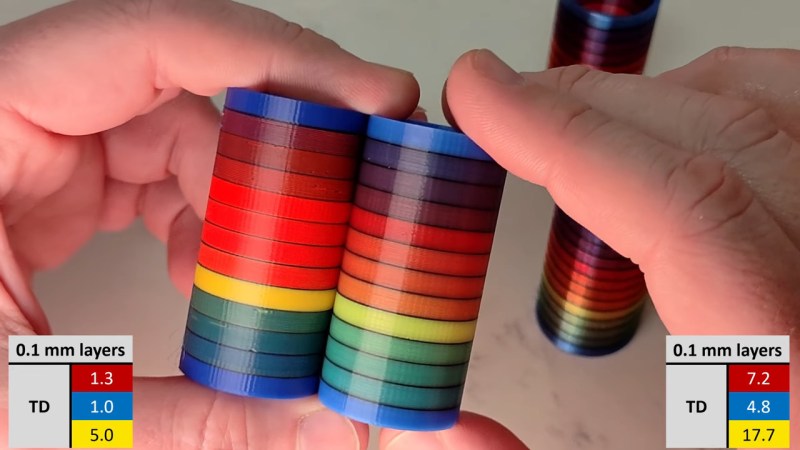
FullSpectrum is Like HueForge for 3D Models, but Bring Your ToolchangerFull-color 3D printing is something of a holy grail, if nothing else just because of how much it impresses the normies. We’ve seen a lot of multi-material units the past few years, and with Snapmaker’s U1 and the Prusa XL it looks like tool changers are coming back into vogue. Just in time, [Radoux] has a fork of OrcaSlicer called FullSpectrum that brings HueForge-like color mixing to tool changing printers.The hook behind FullSpectrum is very simple: stacking thin layers of colors, preferably with semi-translucent filament, allows for a surprising degree of mixing. The towers in the image above have only three colors: red, blue, and yellow. It’s not literally full-spectrum, but you can generate surprisingly large palettes this way. You aren’t limited to single-layer mixes, either: A-A-B repeats and even arbitrary patterns of four colors are possible, assuming you have a four-head tool changing printer like the Snapmaker U1 this is being developed for.FullSpectrum is in fact a fork of Snapmaker’s fork of OrcaSlicer, which is itself forked from Bambu Slicer, which forked off of PrusaSlicer, which originated as a fork of Slic3r. Some complain about the open-source chaos of endless forking, but you can see in that chain how much innovation it gets us — including this technique of color mixing by alternating layers.[Wombly Wonders] shows the limits of this in his video: you really want layer heights of 0.8 mm to 0.12 mm, as the standard 0.2 mm height introduces striping, particularly with opaque filaments. Depending on the colors and the overhang, you might get away with it, but thinner layers generally going to be a safer bet. Fully translucent filaments can blend a little too well at the edges, but the HueForge community — that we’ve covered previously — has already got a good handle on characterizing translucency and we’ll likely see a lot of that knowledge applied to FullSpectrum OrcaSlicer as time goes on.Now, you could probably use this technique with an multi-material unit (MMU), but the tool-changing printers are where it is going to shine because they’re so much faster at it. With the right tool-changer, it’s actually faster to run off a model mixing colors from the cyan-yellow-magenta color space that it is to print the same model with the exact colors needed loaded on an MMU. That’s unexpected, but [Wombly] does demonstrate in his video with a chicken that’s listed as taking nineteen hours on Bambu’s MakerWorld as taking under seven hours.Could this be the killer app that pushes tool-change printers into the spotlight? Maybe! Tool changing printers are nothing new, after all. We’ve even seen it done with a delta, and lots of other DIY options if you don’t fancy buying the big Prusa. If you’ve been lusting after such a beast, though, you might finally have your excuse.youtube.com/embed/uE1Su-FUvls?…hackaday.com/2026/03/17/fullsp…


 undefined oblomov@sociale.network shared this topic on