Cross-server Interactions in ActivityPub
General Discussion
9
Posts
7
Posters
27
Views
-
Cross-server Interactions in ActivityPub
So, Richard McManus asked me about how ActivityPub supports cross-server usage. As an example use case, let’s say a user with the account eric@social.example wants to comment on a photo by dionne@photos.example. In this scenario, Eric would go to the page https://photos.example/users/dionne/photos/1 and enter a comment. How would that work? I can talk about how it would work using the ActivityPub API. But I’m going to have to explain a lot about the API first!
ActivityPub’s API is how client applications interact with the data on a user’s main account server. It lets the user read data on the same or other servers, and it lets them create activities and other kinds of objects on that server that get shared (under the user’s control) with the rest of the world.
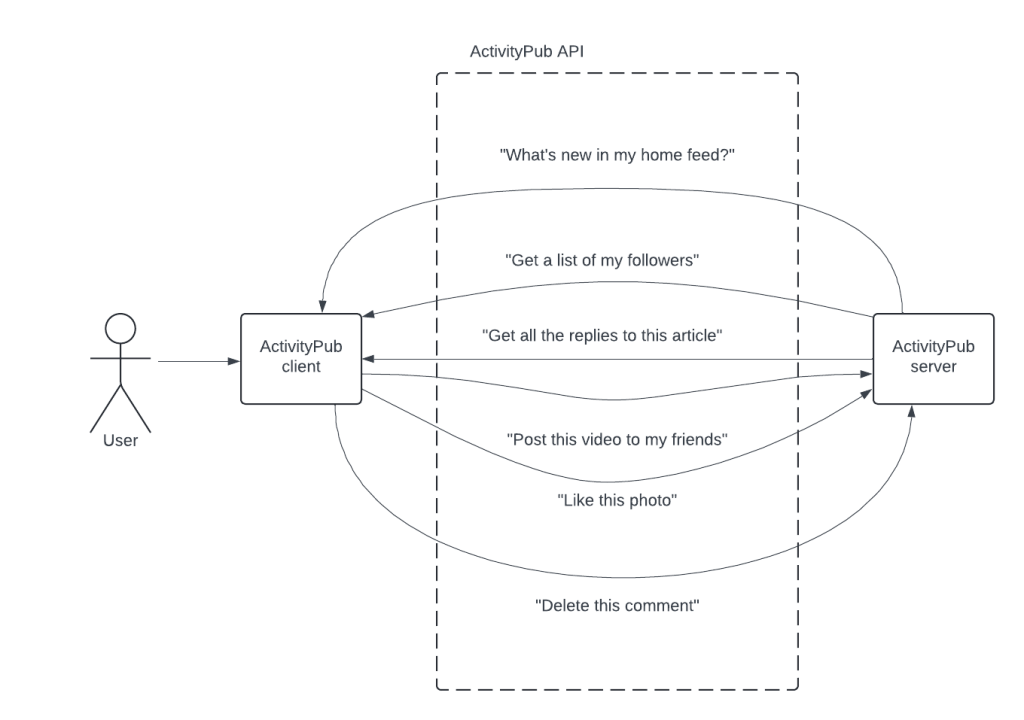
We can all kind of imagine this working for the general-purpose social apps we use — things like an Android social app. But what if we think about more special-purpose apps — applications that provide particular functionality not found in most general-purpose social clients? Let’s consider an ActivityPub enabled photo-editing tool that lets you change lighting, add cartoon characters, change your appearance, or other modifications that are often seen in “filters” on Instagram or Snap:
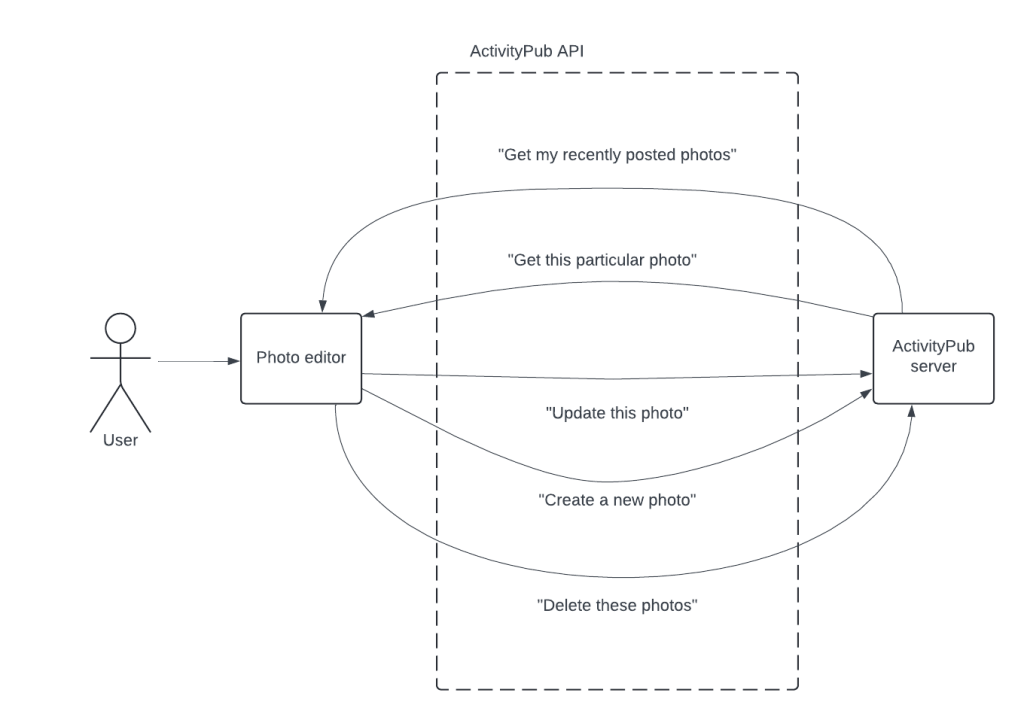
Two neat things to note: first, yes, there are control mechanisms so that remote apps can’t do just anything they want behind your back; you get control. The other thing that’s neat is that because ActivityPub is very extensible, you can have all kinds of cool apps interacting with your ActivityPub account. Games, dating, ecommerce, all kinds of stuff.
Now, what does all this have to do with cross-server interactions? Here’s the idea: when a user from social.example is browsing the web site for photos.example and wants to interact with the people or the photos, they log in and treat that remote server as if it was an ActivityPub client. Then, the ActivityPub server reports the activities back to the remote server using the ActivityPub federation protocol.
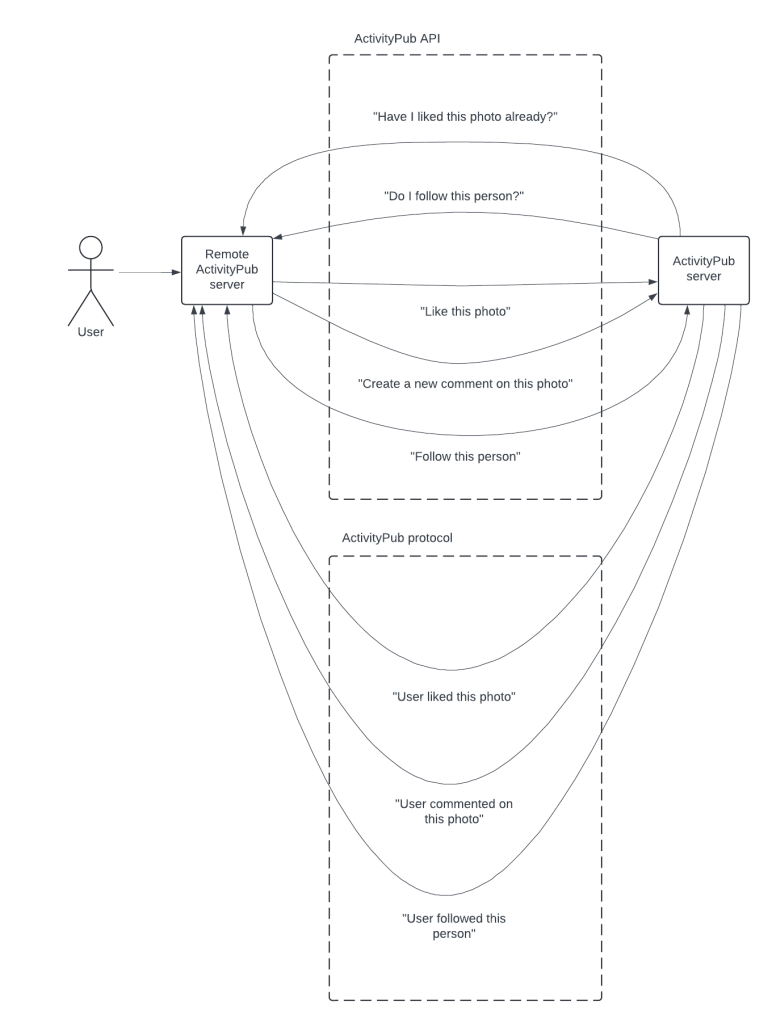
This is actually a good model that works fairly well. It makes your own ActivityPub server your real home on the social web, where all your activities go through. It’s still in development and unfolding in the ActivityPub world — not everyone supports the ActivityPub API fully, so it’s hard to see these benefits today.
This is a topic I cover in my book ActivityPub: Programming for the Social Web, so if you’re interested in more detail, please check out the book.
-
Cross-server Interactions in ActivityPub
So, Richard McManus asked me about how ActivityPub supports cross-server usage. As an example use case, let’s say a user with the account eric@social.example wants to comment on a photo by dionne@photos.example. In this scenario, Eric would go to the page https://photos.example/users/dionne/photos/1 and enter a comment. How would that work? I can talk about how it would work using the ActivityPub API. But I’m going to have to explain a lot about the API first!
ActivityPub’s API is how client applications interact with the data on a user’s main account server. It lets the user read data on the same or other servers, and it lets them create activities and other kinds of objects on that server that get shared (under the user’s control) with the rest of the world.
We can all kind of imagine this working for the general-purpose social apps we use — things like an Android social app. But what if we think about more special-purpose apps — applications that provide particular functionality not found in most general-purpose social clients? Let’s consider an ActivityPub enabled photo-editing tool that lets you change lighting, add cartoon characters, change your appearance, or other modifications that are often seen in “filters” on Instagram or Snap:
Two neat things to note: first, yes, there are control mechanisms so that remote apps can’t do just anything they want behind your back; you get control. The other thing that’s neat is that because ActivityPub is very extensible, you can have all kinds of cool apps interacting with your ActivityPub account. Games, dating, ecommerce, all kinds of stuff.
Now, what does all this have to do with cross-server interactions? Here’s the idea: when a user from social.example is browsing the web site for photos.example and wants to interact with the people or the photos, they log in and treat that remote server as if it was an ActivityPub client. Then, the ActivityPub server reports the activities back to the remote server using the ActivityPub federation protocol.
This is actually a good model that works fairly well. It makes your own ActivityPub server your real home on the social web, where all your activities go through. It’s still in development and unfolding in the ActivityPub world — not everyone supports the ActivityPub API fully, so it’s hard to see these benefits today.
This is a topic I cover in my book ActivityPub: Programming for the Social Web, so if you’re interested in more detail, please check out the book.
-
Cross-server Interactions in ActivityPub
So, Richard McManus asked me about how ActivityPub supports cross-server usage. As an example use case, let’s say a user with the account eric@social.example wants to comment on a photo by dionne@photos.example. In this scenario, Eric would go to the page https://photos.example/users/dionne/photos/1 and enter a comment. How would that work? I can talk about how it would work using the ActivityPub API. But I’m going to have to explain a lot about the API first!
ActivityPub’s API is how client applications interact with the data on a user’s main account server. It lets the user read data on the same or other servers, and it lets them create activities and other kinds of objects on that server that get shared (under the user’s control) with the rest of the world.
We can all kind of imagine this working for the general-purpose social apps we use — things like an Android social app. But what if we think about more special-purpose apps — applications that provide particular functionality not found in most general-purpose social clients? Let’s consider an ActivityPub enabled photo-editing tool that lets you change lighting, add cartoon characters, change your appearance, or other modifications that are often seen in “filters” on Instagram or Snap:
Two neat things to note: first, yes, there are control mechanisms so that remote apps can’t do just anything they want behind your back; you get control. The other thing that’s neat is that because ActivityPub is very extensible, you can have all kinds of cool apps interacting with your ActivityPub account. Games, dating, ecommerce, all kinds of stuff.
Now, what does all this have to do with cross-server interactions? Here’s the idea: when a user from social.example is browsing the web site for photos.example and wants to interact with the people or the photos, they log in and treat that remote server as if it was an ActivityPub client. Then, the ActivityPub server reports the activities back to the remote server using the ActivityPub federation protocol.
This is actually a good model that works fairly well. It makes your own ActivityPub server your real home on the social web, where all your activities go through. It’s still in development and unfolding in the ActivityPub world — not everyone supports the ActivityPub API fully, so it’s hard to see these benefits today.
This is a topic I cover in my book ActivityPub: Programming for the Social Web, so if you’re interested in more detail, please check out the book.
-
@evan @evanprodromou Thanks Evan, it sounds compelling and I look forward to reading more! Re “It makes your own ActivityPub server your real home on the Web” -> is the idea that you would host your own AP server (e.g. for me it could be at ricmac.org), or do you think managed services will emerge that offer this as a service? Or is it something you can do with your Mastodon account potentially?
-
@evan @evanprodromou Thanks Evan, it sounds compelling and I look forward to reading more! Re “It makes your own ActivityPub server your real home on the Web” -> is the idea that you would host your own AP server (e.g. for me it could be at ricmac.org), or do you think managed services will emerge that offer this as a service? Or is it something you can do with your Mastodon account potentially?
@ricmac
ActivityPub servers capable of hosting your identity at a domain of your choice, rather than the servers' own domain, are going to be a thing. Mastodon today doesn't do that. One of the few that does is @takahe - but it'll become more common for a general purpose "social" server.And then there are going to be the special purpose apps, which will also speak ActivityPub - in their domains, or yours, depending on their ops model.
@evan @evanprodromou -
@ricmac
ActivityPub servers capable of hosting your identity at a domain of your choice, rather than the servers' own domain, are going to be a thing. Mastodon today doesn't do that. One of the few that does is @takahe - but it'll become more common for a general purpose "social" server.And then there are going to be the special purpose apps, which will also speak ActivityPub - in their domains, or yours, depending on their ops model.
@evan @evanprodromou@osma @ricmac @takahe @evan @evanprodromou i'd add that @gotosocial is a really good option for own-domain activitypub server, too.
-
@ricmac
ActivityPub servers capable of hosting your identity at a domain of your choice, rather than the servers' own domain, are going to be a thing. Mastodon today doesn't do that. One of the few that does is @takahe - but it'll become more common for a general purpose "social" server.And then there are going to be the special purpose apps, which will also speak ActivityPub - in their domains, or yours, depending on their ops model.
@evan @evanprodromou@osma @takahe @evan @evanprodromou
Osma, just to note that @evanprodromou replied to you and I on his blog: https://evanp.me/2024/04/22/cross-server-interactions-in-activitypub/#comment-942 (and the fact those comments didn't flow through to Mastodon shows some of the practical issues we're dealing with!)
-
@osma @ricmac @takahe @evan @evanprodromou @gotosocial huh, interesting idea...my assumption was that takahe maintained a separate "federated timeline" for each domain it was configured with.
-
Cross-server Interactions in ActivityPub
So, Richard McManus asked me about how ActivityPub supports cross-server usage. As an example use case, let’s say a user with the account eric@social.example wants to comment on a photo by dionne@photos.example. In this scenario, Eric would go to the page https://photos.example/users/dionne/photos/1 and enter a comment. How would that work? I can talk about how it would work using the ActivityPub API. But I’m going to have to explain a lot about the API first!
ActivityPub’s API is how client applications interact with the data on a user’s main account server. It lets the user read data on the same or other servers, and it lets them create activities and other kinds of objects on that server that get shared (under the user’s control) with the rest of the world.
We can all kind of imagine this working for the general-purpose social apps we use — things like an Android social app. But what if we think about more special-purpose apps — applications that provide particular functionality not found in most general-purpose social clients? Let’s consider an ActivityPub enabled photo-editing tool that lets you change lighting, add cartoon characters, change your appearance, or other modifications that are often seen in “filters” on Instagram or Snap:
Two neat things to note: first, yes, there are control mechanisms so that remote apps can’t do just anything they want behind your back; you get control. The other thing that’s neat is that because ActivityPub is very extensible, you can have all kinds of cool apps interacting with your ActivityPub account. Games, dating, ecommerce, all kinds of stuff.
Now, what does all this have to do with cross-server interactions? Here’s the idea: when a user from social.example is browsing the web site for photos.example and wants to interact with the people or the photos, they log in and treat that remote server as if it was an ActivityPub client. Then, the ActivityPub server reports the activities back to the remote server using the ActivityPub federation protocol.
This is actually a good model that works fairly well. It makes your own ActivityPub server your real home on the social web, where all your activities go through. It’s still in development and unfolding in the ActivityPub world — not everyone supports the ActivityPub API fully, so it’s hard to see these benefits today.
This is a topic I cover in my book ActivityPub: Programming for the Social Web, so if you’re interested in more detail, please check out the book.
@evanprodromou I wish we'd also had a url handle to deal with everything. like web+ap:// but supported by everyone and used for everything, not just links.








Gli ultimi otto messaggi ricevuti dalla Federazione
-
@julian ah, ok!
-
@evan@cosocial.ca vice versa only, yes.
So from a.s I can see and browse into a SocialHub forum. SocialHub cannot see any other content from the open social web as it lacks discovery features (e.g. a timeline, user following, etc.)
A socialhub forum CAN "sync" with a threadiverse community and pull in content that way. It used to be connected to @general that way but there was too much content, and out of respect of their customs (and the relatively lower SNR compared to the local topics there), I terminated the connection.
-
@julian @strypey oh, cool. I mostly meant, I thought people could use SH to post on ap.s and vice versa.
-
Hey @strypey@mastodon.nzoss.nz (and @evan@cosocial.ca), I've cross-posted your topic to @technical-discussion
Hopefully that will kick-start some activity. Happy to discuss what Fennec is encountering... it's odd because Fennec from F-Droid was my daily driver for awhile, and I didn't have any issues... mainly push notifications were not supported.
-
@strypey can't you cross-post?
-
I love it! I also believe in the power of the alternatives and collaboration, the more open alternatives the merrier.
I would also need a very specific activitypub integration to allow to among other things show badges. As far as I understand Linkstack does not have an activitypub implementation? Maybe I am wrong.
I also love PHP, but I wanted to host it in other stack, so that is why to build the alternative.
-
@mapache @badgefed Yes, I am interested to test. For functionality, and even accessibility - but isn't there Linkstack already?