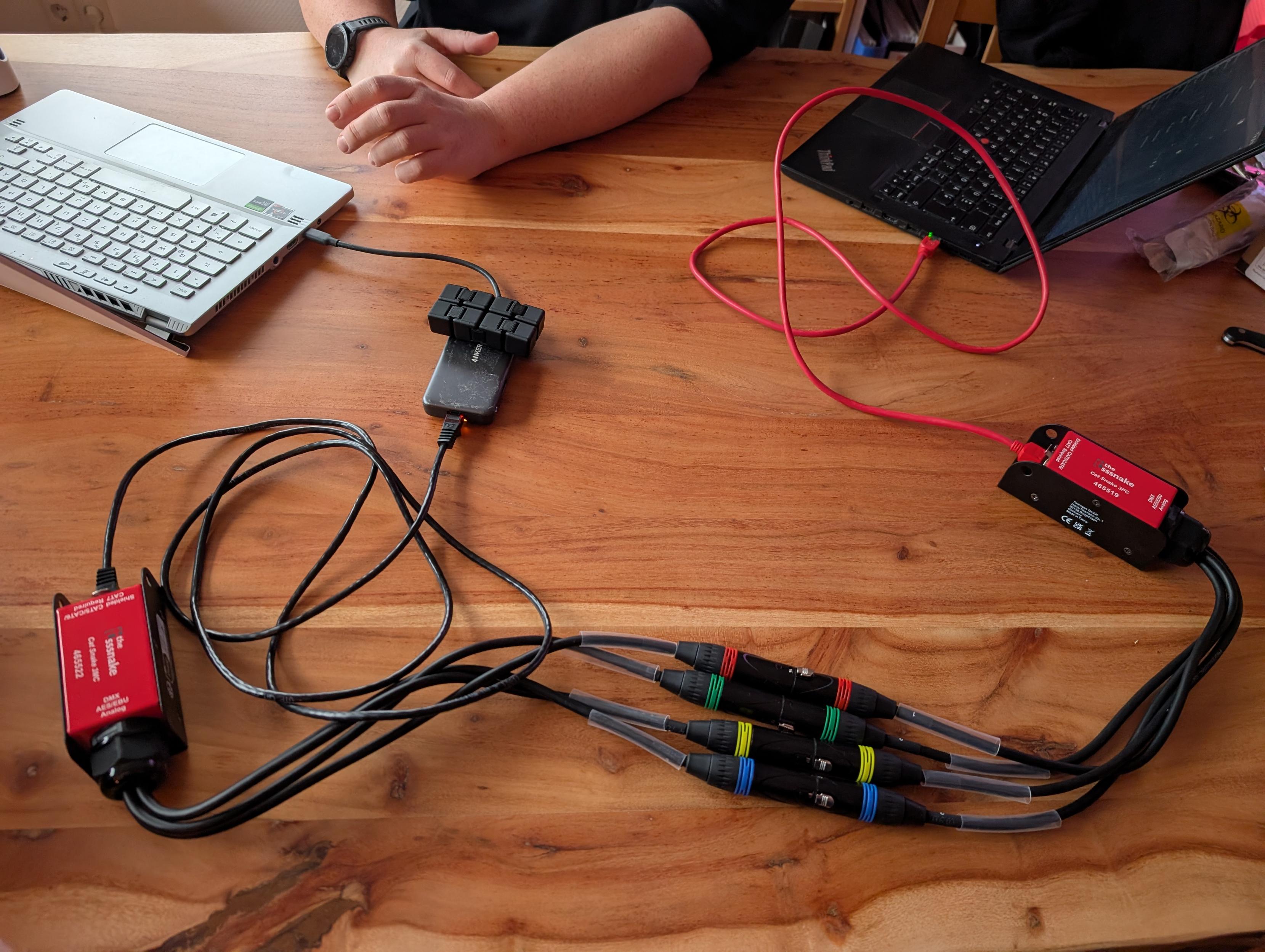
Ethernet over XLR works :3
Uncategorized
46
Posts
31
Posters
0
Views
-
@aurora are there preinstalled shrink tubes on the cable in case it breaks somewhere or sth?!
If yes that's sooo good, I wish more cables had that
@henry_null according to the manual those are intended for labeling
-
@wolf480pl @simon_m @rojun @aurora slightly related stupid idea is USB through ethernet cable. I can confirm it does not work well, of course I tried it. https://www.ondrovo.com/a/20220215-sdr-nooelec/
-
Ethernet over XLR works :3
@aurora is that a fidget cube on the left and if yes, is it mandatory for this setup?
(in all seriousness: wow, so cool!)
-
Ethernet over XLR works :3
@aurora are those off the shelf adapters that are usually used to do the exact opposite? (I know, CAT and Ethernet are not the same, but for the sake of this shitpost I guess it's fine to say so).
-
I wouldn't be surprised if this goes far beyond the typical standards because XLR is shielded Coax which, I think, is superior to S/FTP.
The problem is probably the connector, not the cable length itself.
@simon_m @wolf480pl @aurora also, if you use XLR cables for DMX, you’ll get even better results than with standard XLR for analog audio, since the XLR for digital purposes usually needs far better shielding and signal integrity as well.
-
Ethernet over XLR works :3
@aurora@queer-lexikon.net I mean... XLR is just coax cable. Ethernet is made to run on coax cables.
This is just Ethernet over four twisted pairs. -
no, USB does not do symmetrical signalling.
so probably
TP < coax < symmetric signalling < the "star quad" which until today didn't know exists
-
Ethernet over XLR works :3
@aurora …is this Dante
-
Ethernet over XLR works :3
@aurora I'd like to put a tester on that, and hear how much it screams in pain. xD
-
no, USB does not do symmetrical signalling.
so probably
TP < coax < symmetric signalling < the "star quad" which until today didn't know exists
@simon_m @wolf480pl @aurora @rojun @MrDOS ooooh!
Also, one star quad would easily suffice for 100 Mbit/s.
-
@aurora@queer-lexikon.net I mean... XLR is just coax cable. Ethernet is made to run on coax cables.
This is just Ethernet over four twisted pairs.XLR is designed to carry analog audio over long distances where electrical interface in the audible spectrum is an issue. They solve it by sending an inverted signal alongside the normal one* so in theory if you double the number of connections and use that technique you could run a cable hundreds of metres long.
* other techniques are available.
-
Ethernet over XLR works :3
@aurora This has been a fairly common solution for running more modern lighting & sound protocols across legacy infrastructure cabling in entertainments venues for quite a while I think!
-
no, USB does not do symmetrical signalling.
so probably
TP < coax < symmetric signalling < the "star quad" which until today didn't know exists
-
Ethernet over XLR works :3
@aurora Fun fact: The other way also works. You can send analog audio via XLR -> Cat5e -> XLR without issues (and without big audio loss).
-
Ethernet over XLR works :3
@aurora I love you’re using those adapters opposite of how they would likely be used in a broadcast or live event system.
-
@aurora This has been a fairly common solution for running more modern lighting & sound protocols across legacy infrastructure cabling in entertainments venues for quite a while I think!
@karyxdragon @aurora it’s more for sending multiple signals (DMX, AES/EBU, analog audio, etc) over one cable rather than four. Since it’s just a passive adapter that takes the Cat cable’s twisted pairs and breaks it out to four 3-pin XLRs pins 1 and 2. It seems like the shield is shared across all four XLRs.
-
Ethernet over XLR works :3
@aurora I hope that you heard about EtherCON. =)
Cool, btw.
-
@aurora this means you could run Art-Net over an audio snake... >:)
@aurora @aedancullen that is deeply disturbing.
Has most probably happened at a gig somewhere! -
@aurora Fun fact: The other way also works. You can send analog audio via XLR -> Cat5e -> XLR without issues (and without big audio loss).
@fx that is indeed what those adapters are actually designed to do^^
-
@aurora are those off the shelf adapters that are usually used to do the exact opposite? (I know, CAT and Ethernet are not the same, but for the sake of this shitpost I guess it's fine to say so).
@jonas exactly yea



















Feed RSS
Gli ultimi otto messaggi ricevuti dalla Federazione
-
@aeva I'm thinking Waiting For Godot might be God's peed aka on an extended bio break (look, the teriyaki place's always been fine before; but yesterday, apparently, less fine)
-
@rygorous it has many contextually dependent mutually contradictory interpretations the way I use it. if we're talking king of kings god it's infinity + 1 speeds per second. if we're talking a god with more of a Waiting For Godot vibe, then perhaps we're on more of an epsilon per second timescale
-
@aeva where on the speed of sound to ludicrous speed continuum is godspeed?
-
Quasi sapiens (ebook)
@libri - La storia dell'umanità in pillole, con qualche spunto non banale
-
@aeva how do I get your phone's autocorrect on my phone? This one thinks I want to talk about waterfowl all the time.
-
@aeva Makes more sense to me. Still not fond of phones.
-
stay ahead of your debate opponent by simply being correct about politics. follow me for more tips
-
my phone tried to autocorrect "god speed" to "god died" just now