Geez, reactive DOM systems really are not very good at displaying long lists of items are they
Uncategorized
3
Posts
3
Posters
0
Views
-
Geez, reactive DOM systems really are not very good at displaying long lists of items are they
-
Geez, reactive DOM systems really are not very good at displaying long lists of items are they
@mcc DOM nodes with a lot of children are painful in general. Working around those pain points with a custom reactive component trades off for different pain points. Ask me how I know. 🙃
It would be nice if browsers worked on making DOM nodes with lots of children work better, but I get why they don’t. “Who in their right mind would want a table with 300,000 rows?”
-
Geez, reactive DOM systems really are not very good at displaying long lists of items are they
@mcc to be fair, this has always sucked in every GUI system
-
 undefined oblomov@sociale.network shared this topic



Feed RSS
Gli ultimi otto messaggi ricevuti dalla Federazione
-
@danjones000 @Matt_Noyes It does not hurt to try to reduce those emissions; reducing any emissions is good.
But shaming people for using AI as if they are solely responsible for climate change is intellectually dishonest.
There are plenty of other problems with AI; "burning up the planet" is not a convincing one.
-
Quieting Noisy Resistors
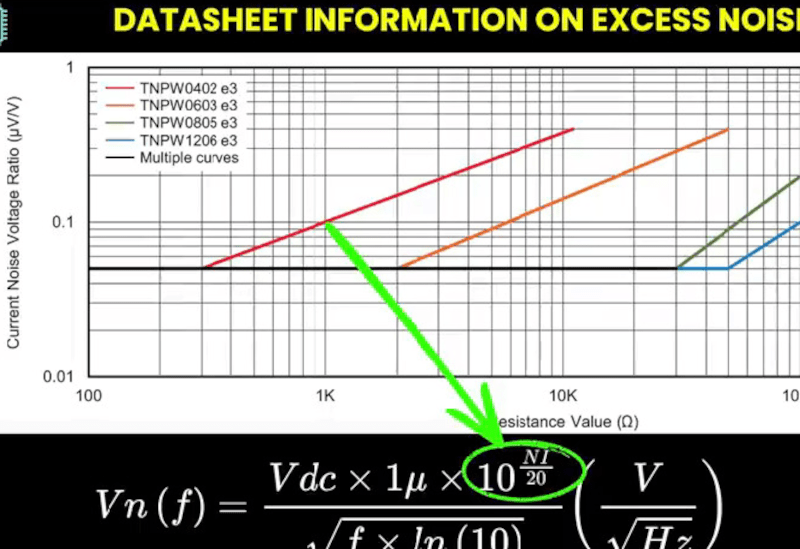
[Hans Rosenberg] has a new video talking about a nasty side effect of using resistors: noise. If you watch the video below, you’ll learn that there are two sources of resistor noise: Johnson noise, which doesn’t depend on the construction of the resistor, and 1/f noise, which does vary depending on the material and construction of the resistor.
In simple terms, some resistors use materials that cause electron flow to take different paths through the resistor. That means that different parts of the signal experience slightly different resistance values. In simple applications, it won’t matter much, but in places where noise is an important factor, the 1/f or excess noise contributes more to errors than the Johnson noise at low frequencies.
[Hans] doesn’t just talk the math. He also built a simple test rig that lets him measure the 1/f noise with some limitations. While you might pretend that all resistors are the same, the test shows that thick film resistors produce much more noise than other types.
The video shows some rule-of-thumb lists indicating which resistors have better noise figures than others. Of course, resistors are only one source of noise in circuits. But they are so common that it is easy to forget they aren’t as perfect as we pretend in our schematics.
Want to learn more about noise? We can help. On the other hand, noise isn’t always a bad thing.
-
@sako this looks so beautiful!
-
@danjones000 @Matt_Noyes electricity is only about 1/3 of global emissions. All data centers, including AI datacenters, are only 1% of electricity usage. That makes 0.3% of total emissions.
Much more emissions are due to cars, meat, cement production and rice cultivation.
I recognize that AI has a lot of electricity use; it is nothing compared to the other things you do with your time.
-
Energy from training
-
Oh no, Deep Space Nine auto-played after Starfleet Academy. Now I have to watch the whole thing for the third or fourth time. No other option, I guess.
-
Another application for AI. Have an AI bot go to a conference for me and listen to everything. Only tell me about the things that I would be interested in.
-
@evan@cosocial.ca The article that @Matt_Noyes@social.coop posted in the thread pretty clearly laid out the massive amount of electricity that AI data centers are using. That article isn't the only one saying the same thing. AI is using massive amounts of power.
Traditional server racks consume 5-15 kW, while AI-optimized racks with high-performance GPUs require 40-60+ kW. Some cutting-edge AI training facilities are pushing individual racks to 100+ kW, fundamentally changing data center design and cooling requirements. (ref)
It doesn't really matter if the power is coming from requests to the API, running the models, training the models, or making ritual sacrifices to Baphomet in hopes of making the models sentient.
If someone is using AI, they are indirectly contributing to that power usage. If you can acknowledge that and make peace with it, fine. But, saying that the energy cost is minimal in light of this is ignoring reality.