Virus-Based Thermoresponsive Separation of Rare-Earth Elements
Uncategorized
1
Posts
1
Posters
2
Views
-
Virus-Based Thermoresponsive Separation of Rare-Earth Elements
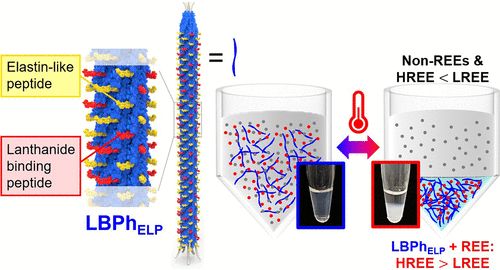
Although rare-earth elements (REEs) are not very rare, their recovery and purification is very cumbersome, with no significant concentrations that would help with mining. This does contribute to limiting their availability, but there might be more efficient ways to recover these REEs. One such method involves the use of a bacteriophage that has been genetically modified to bind to specific REEs and release them based on thermal conditions.
The primary research article in Nano Letters is sadly paywalled, but the supporting information PDF gives some details. We can also look at the preceding article (full PDF) by [Inseok Chae] et al. in Nano Letters from 2024, in which they cover the binding part using a lanthanide-binding peptide (LBP) that was adapted from Methylobacterium extorquens.
With the new research an elastin-like peptide (ELP) was added that has thermoresponsive responsive properties, allowing the triggering of coacervation after the phages have had some time in the aqueous REE containing solution. The resulting slurry makes it fairly easy to separate the phages from the collected REE ions, with the phages ready for another cycle afterwards. Creating more of these modified phages is also straightforward, with the papers showing the infecting of E. coli to multiply the phages.
Whether the recovery rate and ability to scale makes it an economically feasible method of REE recovery remains to be seen, but it’s definitely another fascinating use of existing biology for new purposes.

Gli ultimi otto messaggi ricevuti dalla Federazione
-
E un altro anno è iniziato. Auguri a tutti!!
-
Il razzo SLS della missione Artemis 2 proiettato sul Washington Monument. Il 2026 sarà l'anno della Luna. Si avvicina il primo lancio di astronauti verso il nostro satellite dal 1972. La sorvoleranno testando i sistemi per preparare l'allunaggio con la missione seguente. Foto NASA/Bill Ingals
https://www.flickr.com/photos/nasahqphoto/55016654116/in/album-72177720331210302
-
Chi #manmaggia a capodanno…
-
A joyful close-up of an evergreen would be a Happy Yew Near.
-
Buon anno regà! Vojo inizzià questo 2026 faciendovi tante belle promesse che sò le stesse de gli anni scorsi e che verano piaciute tanto!
Questo sarà l'anno che costruiremo er Ponte, supereremo la Fornero, abboliremo le accise, e tante belle cose così
Bevetevele tutte con un buon prosecco! Auguri! 🥂 ❤️
https://www.ilpost.it/2025/12/31/meloni-promesse-mancate-accise-ponte-tasse-pensioni/
-
The Many-Sprites Interpretation of Amiga Mechanics
The invention of sprites triggered a major shift in video game design, enabling games with independent moving objects and richer graphics despite the limitations of early video gaming hardware. As a result, hardware design was specifically built to manipulate sprites, and generally as new generations of hardware were produced the number of sprites a system could produce went up. But [Coding Secrets], who published games for the Commodore Amiga, used an interesting method to get this system to produce far more sprites at a single time than the hardware claimed to support.
This hack is demonstrated with [Coding Secrets]’s first published game on the Amiga, Leander. Normally the Amiga can only display up to eight sprites at once, but there is a coprocessor in the computer that allows for re-drawing sprites in different areas of the screen. It can wait for certain vertical and horizontal line positions and then execute certain instructions. This doesn’t allow unlimited sprites to be displayed, but as long as only eight are displayed on any given line the effect is similar. [Coding Secrets] used this trick to display the information bar with sprites, as well as many backgrounds, all simultaneously with the characters and enemies we’d normally recognize as sprites.
Of course, using built-in hardware to do something the computer was designed to do isn’t necessarily a hack, but it does demonstrate how intimate knowledge of the system could result in a much more in-depth and immersive experience even on hardware that was otherwise limited. It also wasn’t free to use this coprocessor; it stole processing time away from other tasks the game might otherwise have to perform, so it did take finesse as well. We’ve seen similar programming feats in other gaming projects like this one which gets Tetris running with only 1000 lines of code.
youtube.com/embed/YdeUebxTt5M?…
Thanks to [Keith] for the tip!
-
Odd lang syne, Mastodon.
-
Happy New Year!!!