Skip to content

Piero Bosio Social Web Site Personale Logo Fediverso

Social Forum federato con il resto del mondo. Non contano le istanze, contano le persone

Energy from training

Uncategorized
1 1 2

Gli ultimi otto messaggi ricevuti dalla Federazione
  • Quizzino della domenica: dadi riordinati

    @matematica - Riordinare i dadi non è sempre facile.

    https://wp.me/p6hcSh-9j3

    read more

  • @danjones000 @Matt_Noyes It does not hurt to try to reduce those emissions; reducing any emissions is good.

    But shaming people for using AI as if they are solely responsible for climate change is intellectually dishonest.

    There are plenty of other problems with AI; "burning up the planet" is not a convincing one.

    read more

  • Quieting Noisy Resistors

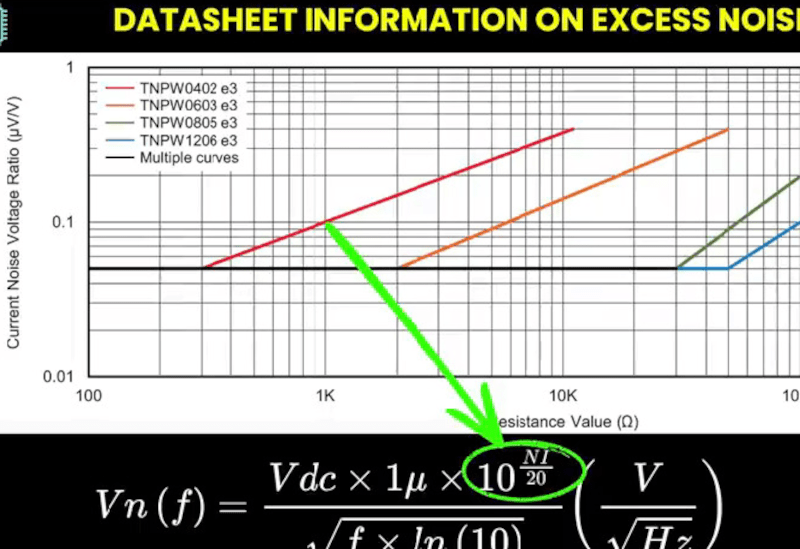
    [Hans Rosenberg] has a new video talking about a nasty side effect of using resistors: noise. If you watch the video below, you’ll learn that there are two sources of resistor noise: Johnson noise, which doesn’t depend on the construction of the resistor, and 1/f noise, which does vary depending on the material and construction of the resistor.

    In simple terms, some resistors use materials that cause electron flow to take different paths through the resistor. That means that different parts of the signal experience slightly different resistance values. In simple applications, it won’t matter much, but in places where noise is an important factor, the 1/f or excess noise contributes more to errors than the Johnson noise at low frequencies.

    [Hans] doesn’t just talk the math. He also built a simple test rig that lets him measure the 1/f noise with some limitations. While you might pretend that all resistors are the same, the test shows that thick film resistors produce much more noise than other types.

    The video shows some rule-of-thumb lists indicating which resistors have better noise figures than others. Of course, resistors are only one source of noise in circuits. But they are so common that it is easy to forget they aren’t as perfect as we pretend in our schematics.

    Want to learn more about noise? We can help. On the other hand, noise isn’t always a bad thing.

    youtube.com/embed/omn_Lh0MLA4?…

    hackaday.com/2026/02/21/quieti…

    read more

  • @sako this looks so beautiful!

    read more

  • @danjones000 @Matt_Noyes electricity is only about 1/3 of global emissions. All data centers, including AI datacenters, are only 1% of electricity usage. That makes 0.3% of total emissions.

    Much more emissions are due to cars, meat, cement production and rice cultivation.

    I recognize that AI has a lot of electricity use; it is nothing compared to the other things you do with your time.

    read more

  • Energy from training

    read more

  • Oh no, Deep Space Nine auto-played after Starfleet Academy. Now I have to watch the whole thing for the third or fourth time. No other option, I guess.

    read more

  • Another application for AI. Have an AI bot go to a conference for me and listen to everything. Only tell me about the things that I would be interested in.

    read more
Post suggeriti
  • Quizzino della domenica: dadi riordinati

    Uncategorized
    1
    0 Votes
    1 Posts
    0 Views
    Quizzino della domenica: dadi riordinati @matematica - Riordinare i dadi non è sempre facile.https://wp.me/p6hcSh-9j3
  • Quieting Noisy Resistors

    Uncategorized
    1
    1
    0 Votes
    1 Posts
    1 Views
    Quieting Noisy Resistors[Hans Rosenberg] has a new video talking about a nasty side effect of using resistors: noise. If you watch the video below, you’ll learn that there are two sources of resistor noise: Johnson noise, which doesn’t depend on the construction of the resistor, and 1/f noise, which does vary depending on the material and construction of the resistor.In simple terms, some resistors use materials that cause electron flow to take different paths through the resistor. That means that different parts of the signal experience slightly different resistance values. In simple applications, it won’t matter much, but in places where noise is an important factor, the 1/f or excess noise contributes more to errors than the Johnson noise at low frequencies.[Hans] doesn’t just talk the math. He also built a simple test rig that lets him measure the 1/f noise with some limitations. While you might pretend that all resistors are the same, the test shows that thick film resistors produce much more noise than other types.The video shows some rule-of-thumb lists indicating which resistors have better noise figures than others. Of course, resistors are only one source of noise in circuits. But they are so common that it is easy to forget they aren’t as perfect as we pretend in our schematics.Want to learn more about noise? We can help. On the other hand, noise isn’t always a bad thing.youtube.com/embed/omn_Lh0MLA4?…hackaday.com/2026/02/21/quieti…
  • 0 Votes
    1 Posts
    0 Views
    Oh no, Deep Space Nine auto-played after Starfleet Academy. Now I have to watch the whole thing for the third or fourth time. No other option, I guess.
  • 0 Votes
    5 Posts
    1 Views
    @danjones000 @Matt_Noyes It does not hurt to try to reduce those emissions; reducing any emissions is good. But shaming people for using AI as if they are solely responsible for climate change is intellectually dishonest.There are plenty of other problems with AI; "burning up the planet" is not a convincing one.