The Engineer Who Tried to Put Age Verification Into Linux
Uncategorized
36
Posts
25
Posters
0
Views
-
The Engineer Who Tried to Put Age Verification Into Linux
https://www.sambent.com/the-engineer-who-tried-to-put-age-verification-into-linux-5/
The lasting damage was knowing it could happen at all: that a single contributor with no stated organizational backing could submit compliance infrastructure for surveillance law directly into the software that boots your computer, get it merged by two Microsoft employees, and have the creator of systemd personally block the removal.
-
The Engineer Who Tried to Put Age Verification Into Linux
https://www.sambent.com/the-engineer-who-tried-to-put-age-verification-into-linux-5/
The lasting damage was knowing it could happen at all: that a single contributor with no stated organizational backing could submit compliance infrastructure for surveillance law directly into the software that boots your computer, get it merged by two Microsoft employees, and have the creator of systemd personally block the removal.
@Khrys (disclaimer: IANALAIDEPOOTV)
One remark and one comment:
Remark: the title says "tried to", the article says did -- and Poettering blocked a revert.
Comment: in countries where the GDPR applies, the feature appears contrary to article 5 as overbroad, even probably purposeless *per se* ; maybe also contrary to recent European decisions against generalized citizen data collection, too.
-
@Khrys (disclaimer: IANALAIDEPOOTV)
One remark and one comment:
Remark: the title says "tried to", the article says did -- and Poettering blocked a revert.
Comment: in countries where the GDPR applies, the feature appears contrary to article 5 as overbroad, even probably purposeless *per se* ; maybe also contrary to recent European decisions against generalized citizen data collection, too.
-
The Engineer Who Tried to Put Age Verification Into Linux
https://www.sambent.com/the-engineer-who-tried-to-put-age-verification-into-linux-5/
The lasting damage was knowing it could happen at all: that a single contributor with no stated organizational backing could submit compliance infrastructure for surveillance law directly into the software that boots your computer, get it merged by two Microsoft employees, and have the creator of systemd personally block the removal.
@Khrys
I just don't know what do to with this information. 🤔 -
@Khrys
I just don't know what do to with this information. 🤔@sebsauvage @Khrys Comme je le commentais sur SeenThis dans la semaine, c'est la première vraie démonstration qu'il y a un problème avec systemd et que ce n'est donc finalement pas qu'un problème technique, et qu'il y a aussi un problème politique.
-
The Engineer Who Tried to Put Age Verification Into Linux
https://www.sambent.com/the-engineer-who-tried-to-put-age-verification-into-linux-5/
The lasting damage was knowing it could happen at all: that a single contributor with no stated organizational backing could submit compliance infrastructure for surveillance law directly into the software that boots your computer, get it merged by two Microsoft employees, and have the creator of systemd personally block the removal.
I don't understand what the fuss is about. This is exactly the right way to comply with that law: an optional birth date field. You don't want to have to submit an idea to your OS or implement facial recognition, and you certainly don't want to tie account creation to external services for those things, but now parents can fill in the birth date for their kids, and everybody else can ignore it. This kind of thing needs to be in the hands of parents, not external companies.
So I don't really see the problem here.
-
I don't understand what the fuss is about. This is exactly the right way to comply with that law: an optional birth date field. You don't want to have to submit an idea to your OS or implement facial recognition, and you certainly don't want to tie account creation to external services for those things, but now parents can fill in the birth date for their kids, and everybody else can ignore it. This kind of thing needs to be in the hands of parents, not external companies.
So I don't really see the problem here.
The lasting damage was knowing it could happen at all: that a single contributor with no stated organizational backing could submit compliance infrastructure for surveillance law directly into the software that boots your computer, get it merged by two Microsoft employees, and have the creator of systemd personally block the removal.
What the hell is the issue here? Do you need to be a member of an organization to submit a PR? And if the lack of organisational backing would be a problem, why is it a problem that the people merging it do work for an organisation? The only thing that matters is that an official committer approves it.This whole article sounds like pointless fear mongering. If there's anything else to it that I'm missing, I'd love for someone to explain it.
-
The Engineer Who Tried to Put Age Verification Into Linux
https://www.sambent.com/the-engineer-who-tried-to-put-age-verification-into-linux-5/
The lasting damage was knowing it could happen at all: that a single contributor with no stated organizational backing could submit compliance infrastructure for surveillance law directly into the software that boots your computer, get it merged by two Microsoft employees, and have the creator of systemd personally block the removal.
@Khrys we like to think of FOSS as some sort of anarchist collective°. it never has been.
it's run by a series of people with absolute power, for the most part. the benefit is that it's a lot of tiny dictators rather than a few big ones; that in theory anyone can become one, you don't need to be rich; and that these dictators tend to have technical knowledge.
but they can still be arseholes.
° i mean, we might not CALL it that.
-
I don't understand what the fuss is about. This is exactly the right way to comply with that law: an optional birth date field. You don't want to have to submit an idea to your OS or implement facial recognition, and you certainly don't want to tie account creation to external services for those things, but now parents can fill in the birth date for their kids, and everybody else can ignore it. This kind of thing needs to be in the hands of parents, not external companies.
So I don't really see the problem here.
-
Je ne crois pas avoir suggéré un rapport (encore moins spécifiquement avec une question "du qui et du pourquoi" dont j'ignorais qu'elle était posée), mais pour éviter toute confusion, j'edite mon post.
-
But no single person can force this into the code, right? Someone submitted a PR, and two committers approved it, one of them the creator of the project, as far as I understand. If that's not good enough, then what is?
Of course discussion about this important, but can we do that without panic and fear mongering?
-
@Khrys
I just don't know what do to with this information. 🤔Que le libre fonctionne comme il est censé le faire ?
Un contributeur voit un problème (réel : les lois sur la vérification de l'âge, poussée par Meta), propose une solution (bonne ou mauvaise, à débattre) qui est acceptée par certains projets, ce qui déclenche une shitstorm (bon cet aspect là est moins "comme le libre est censé fonctionner" que "comme il fonctionne en vrai") et le BDL ferme le ticket en disant "c'est optionnel donc chacun reste libre". -
The Engineer Who Tried to Put Age Verification Into Linux
https://www.sambent.com/the-engineer-who-tried-to-put-age-verification-into-linux-5/
The lasting damage was knowing it could happen at all: that a single contributor with no stated organizational backing could submit compliance infrastructure for surveillance law directly into the software that boots your computer, get it merged by two Microsoft employees, and have the creator of systemd personally block the removal.
@Khrys what do you mean, tried? He succeeded, with the complicity of even bigger idiot Poettering.
-
Je ne crois pas avoir suggéré un rapport (encore moins spécifiquement avec une question "du qui et du pourquoi" dont j'ignorais qu'elle était posée), mais pour éviter toute confusion, j'edite mon post.
@aaribaud À mon avis, cet article a comme sujet "Ce type décide d'ajouter une pseudo-fonctionnalité de vérification d'âge par collaboration. Dans quel but ?", pas "La législation de vérification d'âge ne respecte pas la limitation de collecte généralisée de données sur les citoyens, européens ou non."
-
@aaribaud À mon avis, cet article a comme sujet "Ce type décide d'ajouter une pseudo-fonctionnalité de vérification d'âge par collaboration. Dans quel but ?", pas "La législation de vérification d'âge ne respecte pas la limitation de collecte généralisée de données sur les citoyens, européens ou non."
@CypherSephiroth Ton avis semble fondé. Mais en quoi le supposé angle de l'article sur les faits décrits interdit-il de faire des commentaires sur ces faits sous un autre angle ?
-
But no single person can force this into the code, right? Someone submitted a PR, and two committers approved it, one of them the creator of the project, as far as I understand. If that's not good enough, then what is?
Of course discussion about this important, but can we do that without panic and fear mongering?
-
The Engineer Who Tried to Put Age Verification Into Linux
https://www.sambent.com/the-engineer-who-tried-to-put-age-verification-into-linux-5/
The lasting damage was knowing it could happen at all: that a single contributor with no stated organizational backing could submit compliance infrastructure for surveillance law directly into the software that boots your computer, get it merged by two Microsoft employees, and have the creator of systemd personally block the removal.
@Khrys https://agelesslinux.org/ je préfère cette approche
-
The Engineer Who Tried to Put Age Verification Into Linux
https://www.sambent.com/the-engineer-who-tried-to-put-age-verification-into-linux-5/
The lasting damage was knowing it could happen at all: that a single contributor with no stated organizational backing could submit compliance infrastructure for surveillance law directly into the software that boots your computer, get it merged by two Microsoft employees, and have the creator of systemd personally block the removal.
@Khrys Open source's entire threat model assumed contributors act toward user freedom. The surveillance state runs on volunteers: people who do the implementation work for free, out of genuine conviction, with no paper trail connecting them to the money that wrote the laws.
-
-
The Engineer Who Tried to Put Age Verification Into Linux
https://www.sambent.com/the-engineer-who-tried-to-put-age-verification-into-linux-5/
The lasting damage was knowing it could happen at all: that a single contributor with no stated organizational backing could submit compliance infrastructure for surveillance law directly into the software that boots your computer, get it merged by two Microsoft employees, and have the creator of systemd personally block the removal.
@Khrys @pluralistic best argument for removing systemd (and I actually like systemd).















Gli ultimi otto messaggi ricevuti dalla Federazione
-
L'istanza poliversity.it è invece quella con la crescita più rapida.
Poter creare post lunghi e formattati è valore aggiunto di questa versione potenziata di #Mastodon e consente gratuitamente quello che con X costerebbe diversi dollari a settimana!
Ringraziamo soprattutto quegli utenti italiani di Mastodon che abitavano presso istanze straniere e ch hanno deciso di trasferirsi da noi ❤️
https://poliversity.it
@fediverso./.
-
L'istanza #Friendica poliverso.org ci sta dando le maggiori soddisfazioni.
Oggi è stabilmente la quarta istanza social più attiva del Fediverso italiano.
La nuova release ha mantenuto molt delle promesse, migliorando la velocità, l'integrazione con #Bluesky e la gestione dei filtri.
Friendica è l'unico software del Fediverso che gestisce la visibilità dei post differenziata per cerchie di contatti (follower, amici, colleghi, compagni di club, etc)
./.
-
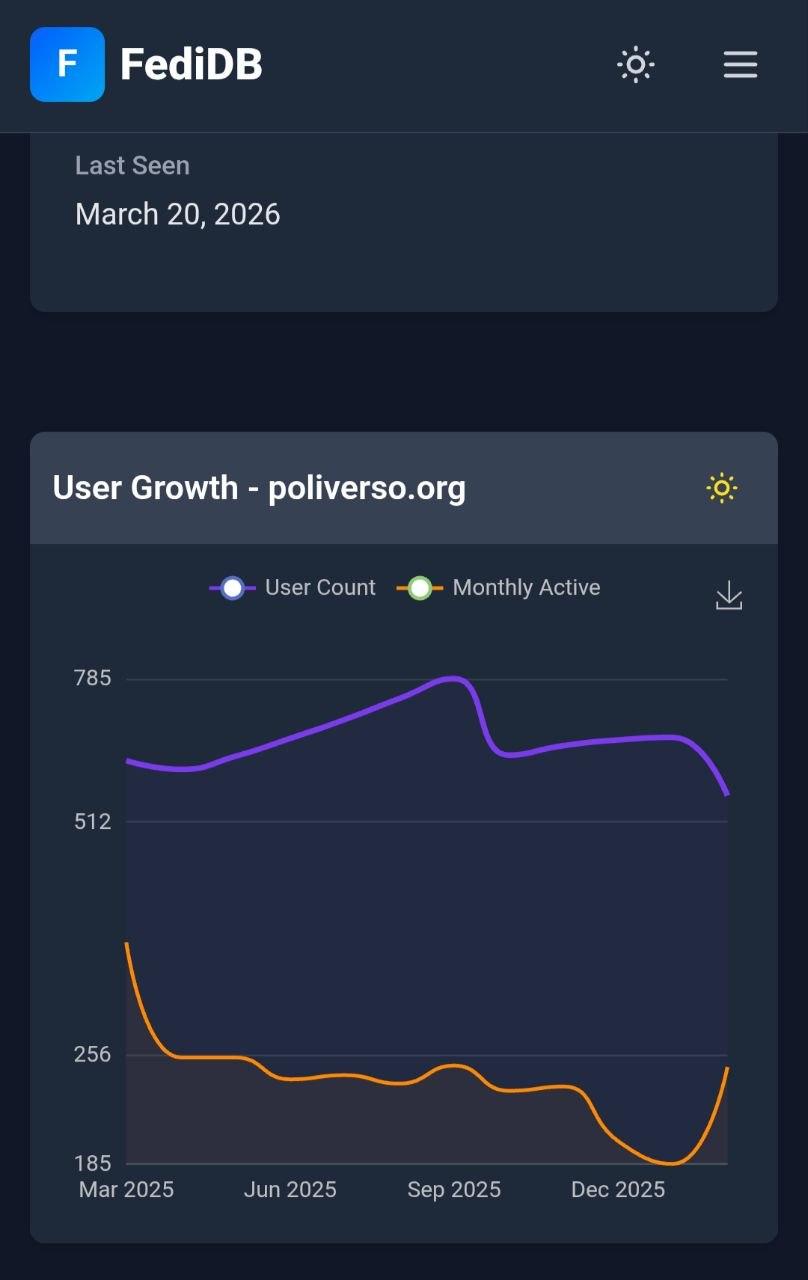
La crescita del Fediverso italiano è tangibile anche nelle nostre 4 istanze
Nell'ultimo mese abbiamo riscontrato un importante incremento degli utenti:
 poliverso.org: 247 utenti attivi
 poliversity.it: 194 utenti attivi
  feddit.it: 145 utenti attivi
🏙️ citiverse.it: 37 utanti attiviInoltre grazie a tutti gli utenti che taggano le categorie di citiverse e feddit, il servizio https://fedinews.it è diventato un fantastico portale di notizie!
./.
-
@eniko was a vibrator involved?
-
@pierobosio grazie!
-
@amoroso Me too. Some I have in my collection are my own old machines, some I've had to reacquire when my teenage old stuff was thrown away as "junk".
-
@G3rt mi chiedo quando la si smetterà, nel piccolo occidente, con questo senso di colpa che ci fa sentire causa di tutti i mali del mondo.
-
@apzpins I owned one of those laptops back in the day.