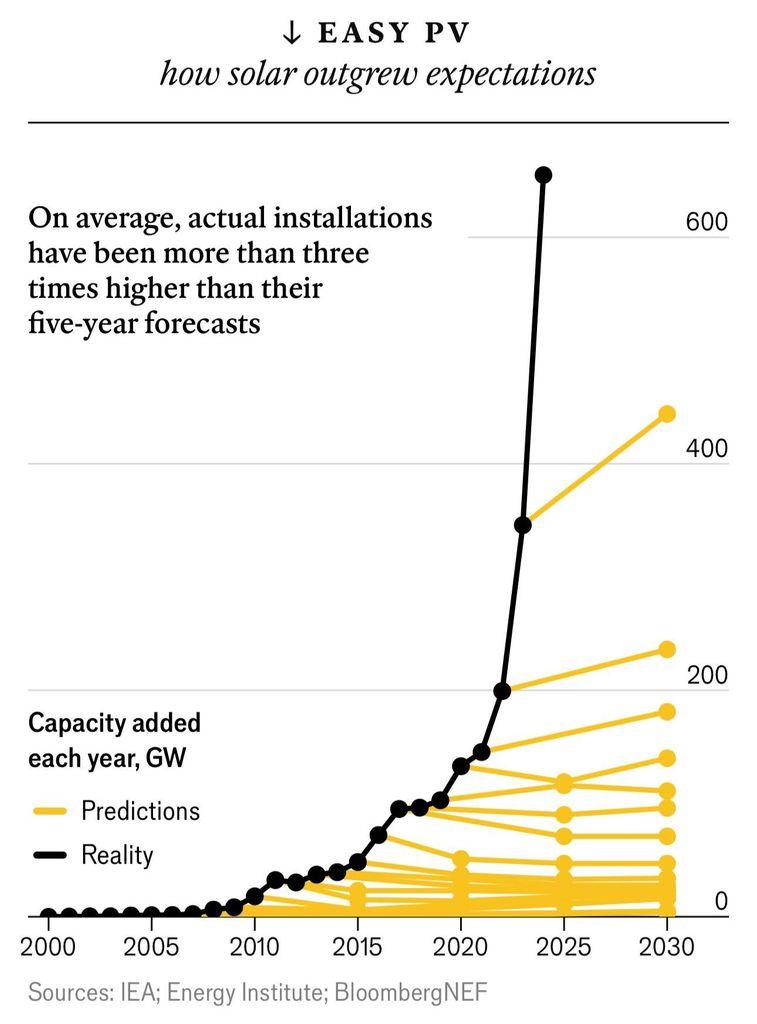
The world’s solar capacity reached 1,419 gigawatts in 2023, way beyond any predictions.
Uncategorized
57
Posts
29
Posters
0
Views
-
If we could recycle all the organic stuff, they keep it separated from all the toxic produced with today’s economy, and have all of that go back into use for growing food we wouldn’t really need fertilizer
Animals and farms used to go together and chickens and ducks and geese and cows and pigs. All played their part in farms used to raise multiple things. The factory farms, all kinds both animal and vegetable really are more fossil fuel than they are the natural world.
-
Animals and farms used to go together and chickens and ducks and geese and cows and pigs. All played their part in farms used to raise multiple things. The factory farms, all kinds both animal and vegetable really are more fossil fuel than they are the natural world.
-
@dr2chase
You will never have enough batteries. Do the math.
Without fossil fuel reserves, it would mean shutting down the country several times a year. Not part of the economy. Not even the entire economy. But the entire country. A total blackout. Worse than what is happening now in Ukraine.@martin At the scale of the US, we never get nationwide overcast, nor nationwide lack of wind. We DO need to overprovision both batteries and wind, and distribute that overprovision across the country, and connect it nationwide so that power can be sent from sunny places to overcast places when that occurs.
Putting "Do the math" in bold face is not a proof. If you think it's that obvious, the proof should be easy.
-
@martin At the scale of the US, we never get nationwide overcast, nor nationwide lack of wind. We DO need to overprovision both batteries and wind, and distribute that overprovision across the country, and connect it nationwide so that power can be sent from sunny places to overcast places when that occurs.
Putting "Do the math" in bold face is not a proof. If you think it's that obvious, the proof should be easy.
@martin We an also rearrange our consumption so that loads are curtailed when the weather is unfavorable. Assuming we electrify processes that are currently done with fossil fuel, those will be large loads, and shutting them down for the duration of the worst 1% supply shortages will reduce the energy storage needed -- and only idles the industrial process 1% of the time, not a large loss in production.
-
@martin We an also rearrange our consumption so that loads are curtailed when the weather is unfavorable. Assuming we electrify processes that are currently done with fossil fuel, those will be large loads, and shutting them down for the duration of the worst 1% supply shortages will reduce the energy storage needed -- and only idles the industrial process 1% of the time, not a large loss in production.
@martin Looking at the wikipedia page: "Events that last more than two days over most of Europe happen about once every five years." And most of them are 24 hours. If the day/night ratio is a cloudless 12:12 and load is Y watts, then solar capacity needs to be 2Y , and battery capacity needs to be 12Ywatt-hours. Away from the equator, say worst is 6:18 then solar needs to be 4Y, and 18Y watt-hours of storage. If, rarely, an entire day's production is missed, then 42Y storage,
-
@martin Looking at the wikipedia page: "Events that last more than two days over most of Europe happen about once every five years." And most of them are 24 hours. If the day/night ratio is a cloudless 12:12 and load is Y watts, then solar capacity needs to be 2Y , and battery capacity needs to be 12Ywatt-hours. Away from the equator, say worst is 6:18 then solar needs to be 4Y, and 18Y watt-hours of storage. If, rarely, an entire day's production is missed, then 42Y storage,
@martin but not much more solar because the 24-hour surplus can be accumulated over several days. Obviously the batteries will cost more, but the larger amount of storage allows gentler charge+discharge and provides more opportunities for load management -- the batteries will have a longer service life.
I'm not seeing a proof of impossibility here, and batteries are still improving.
-
The world’s solar capacity reached 1,419 gigawatts in 2023, way beyond any predictions. 1 gigawatt = power for a medium sized city
-
@martin but not much more solar because the 24-hour surplus can be accumulated over several days. Obviously the batteries will cost more, but the larger amount of storage allows gentler charge+discharge and provides more opportunities for load management -- the batteries will have a longer service life.
I'm not seeing a proof of impossibility here, and batteries are still improving.
@dr2chase
You have refuted your own statement. Germany is much smaller than the US and has to invest huge amounts of money in backbone lines precisely so that it can transmit electricity from places where the wind blows to places where it does not. These are astronomical costs that are borne by Renew. It will be no different in the US. The laws of physics are the same there.
Like stopping trains? Or refineries? Or a CPU factory? That's not possible. Not even 1% unplanned.
1%? Well, I don't know about the USA, but here in Central Europe we have to reckon with 30 days. That's almost 10%. Several total blackouts a year.
Again, do the math. With real numbers.
The idea from Wiki is naive. There are no backbone lines across Europe that could transmit such surpluses. Perhaps in the distant future, for a few hundred billion euros, such a system could be built. And even then, according to the naive Wiki, it would mean a total blackout once every five years. Even Germany is unable to do so after decades!! And now you ask it for whole EU or USA? No way...
So, for the coming decades, it looks like you need batteries with a capacity of 125 TWh and a peak output of 900 GW for 100% renewable energy and winter outages (1 week). That means batteries worth about $15 trillion. 15T$. Not 15G$. And you have to replace them every 15-20 years or so.
Thanks Thor for France, Finland, Sweden, Slovakia, Bulgaria,...
So I did the math. You are welcome. 😁 -
@dr2chase
You have refuted your own statement. Germany is much smaller than the US and has to invest huge amounts of money in backbone lines precisely so that it can transmit electricity from places where the wind blows to places where it does not. These are astronomical costs that are borne by Renew. It will be no different in the US. The laws of physics are the same there.
Like stopping trains? Or refineries? Or a CPU factory? That's not possible. Not even 1% unplanned.
1%? Well, I don't know about the USA, but here in Central Europe we have to reckon with 30 days. That's almost 10%. Several total blackouts a year.
Again, do the math. With real numbers.
The idea from Wiki is naive. There are no backbone lines across Europe that could transmit such surpluses. Perhaps in the distant future, for a few hundred billion euros, such a system could be built. And even then, according to the naive Wiki, it would mean a total blackout once every five years. Even Germany is unable to do so after decades!! And now you ask it for whole EU or USA? No way...
So, for the coming decades, it looks like you need batteries with a capacity of 125 TWh and a peak output of 900 GW for 100% renewable energy and winter outages (1 week). That means batteries worth about $15 trillion. 15T$. Not 15G$. And you have to replace them every 15-20 years or so.
Thanks Thor for France, Finland, Sweden, Slovakia, Bulgaria,...
So I did the math. You are welcome. 😁@martin the wikipedia article that YOU put up there said multiday events are very rare, once per 5 years. Not 30 days. The US already has things like the Pacific Intertie, connecting Washington State to southern California on the west coast -- and this was done, for hydropower, so it was already judged to be worth it.
You need to quantify. "Astronomical" is not a number. The things I expect will be electrified in the future include steel, concrete, ammonia, and fresh water production.
-
The world’s solar capacity reached 1,419 gigawatts in 2023, way beyond any predictions. 1 gigawatt = power for a medium sized city
@infobeautiful Great Scott!
I need to immediately use 1.21 of those gigawatts to get us off this timeline where Biff Tannen is POTUS.
Probably the most environmentally sound thing we can do with 1.21 of them.
-
@martin the wikipedia article that YOU put up there said multiday events are very rare, once per 5 years. Not 30 days. The US already has things like the Pacific Intertie, connecting Washington State to southern California on the west coast -- and this was done, for hydropower, so it was already judged to be worth it.
You need to quantify. "Astronomical" is not a number. The things I expect will be electrified in the future include steel, concrete, ammonia, and fresh water production.
@dr2chaseover most of Europe
You're not reading very carefully.
So, once again. After decades of building the Renew utopia, Germany still does not have the backbone lines to move surpluses to where there are shortages. Look at the map. And Wiki is talking about the continent. Not Germany. So it will cost decades and hundreds of billions of euros to strengthen/build this backbone network. It doesn't exist. It just isn't there. The current connections between countries can only handle a small part of the surpluses.
And it's not much different in the USA. You will also have to dramatically increase your transmission capacity. Just because you have a wire somewhere doesn't mean that everything will flow through it. 🤷♂️ -
@dr2chase
over most of Europe
You're not reading very carefully.
So, once again. After decades of building the Renew utopia, Germany still does not have the backbone lines to move surpluses to where there are shortages. Look at the map. And Wiki is talking about the continent. Not Germany. So it will cost decades and hundreds of billions of euros to strengthen/build this backbone network. It doesn't exist. It just isn't there. The current connections between countries can only handle a small part of the surpluses.
And it's not much different in the USA. You will also have to dramatically increase your transmission capacity. Just because you have a wire somewhere doesn't mean that everything will flow through it. 🤷♂️@martin If you cite an article, and then call it naive, then you haven't really cited anything.
The Pacific Intertie is not small. https://en.wikipedia.org/wiki/Pacific_DC_Intertie
"The line capacity is 3.1 gigawatts, which is enough to serve two to three million Los Angeles households and represents almost half of the Los Angeles Department of Water and Power (LADWP) electrical system's peak capacity."
"When completed in 1970 ... estimated to save consumers in Los Angeles approximately US$600,000 per day"
-
The chief reason to eat local is to avoid dependence on the global or national supply chain, which carries with it in implied industrial mass in order to deliver food to you.
It would seem that lots of locally produced food would usually be the vegetable variety.
-
 undefined oblomov@sociale.network shared this topic







Gli ultimi otto messaggi ricevuti dalla Federazione
-
Questa è la telefonata di #Zelensky a #Macron il giorno inizio dell'invasione.
Zelensky chiede a macron di spendersi con altri leader Europei e Biden x chiedere aPutin di fermarsi.
Macron gli chiede se Lui è disposto a sedersi a tavolo trattative.
Zelensky risponde "Ovviamente, dobbiamo farlo!"Dal giorno 1 c'è chi vorrebbe la fine della guerra e chi vuole solo conquistare.
#Ucraina
-
I forgot Q was whipped in DS9.
-
-
Fatto bene il concerto, birra, recuperata l'auto a Conegliano, sosta sonno a Follina, torno a casa.
-
@Em0nM4stodon it's kind of (also) a parenting problem?
Having a proper dialogue and clear rules for all technology usage, whether TV, Tablets, Games or Social media isn't a goal to aspire to, it's the minimum bar required for responsible usage.
-
It's the "m" in "E=mc2".
-
@simone @marcoboh @ju @Uilebheist @matz @LaVi
È fantastico il #fediverso!
Passare con disinvoltura dalla neve che non arriva agli accenti sconosciuti di lingue più o meno lontane... 👍😊😉
-
@Robertostorti e gioggia urla per Pucci e per te tace!
Tanatosi!