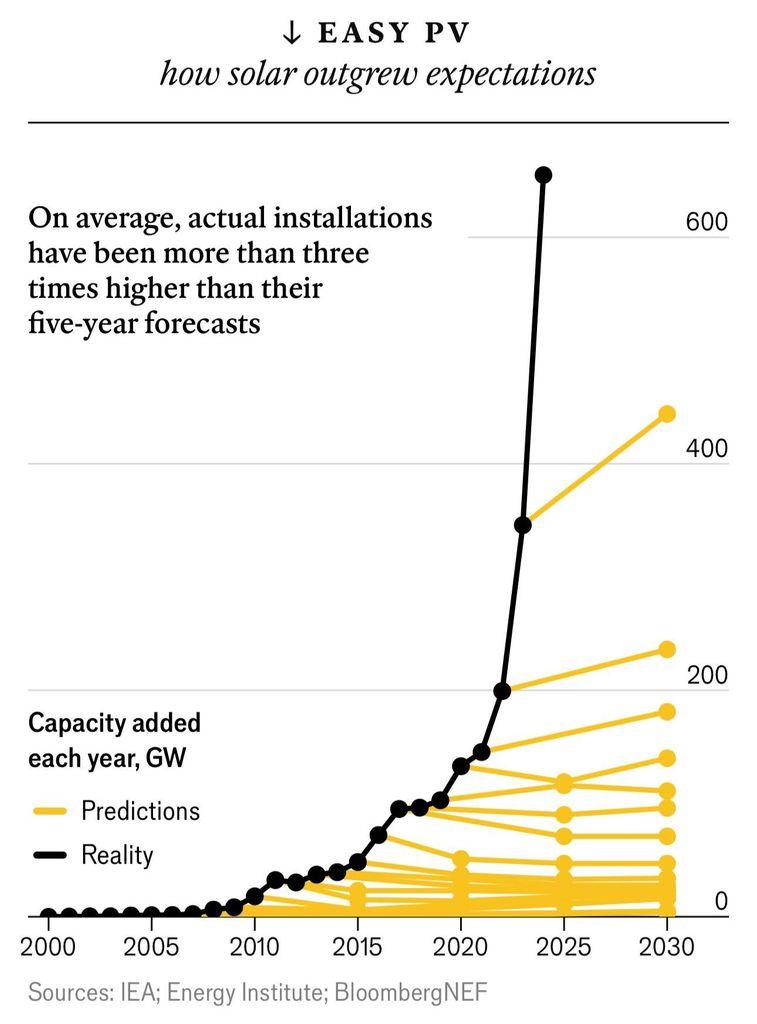
The world’s solar capacity reached 1,419 gigawatts in 2023, way beyond any predictions.
Uncategorized
57
Posts
29
Posters
0
Views
-
@ohir
So you're saying that to solve energy and heat storage we need sites that will have large amounts of a poisonous, bio-accumulative heavy metal working in an highly hazardous acid, and all that working within daily deep-cycling, on an industrial scale, plus constant industrial-scale recycling, and that it will be cheap and safe?Yeah, no citations (not counting regulation existing alone) means I'll pass.
As for the heat storage: mid-temperature heat accumulator can store around 500kWh per 1 cubic meter of gravel. Insulated by the very same gravel turned into the mineral wool. My house heat accu (I can not build on my own land) is designed to the tune of 7MWh, co it could store heat from 30kW solar installation operating from March to September. This fits into the 6m diameter rotunde. In 2020 was expected to cost around €15000. 4/5 of that the insulation. In non-lobbied regulatory environment this insulation could be made on-site from the gravel (and some amount of aluminium) by simple machine known for two centuries now.
Edit: checked project. The nearest unsorted bedding was 1700kg/m³ , 0.3kWh/°C/kg. The accu core has 38m³ of bedding (way cheaper than gravel) and can store up to 7MWh at edge temperature of 560°C (60-560). Long-term safe capacity is 7MWh. Accu core is almost cylindrical cone 4m diameter x 3m height. 150m³ insulation. Fully loaded gives ~8kW at the collector with all vents closed so heat all goes thru insulation. Empty (60°C) with all vents open outputs around 6.5kW. -
@infobeautiful why were people predicting a /downslope/ for so long, seems like a bizarre forecast. “Oh, solar rates have been climbing modestly for the last few years but I’m sure it’s just a passing fad…”
@bitprophet @infobeautiful there is a whole book by @solar_chase from bloombergNEF on the subject.
-
The world’s solar capacity reached 1,419 gigawatts in 2023, way beyond any predictions. 1 gigawatt = power for a medium sized city
It’s almost like there’s an entrenched, wealthy, and powerful special interest group with a vested interest in discouraging investments in solar … 🤷♂️
-
The world’s solar capacity reached 1,419 gigawatts in 2023, way beyond any predictions. 1 gigawatt = power for a medium sized city
@infobeautiful Welp, Marty and Doc Brown ought to be happy.
-
The world’s solar capacity reached 1,419 gigawatts in 2023, way beyond any predictions. 1 gigawatt = power for a medium sized city
@infobeautiful@vis.social this chart demonstrates how ridiculously pessimistic the IEA is, to the point of uselessness. i mean just look at it, it wasn't until 2020 where they didn't predict an actual decline in installations. pure clown shit
-
@Jonathan Hartley Nope. You need 100% backup(from about 50% of Ren share). Fossil backup.
That's why it's not cheap. and will not be. Never.
#^https://en.wikipedia.org/wiki/Dunkelflaute@martin you seem very certain, as if we could not, say grossly over provision green + batteries, and shut down some industrial processes for the tiny fraction of time when still+dark is too long.
-
@martin you seem very certain, as if we could not, say grossly over provision green + batteries, and shut down some industrial processes for the tiny fraction of time when still+dark is too long.
@dr2chase
You will never have enough batteries. Do the math.
Without fossil fuel reserves, it would mean shutting down the country several times a year. Not part of the economy. Not even the entire economy. But the entire country. A total blackout. Worse than what is happening now in Ukraine. -
Herbicides, pesticides, fertilizer and soil compaction, as well as erosion from modern farming have obliterated 40% of the world’s carbon and hydrological capacity as well as it’s fertility.
Industrial Farms are a biological waste land of toxic chemicals, fossil fuel emissions, herbicides, fungicides and pesticides.
All this to make corporations massively wealthier, while destroying the product, actual productive capacity of the land to sustain both the our climate and us
-
Would be a great start, the thing we need to remember is that up to 10 fossil fuel calories we used to bring a single food calorie to table. There is something very, very wrong about crops made from oil.
We could add on all the food ways that goes on in the 1300 miles at most food travels before reaching that final destination and what that means for recycling all the table scraps and all the other things that are the consequence of eating food.
-
Would be a great start, the thing we need to remember is that up to 10 fossil fuel calories we used to bring a single food calorie to table. There is something very, very wrong about crops made from oil.
We could add on all the food ways that goes on in the 1300 miles at most food travels before reaching that final destination and what that means for recycling all the table scraps and all the other things that are the consequence of eating food.
If we could recycle all the organic stuff, they keep it separated from all the toxic produced with today’s economy, and have all of that go back into use for growing food we wouldn’t really need fertilizer
-
If we could recycle all the organic stuff, they keep it separated from all the toxic produced with today’s economy, and have all of that go back into use for growing food we wouldn’t really need fertilizer
Animals and farms used to go together and chickens and ducks and geese and cows and pigs. All played their part in farms used to raise multiple things. The factory farms, all kinds both animal and vegetable really are more fossil fuel than they are the natural world.
-
Animals and farms used to go together and chickens and ducks and geese and cows and pigs. All played their part in farms used to raise multiple things. The factory farms, all kinds both animal and vegetable really are more fossil fuel than they are the natural world.
-
@dr2chase
You will never have enough batteries. Do the math.
Without fossil fuel reserves, it would mean shutting down the country several times a year. Not part of the economy. Not even the entire economy. But the entire country. A total blackout. Worse than what is happening now in Ukraine.@martin At the scale of the US, we never get nationwide overcast, nor nationwide lack of wind. We DO need to overprovision both batteries and wind, and distribute that overprovision across the country, and connect it nationwide so that power can be sent from sunny places to overcast places when that occurs.
Putting "Do the math" in bold face is not a proof. If you think it's that obvious, the proof should be easy.
-
@martin At the scale of the US, we never get nationwide overcast, nor nationwide lack of wind. We DO need to overprovision both batteries and wind, and distribute that overprovision across the country, and connect it nationwide so that power can be sent from sunny places to overcast places when that occurs.
Putting "Do the math" in bold face is not a proof. If you think it's that obvious, the proof should be easy.
@martin We an also rearrange our consumption so that loads are curtailed when the weather is unfavorable. Assuming we electrify processes that are currently done with fossil fuel, those will be large loads, and shutting them down for the duration of the worst 1% supply shortages will reduce the energy storage needed -- and only idles the industrial process 1% of the time, not a large loss in production.
-
@martin We an also rearrange our consumption so that loads are curtailed when the weather is unfavorable. Assuming we electrify processes that are currently done with fossil fuel, those will be large loads, and shutting them down for the duration of the worst 1% supply shortages will reduce the energy storage needed -- and only idles the industrial process 1% of the time, not a large loss in production.
@martin Looking at the wikipedia page: "Events that last more than two days over most of Europe happen about once every five years." And most of them are 24 hours. If the day/night ratio is a cloudless 12:12 and load is Y watts, then solar capacity needs to be 2Y , and battery capacity needs to be 12Ywatt-hours. Away from the equator, say worst is 6:18 then solar needs to be 4Y, and 18Y watt-hours of storage. If, rarely, an entire day's production is missed, then 42Y storage,
-
@martin Looking at the wikipedia page: "Events that last more than two days over most of Europe happen about once every five years." And most of them are 24 hours. If the day/night ratio is a cloudless 12:12 and load is Y watts, then solar capacity needs to be 2Y , and battery capacity needs to be 12Ywatt-hours. Away from the equator, say worst is 6:18 then solar needs to be 4Y, and 18Y watt-hours of storage. If, rarely, an entire day's production is missed, then 42Y storage,
@martin but not much more solar because the 24-hour surplus can be accumulated over several days. Obviously the batteries will cost more, but the larger amount of storage allows gentler charge+discharge and provides more opportunities for load management -- the batteries will have a longer service life.
I'm not seeing a proof of impossibility here, and batteries are still improving.
-
The world’s solar capacity reached 1,419 gigawatts in 2023, way beyond any predictions. 1 gigawatt = power for a medium sized city
-
@martin but not much more solar because the 24-hour surplus can be accumulated over several days. Obviously the batteries will cost more, but the larger amount of storage allows gentler charge+discharge and provides more opportunities for load management -- the batteries will have a longer service life.
I'm not seeing a proof of impossibility here, and batteries are still improving.
@dr2chase
You have refuted your own statement. Germany is much smaller than the US and has to invest huge amounts of money in backbone lines precisely so that it can transmit electricity from places where the wind blows to places where it does not. These are astronomical costs that are borne by Renew. It will be no different in the US. The laws of physics are the same there.
Like stopping trains? Or refineries? Or a CPU factory? That's not possible. Not even 1% unplanned.
1%? Well, I don't know about the USA, but here in Central Europe we have to reckon with 30 days. That's almost 10%. Several total blackouts a year.
Again, do the math. With real numbers.
The idea from Wiki is naive. There are no backbone lines across Europe that could transmit such surpluses. Perhaps in the distant future, for a few hundred billion euros, such a system could be built. And even then, according to the naive Wiki, it would mean a total blackout once every five years. Even Germany is unable to do so after decades!! And now you ask it for whole EU or USA? No way...
So, for the coming decades, it looks like you need batteries with a capacity of 125 TWh and a peak output of 900 GW for 100% renewable energy and winter outages (1 week). That means batteries worth about $15 trillion. 15T$. Not 15G$. And you have to replace them every 15-20 years or so.
Thanks Thor for France, Finland, Sweden, Slovakia, Bulgaria,...
So I did the math. You are welcome. 😁 -
@dr2chase
You have refuted your own statement. Germany is much smaller than the US and has to invest huge amounts of money in backbone lines precisely so that it can transmit electricity from places where the wind blows to places where it does not. These are astronomical costs that are borne by Renew. It will be no different in the US. The laws of physics are the same there.
Like stopping trains? Or refineries? Or a CPU factory? That's not possible. Not even 1% unplanned.
1%? Well, I don't know about the USA, but here in Central Europe we have to reckon with 30 days. That's almost 10%. Several total blackouts a year.
Again, do the math. With real numbers.
The idea from Wiki is naive. There are no backbone lines across Europe that could transmit such surpluses. Perhaps in the distant future, for a few hundred billion euros, such a system could be built. And even then, according to the naive Wiki, it would mean a total blackout once every five years. Even Germany is unable to do so after decades!! And now you ask it for whole EU or USA? No way...
So, for the coming decades, it looks like you need batteries with a capacity of 125 TWh and a peak output of 900 GW for 100% renewable energy and winter outages (1 week). That means batteries worth about $15 trillion. 15T$. Not 15G$. And you have to replace them every 15-20 years or so.
Thanks Thor for France, Finland, Sweden, Slovakia, Bulgaria,...
So I did the math. You are welcome. 😁@martin the wikipedia article that YOU put up there said multiday events are very rare, once per 5 years. Not 30 days. The US already has things like the Pacific Intertie, connecting Washington State to southern California on the west coast -- and this was done, for hydropower, so it was already judged to be worth it.
You need to quantify. "Astronomical" is not a number. The things I expect will be electrified in the future include steel, concrete, ammonia, and fresh water production.
-
The world’s solar capacity reached 1,419 gigawatts in 2023, way beyond any predictions. 1 gigawatt = power for a medium sized city
@infobeautiful Great Scott!
I need to immediately use 1.21 of those gigawatts to get us off this timeline where Biff Tannen is POTUS.
Probably the most environmentally sound thing we can do with 1.21 of them.













Gli ultimi otto messaggi ricevuti dalla Federazione
-
-
#Trump: "divulgheremo importanti informazioni governative su #UFO e alieni". Han trovato anche quelli negli Epstein files?
-
Le mettiamo le sanzioni?
Date una letttura alla Dichiarazione Sovranità Digitale Europea: Italia sottoscrive il documento con gli altri Stati membri sul sito governativo innovazione.gov.it; e notate questo passaggio che toglie ogni dubbio:"In questo quadro, viene riconosciuto anche il ruolo delle soluzioni open source, purché rispettino elevati standard di sicurezza informatica e siano integrate, ove necessa
https://monodes.com/predaelli/2026/02/22/le-mettiamo-le-sanzioni/
#Ethics
-
Android diventerà una piattaforma bloccata
Android diventerà una piattaforma bloccata!!!Nell’agosto 2025 Google ha annunciato ↗ che a partire da settembre 2026 non sarà più possibile sviluppare applicazioni per la piattaforma Android senza prima registrarsi centralmente presso Google. Questa registrazione richiederà di:
Pagare una commissione a Google
Accettare i termini e le co
https://monodes.com/predaelli/2026/02/22/android-diventera-una-piattaforma-bloccata/
#Ethics
-
Movim: Your Network, Your Rules.
Fully standard, decentralized and secured.Chat, Share and Connect, without the compromise.
https://monodes.com/predaelli/2026/02/22/15127/
#SocialNetworks
-
This post did not contain any content.
-
@mattiagiovanetti@mastodon.un
Sono millenni che me lo chiedo pure io.
-
RE: https://mamot.fr/@Martin_Pigeon/116113491654948651
Having said I'd seen no obituaries of Susan George, @Martin_Pigeon has provided links to two....