https://www.forth.org/Ting/Forth-for-the-Complete-Idiot/Forth-for-the-Complete-Idiot.pdf#forth
Uncategorized
27
Posts
6
Posters
2
Views
-
@neauoire hehe. yeah ok but the argument is likely that it's too high level, right?
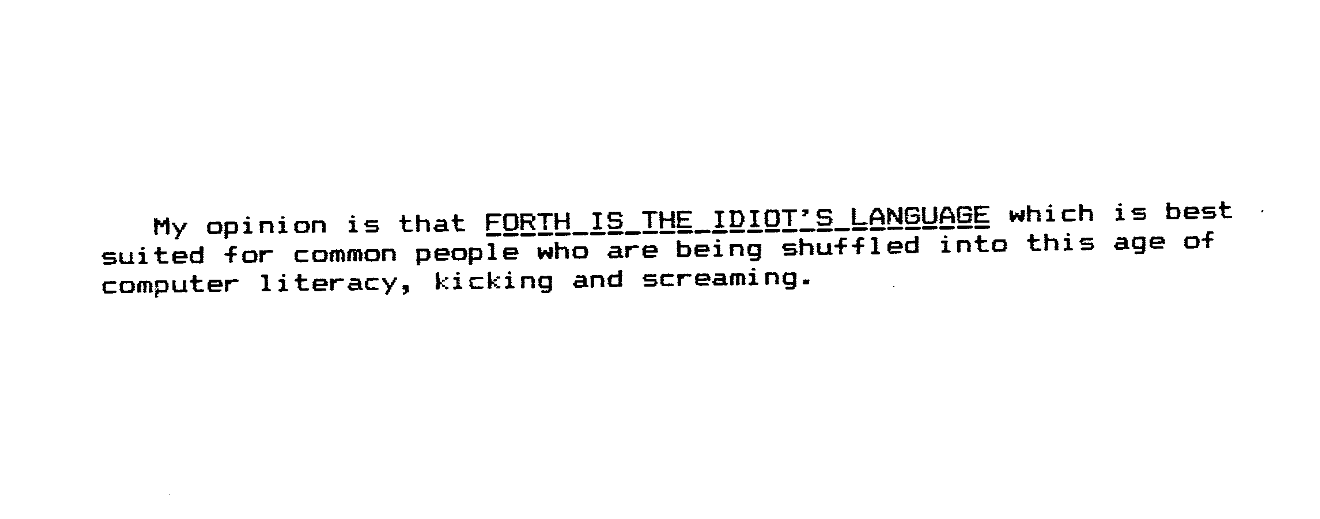
@lritter No, no, this book is like a .. early "Learning X for idiots", the author says you don't need to rely on a language's high priests to learn how to do any one thing, the language will enable the average cretin to get where they want to go.
-
@lritter No, no, this book is like a .. early "Learning X for idiots", the author says you don't need to rely on a language's high priests to learn how to do any one thing, the language will enable the average cretin to get where they want to go.
@neauoire ok but that's just what i contest. the "cretins" that it might attract might still not be average enough.
-
@neauoire ok but that's just what i contest. the "cretins" that it might attract might still not be average enough.
@lritter oh you meant great as in accessible? If so, yeah, I'm not sure, it's hard to say. I have .. toughts
-
@lritter oh you meant great as in accessible? If so, yeah, I'm not sure, it's hard to say. I have .. toughts
-
@mcc @lritter Have you ever come across this episode of Computer Chronicles? I think it still is true today X)
https://www.youtube.com/watch?v=-31sZfPMzwQ -
@mcc @lritter Have you ever come across this episode of Computer Chronicles? I think it still is true today X)
https://www.youtube.com/watch?v=-31sZfPMzwQ -
@AlgoCompSynth @mcc @lritter I have both, but I meant to share this segment when the guest says none of the standard programming languages are appropriate for the end user, not even BASIC.
-
@mcc @lritter Have you ever come across this episode of Computer Chronicles? I think it still is true today X)
https://www.youtube.com/watch?v=-31sZfPMzwQ -
@lritter @mcc I can't wait to see what you come up with! The best contender I've ever come across is still this(fractran): https://wiki.xxiivv.com/site/pocket_rewriting.html
I'm always on the lookout for even more distilled and approachable interfaces for computing.
-
@lritter @mcc I can't wait to see what you come up with! The best contender I've ever come across is still this(fractran): https://wiki.xxiivv.com/site/pocket_rewriting.html
I'm always on the lookout for even more distilled and approachable interfaces for computing.
-
@AlgoCompSynth @mcc @lritter I have both, but I meant to share this segment when the guest says none of the standard programming languages are appropriate for the end user, not even BASIC.
-
-
-
@AlgoCompSynth @neauoire @mcc except with creative tools, sooner or later fixed function is not enough. word, excel, blender, they're all user-programmable.
-
 undefined oblomov@sociale.network shared this topic
-
-
@oblomov @neauoire @lritter The thing is that programming is ultimately not about syntax but about framing what it is you want in an unambiguous way. The reason why slopcoding will always fail is that not only are you framing what you want ambiguously, the machine is incapable of interpreting it unambiguously. But the thing the slopcoders *want* is to be freed from the mental labor of deciding what it is they want. They want to make ambiguous requests and have it do the right thing anyway.
-
@oblomov @neauoire @mcc just looked at some inform 7 code and it's a neat DSL. very consequently avoids special characters and, like SQL, goes by speech patterns people already know.
the question is if this suffices for problems that are better expressed in some kind of gentle mathematical notation.
-
@oblomov @neauoire @lritter The thing is that programming is ultimately not about syntax but about framing what it is you want in an unambiguous way. The reason why slopcoding will always fail is that not only are you framing what you want ambiguously, the machine is incapable of interpreting it unambiguously. But the thing the slopcoders *want* is to be freed from the mental labor of deciding what it is they want. They want to make ambiguous requests and have it do the right thing anyway.
@mcc @oblomov @neauoire @lritter it's been possible to rigorously say what you want and have the computer find a program that does that for a long time. that's called program synthesis. you can even use a language model to make the optimizer that does this more efficient. no one seems to want that, they want to literally put a feature request written by a user at one end and get a program out the other
-
@mcc @oblomov @neauoire @lritter it's been possible to rigorously say what you want and have the computer find a program that does that for a long time. that's called program synthesis. you can even use a language model to make the optimizer that does this more efficient. no one seems to want that, they want to literally put a feature request written by a user at one end and get a program out the other
-
@oblomov @neauoire @lritter The thing is that programming is ultimately not about syntax but about framing what it is you want in an unambiguous way. The reason why slopcoding will always fail is that not only are you framing what you want ambiguously, the machine is incapable of interpreting it unambiguously. But the thing the slopcoders *want* is to be freed from the mental labor of deciding what it is they want. They want to make ambiguous requests and have it do the right thing anyway.
@mcc @neauoire @lritter Oh absolutely, I don't expect NPL to actually do anything for slopcoders. But I have a feeling, with some of the people I've been working with recently, that not having to learn a new syntax would be of non trivial help to them to help resolve any ambiguities, because the issue isn't so much with the reasoning as it is with translating it into the syntax. It is something I still have to actually test, though.





Feed RSS
Gli ultimi otto messaggi ricevuti dalla Federazione
-
I automated my entire morning routine with these 5 free productivity apps
-
What could have been (about "Who Framed Roger Rabbit?")
-
@Zambunny Tutto dipende da RAM e processore. Il mio Acer è più vecchio del tuo e ci gira Linux Mint ma senza Krita 😅
-
@stefano I wonder if this would be of any interest?
-
Mi domando: ma spegnere il telefono la notte no?
Davvero siamo arrivati al punto di non poterne proprio fare a meno?
Posso capire chi, per motivi lavorativi, debba garantire una costante reperibilità, ma gli altri?Personalmente, la sera prima di andare a dormire, telefono spento e in carica, pronto per la mattina successiva (quando è tanto scarico, sopra l'80% non lo ricarico mai).
-
@gabardino Io ho capito male da piccolo, ma ormai è troppo tardi
-
Privacy Badger is now the third most popular extension on Firefox worldwide. Thank you to Privacy Badger users for joining the fight against online surveillance! https://data.firefox.com/dashboard/usage-behavior
-
We're honored to receive the Firefox Extension Developer Award for Privacy Badger. https://blog.mozilla.org/addons/2025/12/17/presenting-2025-firefox-extension-developer-award-recipients/