Brilliant news!
Uncategorized
131
Posts
54
Posters
0
Views
-
@revk TBH, it seems to change regularly. When we had ours done 5ish years ago it required DNO sign off, I think.
But, yeah, with all the grid upgrades going on it looks like it is just a regulatory problem.
-
Brilliant news! The UK's Labour Government are going to make "plug in solar" legal.
Grab some panels from Lidl, hang them off your balcony or out your window, plug them in to your mains. Done!
https://www.gov.uk/government/news/government-to-go-further-and-faster-in-becoming-energy-secure
@Edent I wonder why they were illegal in the first st place, are they notorious shoplifters or something?
-
I think you're right. Most meters presumably only measure what comes in. we have a separate export meter for our solar panels.
-
-
@Edent I wonder why they were illegal in the first st place, are they notorious shoplifters or something?
@inpc because the grid was originally designed to support electricity flowing in one direction.
It's a bit like asking why it's illegal to connect your sewage pipe back into the mains. It wasn't designed for that and it carries risks.
Thankfully, the grid is mostly upgraded and can now handle energy flowing in both directions.
-
@revk TBH, it seems to change regularly. When we had ours done 5ish years ago it required DNO sign off, I think.
But, yeah, with all the grid upgrades going on it looks like it is just a regulatory problem.
@Edent @revk from the press release it seems the govt are working on making the process and regulations clearer to deal with (a consumer is going to have to tell the supplier to get the export enabled on the smart meter and the second MPAN allocated)
However DNO infrastructure isn't always the best (neighbour with 0 export, EV's or anything like that had a service cable failure, it took a month for UKPN to remove the temporary link from the next door house and rebuild the cable, which involved a week of having the road up and parking restrictions outside my house). There's also been at least one "make pumps 2" fire from an overloaded service cable on my street..
-
@inpc because the grid was originally designed to support electricity flowing in one direction.
It's a bit like asking why it's illegal to connect your sewage pipe back into the mains. It wasn't designed for that and it carries risks.
Thankfully, the grid is mostly upgraded and can now handle energy flowing in both directions.
@Edent thanks for the explaination.
I'm now tempted to plug a sewage pipe back into the mains for the lolz tho. -
@revk @Walrus @Edent
I'm not an electrical engineer so this might not be the whole story.As you add generation to the local distribution network, and assuming there's not enough local demand to consume it all, the voltage rises. Eventually it gets to 258V (230+12%) which is the upper tolerance limit. At that point, local generation starts to shut down.
1/2
-
@revk @Walrus @Edent
I'm not an electrical engineer so this might not be the whole story.As you add generation to the local distribution network, and assuming there's not enough local demand to consume it all, the voltage rises. Eventually it gets to 258V (230+12%) which is the upper tolerance limit. At that point, local generation starts to shut down.
1/2
All well and good, but folk then start to complain to their suppliers (and from there to the DNO) that, on sunny summer days, their solar inverter has shut down and they've missed out on savings/earnings.
The DNO limit / permission process is designed to keep export low enough that the local network rarely reaches 258V and they don't get deluged with complaints from their customers.
2/2
-
Brilliant news! The UK's Labour Government are going to make "plug in solar" legal.
Grab some panels from Lidl, hang them off your balcony or out your window, plug them in to your mains. Done!
https://www.gov.uk/government/news/government-to-go-further-and-faster-in-becoming-energy-secure
@Edent
Not if you live on a listed residential estate -
@Edent
Not if you live on a listed residential estate@Christo_459 You should write to your MP and assembly member to let them know your concerns.
But, it looks like you can apply for consent for a listed building.
https://historicengland.org.uk/advice/technical-advice/building-services-engineering/installing-photovoltaics/consents-permissions/ -
All well and good, but folk then start to complain to their suppliers (and from there to the DNO) that, on sunny summer days, their solar inverter has shut down and they've missed out on savings/earnings.
The DNO limit / permission process is designed to keep export low enough that the local network rarely reaches 258V and they don't get deluged with complaints from their customers.
2/2
-
@Edent
For anyone reading this who thinks "you can't buy plugin solar panels from Lidl!" here's a link to Lidl Germany where that is definitely a thing:https://www.lidl.de/h/stromerzeuger/h10031840?pageId=10067761%2F10067532%2F10031840&sort=price
-
@Christo_459 You should write to your MP and assembly member to let them know your concerns.
But, it looks like you can apply for consent for a listed building.
https://historicengland.org.uk/advice/technical-advice/building-services-engineering/installing-photovoltaics/consents-permissions/@Edent
Thanks -
OK. Want to give a reason why?
-
@OneInterestingFact
Yes. If you have an export tariff you'll get paid for every kWh you pass back to the grid.@Edent @OneInterestingFact Plug-in solar is usually not enough that feeding into the grid is actually worth it (mostly depends on how many forms you have to fill, but you are usually also not paid enough). The main reason you want to have a solar panel on your balcony is to cover your own consumption. Add battery storage to it and you can be quite independent of the grid for a large part of the year.
-
@Edent excellent news if it turns out they don't screw it up.
but.
"plug it into your mains"? really? how does that work?
edit: even if it does work — how would i know it was doing anything?
edit^2: the relevant search term here is "G98". i'm still very confused what the hell this is, but it is a thing, in some areas.
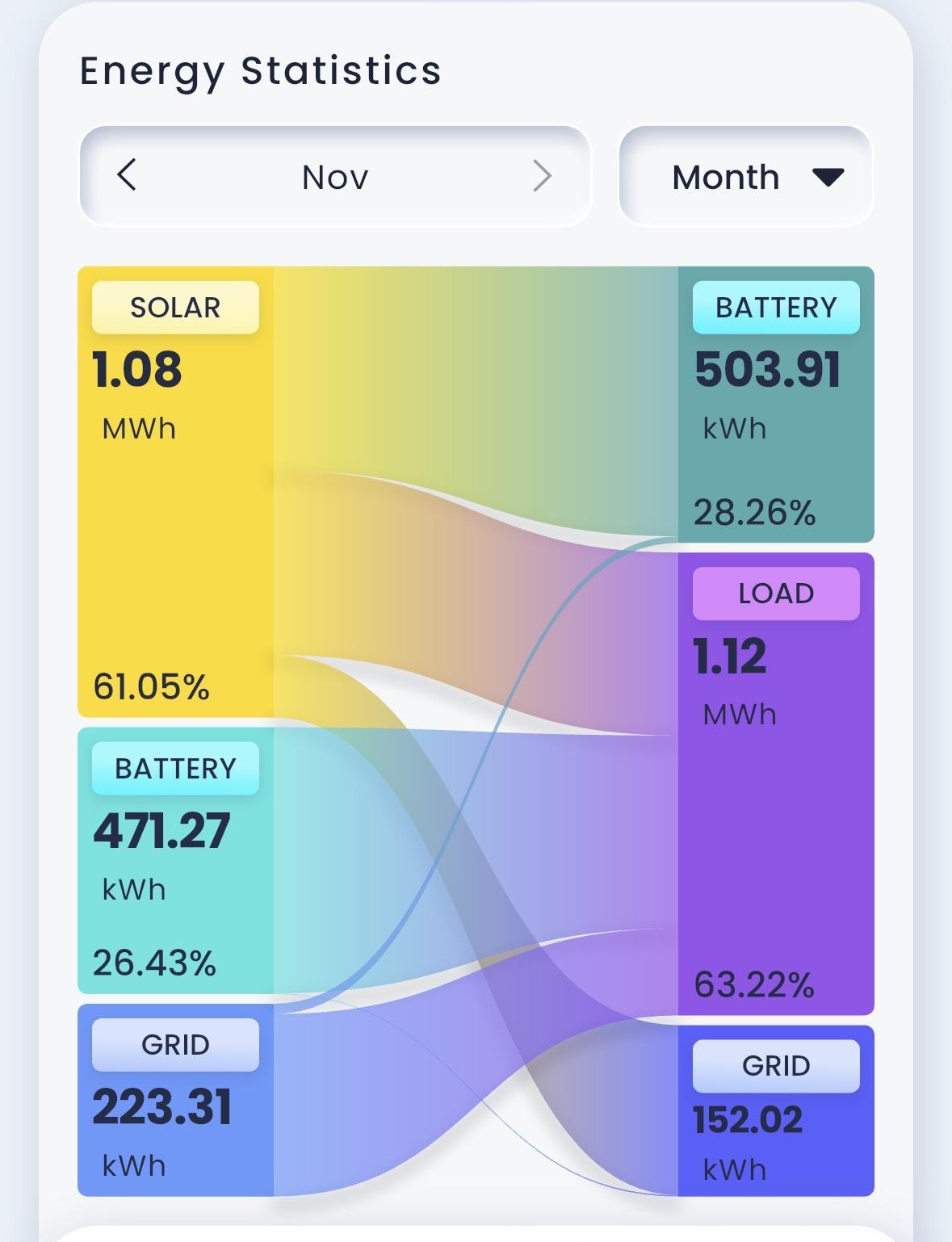
@fishidwardrobe @Edent You plug it into your wall and it makes your meter run more slowly or in reverse. Plug-in solar inverters also often come with apps to track your production.
-
Brilliant news! The UK's Labour Government are going to make "plug in solar" legal.
Grab some panels from Lidl, hang them off your balcony or out your window, plug them in to your mains. Done!
https://www.gov.uk/government/news/government-to-go-further-and-faster-in-becoming-energy-secure
@Edent power / sec nerd here. How does this not energize intentionally-deenergized lines? Mustn’t cook line repair crews.
-
@Edent power / sec nerd here. How does this not energize intentionally-deenergized lines? Mustn’t cook line repair crews.
@InkomTech because an inverter matches the frequency it sees from the grid. If there's no frequency, it doesn't output.
That's how all solar inverters work. -
All well and good, but folk then start to complain to their suppliers (and from there to the DNO) that, on sunny summer days, their solar inverter has shut down and they've missed out on savings/earnings.
The DNO limit / permission process is designed to keep export low enough that the local network rarely reaches 258V and they don't get deluged with complaints from their customers.
2/2
@sheddi@mstdn.party @revk@toot.me.uk @Walrus@toot.wales @Edent@mastodon.social There were mutterings recently of dropping the substation voltage to nearer the lower end of the tolerance band to accommodate more domestic PV contribution.
Nominally we are 230V but most British¹ domestic supplies are still 240V when measured.
__
¹ Northern Ireland is a separate grid and might be doing their own thing.















Feed RSS
Gli ultimi otto messaggi ricevuti dalla Federazione
-
@Lana fuck, how do I know that *I* exist. what I'm just imagining all of this.
-
@Tamami that's really horrible. here's hoping for a swift and steady recovery
-
@Tamami whoa! so sorry to hear that, i hope he’s doing better now! best of luck to both of you in the coming period.
-
Guerra Trump-Iran: il Vietnam prossimo futuro di Trump
@giornalismo
articolo21.org/2026/03/guerra-…
In un articolo precedente spiegavo come la narrazione di Donald Trump, fondata sullo slogan “sotto di me nessuna guerra sarebbe mai iniziata”, si stesse infrangendo contro la logistica dei movimenti navali delle
-
Chiaro, semplice, essenziale
#iovotoNO
-
Current* conditions near Lambton County, ON:
-
@nocontexttrek that was a sincere request
-
@Tamami
I am sorry that happened. We hope his health improves, and quickly. Thank you for sharing with us here.