I am doing a weird thing.
Uncategorized
9
Posts
3
Posters
2
Views
-
I am doing a weird thing. Nowhere near done.
-
I am doing a weird thing. Nowhere near done.
If you're curious what this is:
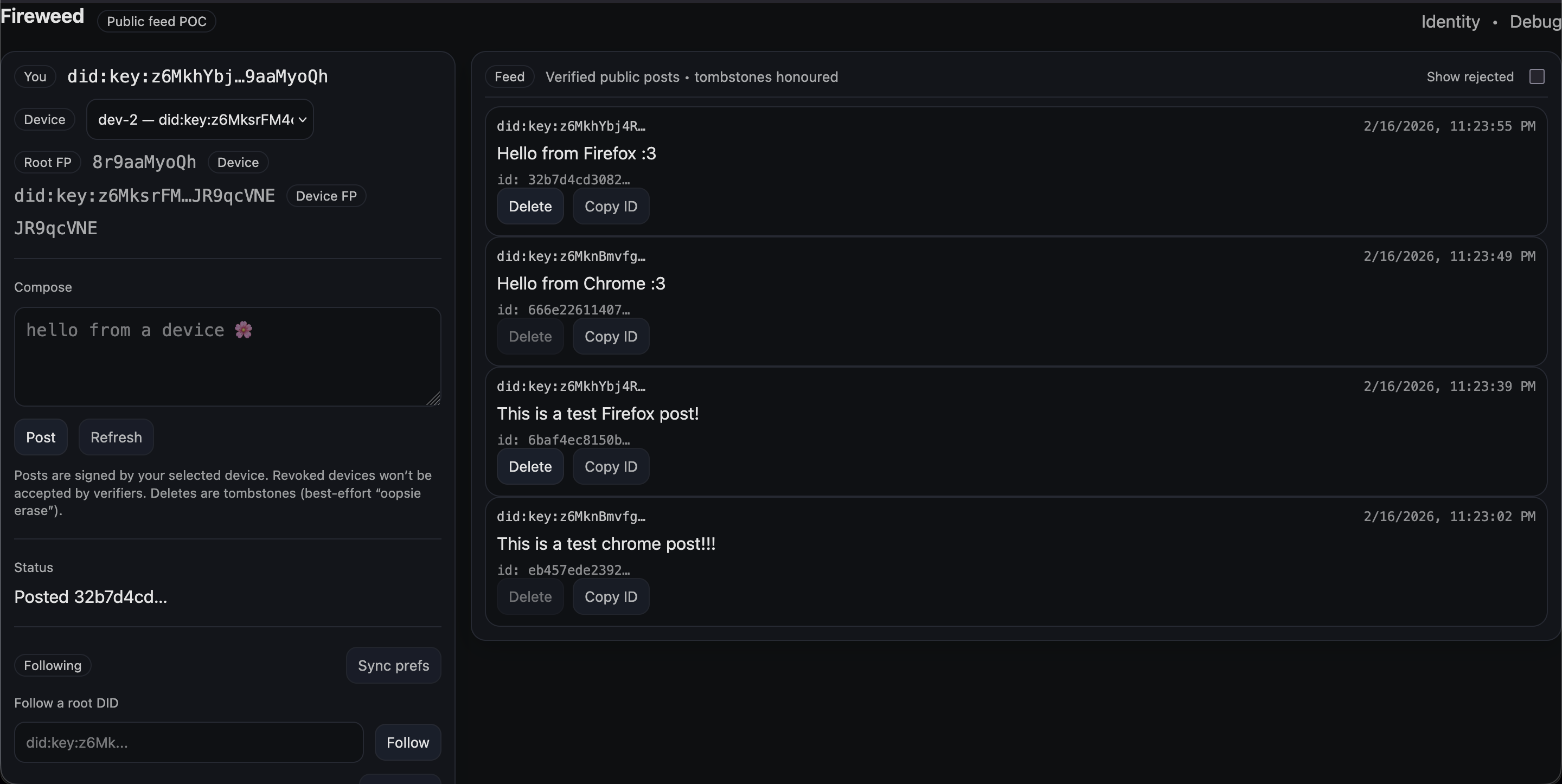
It's a little implementation of a distributed social media system, for now using a local server but will use OrbitDB in the future once I'm more confident in it.
It deserves a whole-ass writeup, but I honestly consider it more proof-of-concept than I do a real thing I feel comfortable people using right now.
-
I am doing a weird thing. Nowhere near done.
@Elizafox did is distributed id right? -
If you're curious what this is:
It's a little implementation of a distributed social media system, for now using a local server but will use OrbitDB in the future once I'm more confident in it.
It deserves a whole-ass writeup, but I honestly consider it more proof-of-concept than I do a real thing I feel comfortable people using right now.
So this is Fireweed.
It is a distributed forum / social protocol thing I'm making built around cryptographic identity instead of accounts. It is a proof-of-concept in essence, to prove it can be done.
No usernames as authority. No central database as truth. Just local cryptographic identity. In the future I plan to allow attestation via signing a nonce you can put on a site or something.
Anyway.
Your identity is a keypair. That’s it. That's the pitch. Everything else revolves around that.
🧵
-
So this is Fireweed.
It is a distributed forum / social protocol thing I'm making built around cryptographic identity instead of accounts. It is a proof-of-concept in essence, to prove it can be done.
No usernames as authority. No central database as truth. Just local cryptographic identity. In the future I plan to allow attestation via signing a nonce you can put on a site or something.
Anyway.
Your identity is a keypair. That’s it. That's the pitch. Everything else revolves around that.
🧵
@Elizafox kinda like #Keybase or #BitMessage?
- Just without #centralization or #Blockchain.
-
So this is Fireweed.
It is a distributed forum / social protocol thing I'm making built around cryptographic identity instead of accounts. It is a proof-of-concept in essence, to prove it can be done.
No usernames as authority. No central database as truth. Just local cryptographic identity. In the future I plan to allow attestation via signing a nonce you can put on a site or something.
Anyway.
Your identity is a keypair. That’s it. That's the pitch. Everything else revolves around that.
🧵
How it works:
You generate a root keypair (Ed25519, small, fast, modern elliptic curve, supported by almost every browser).
That key is:
- Your identity.
- Your authority.
- Your signature stamp.
If you lose it, you’re done. There is no "forgot password." Eventually you will be able to export your keypair and save it somewhere, but you absolutely need this keypair to use it.
This is not far off from how SSH works, actually.
The root never touches the Internet, at least the private key doesn't. Or ideally, shouldn't.
It is encrypted at-rest in your browser and only loaded into memory when needed, decrypted via a password. It's... not perfect, because browser-based crypto is not perfect, but it's irretrievable in direct form.
This is brutal, yes, but it is clean. Also, if you destroy the key? No one can cryptographically prove it was you.
Anyways.
The root key signs:
- Device keys
- Identity metadata
- Potential revocations
- Anything that defines "you"
Obviously, posting from your root key directly would be clunky and having a lot of key material around you really don't want widely duplicated
Instead: the root key generates and signs a device key.
Device key is what signs posts, preferences updates, etc..
Each device key is:
- Separately revocable
- Linked to root
- Explicitly authorized
- Has capabilities attached like posting and preferences updates
If your laptop gets owned? You revoke that device key. The root signs a revocation. Network sees the revocation. That device stops being valid. Posts and preferences updates from it are ignored.
-
How it works:
You generate a root keypair (Ed25519, small, fast, modern elliptic curve, supported by almost every browser).
That key is:
- Your identity.
- Your authority.
- Your signature stamp.
If you lose it, you’re done. There is no "forgot password." Eventually you will be able to export your keypair and save it somewhere, but you absolutely need this keypair to use it.
This is not far off from how SSH works, actually.
The root never touches the Internet, at least the private key doesn't. Or ideally, shouldn't.
It is encrypted at-rest in your browser and only loaded into memory when needed, decrypted via a password. It's... not perfect, because browser-based crypto is not perfect, but it's irretrievable in direct form.
This is brutal, yes, but it is clean. Also, if you destroy the key? No one can cryptographically prove it was you.
Anyways.
The root key signs:
- Device keys
- Identity metadata
- Potential revocations
- Anything that defines "you"
Obviously, posting from your root key directly would be clunky and having a lot of key material around you really don't want widely duplicated
Instead: the root key generates and signs a device key.
Device key is what signs posts, preferences updates, etc..
Each device key is:
- Separately revocable
- Linked to root
- Explicitly authorized
- Has capabilities attached like posting and preferences updates
If your laptop gets owned? You revoke that device key. The root signs a revocation. Network sees the revocation. That device stops being valid. Posts and preferences updates from it are ignored.
Now. Posts.
Every post is:
- Content
- Metadata
- Timestamp
- Signed by a device key
Peers verify:
- Device key signature
- Device key signed by root
- Certificate capabilities
- Root consistency
If that chain holds, the post is authentic.
No central server needed to vouch for it. Cryptography does it for you.
Now... deletions...
Deleting content in distributed systems is messy. You can't actually un-send stuff and distributed databases tend to work with append-only logs.
Fireweed handles this with signed tombstones.
A tombstone is a signed message that says:
"Post X is revoked / deleted by the same identity that created it."
It is signed by a valid device key, traceable to root, and verifiable.
Peers don't erase history from existence (because that’s impossible in distributed systems), but they respect the tombstone, hide the content, and mark it revoked.
It’s consent-based deletion instead of magical deletion.
Also, if you revoke a device, all posts that were created by the device are instantly repudiated.
NB: It doesn't guarantee the content was never saved elsewhere. Nothing can guarantee that. Not even on a centralised system. Especially not on Fedi. It guarantees that the canonical record says "this is withdrawn."
-
Now. Posts.
Every post is:
- Content
- Metadata
- Timestamp
- Signed by a device key
Peers verify:
- Device key signature
- Device key signed by root
- Certificate capabilities
- Root consistency
If that chain holds, the post is authentic.
No central server needed to vouch for it. Cryptography does it for you.
Now... deletions...
Deleting content in distributed systems is messy. You can't actually un-send stuff and distributed databases tend to work with append-only logs.
Fireweed handles this with signed tombstones.
A tombstone is a signed message that says:
"Post X is revoked / deleted by the same identity that created it."
It is signed by a valid device key, traceable to root, and verifiable.
Peers don't erase history from existence (because that’s impossible in distributed systems), but they respect the tombstone, hide the content, and mark it revoked.
It’s consent-based deletion instead of magical deletion.
Also, if you revoke a device, all posts that were created by the device are instantly repudiated.
NB: It doesn't guarantee the content was never saved elsewhere. Nothing can guarantee that. Not even on a centralised system. Especially not on Fedi. It guarantees that the canonical record says "this is withdrawn."
Preferences:
This is subtle. But I think this is cool.
Your preferences are globally stored. But they are encrypted.
What is stored:
- Who you follow
- Muted users
- Block lists
- Client UI preferences
- Custom feeds
- Personal notes
These are not public information.
Fireweed stores these as encrypted blobs. Only people with the password can decrypt them (so... use a strong password).
In the future I plan to add webauthn support as well (also probably going to do this for the root key).
Each preferences update is signed by your device key. Same check flow as posts. If the signature fails, it's not a valid preference.
But basically: your entire social graph becomes sovereign. It is yours. No company can see it.
-
Preferences:
This is subtle. But I think this is cool.
Your preferences are globally stored. But they are encrypted.
What is stored:
- Who you follow
- Muted users
- Block lists
- Client UI preferences
- Custom feeds
- Personal notes
These are not public information.
Fireweed stores these as encrypted blobs. Only people with the password can decrypt them (so... use a strong password).
In the future I plan to add webauthn support as well (also probably going to do this for the root key).
Each preferences update is signed by your device key. Same check flow as posts. If the signature fails, it's not a valid preference.
But basically: your entire social graph becomes sovereign. It is yours. No company can see it.
My plans for moderation:
- I plan to allow sharing of blocklists of did:keys that are known to spam
- Allow clientside filtering of what replies you see to your posts (followers-only, etc.)
Future things also:
- In the future I plan to add RFC9420/MLS support for limited-audience posts (which will mean posts are ACTUALLY encrypted, including DM's). Right now for public posts, that is completely pointless, so I am not doing that. Because... why. If it's public, what's the point in encryption beyond, say, HTTPS?
- Maybe a standalone app or something so you're not running this all as a mystery meat blob of JavaScript.
- Other database/relay backends besides OrbitDB.
- Maybe a proof-of-work system akin to HashCash to prevent spam.
-
 undefined oblomov@sociale.network shared this topic



Feed RSS
Gli ultimi otto messaggi ricevuti dalla Federazione
-
@fucinafibonacci @attualita
grazie del link, interessante
-
Karaganov, casa a Venezia e rivista con Lavrov-Ushakov: “Il nucleare soluzione al problema Europa”
[hanno dimore di lusso in Europa, ma vogliono bombardarla]v
su @LaStampa
-
@cipper @attualita linkiesta è messa addirittura peggio de Il Fatto Quotidiano https://www.kulturjam.it/costume-e-societa/il-karma-del-linkiesta-quando-il-giornalismo-sussidiato-presenta-il-conto/ In ogni caso il senso dell'articolo (e del mio post) è che se qualcuno/a ha l'icona lignea di Francesca Albanese nella cameretta è meglio che non mi segua. Per altro, puoi verificare che quelle 3-4 volte che l'ho citata non ho mai chiesto di censurarla. Semplicemente la vita è breve e non voglio dedicarla ai suoi adepti
-
si', critico l'articolo di Francesco Cundari perche' lo trovo fortemente pregiudiziale e poco obiettivo.
L'inkiesta spesso pubblica articoli molto ben ragionati e interessanti, ma questo articoletto sembra piu' uno sfogo personale di Cundari che giornalismo serio.
-
@GustavinoBevilacqua @sans_serif_girl ma sì, come tante altre cose "di lusso" che fanno schifo e si mangiano/bevono solo perché elitari (tartufi, sanno di zolfo e puzzano; champagne, nove su dieci non è meglio di quello servito all'Ippopotamo di Fantozzi; caviale, uova di pesce...).
Questi però sono cioccolatini *da grande distribuzione*. Trovo più oneste, a questo punto, le pasticcerie artigianali.
-
Paisiello's Count: La tua filosofia è assai gioiosa.
(Aren't you a ray of sunshine?)lol he's such a dick
-
Daily Digest | 17 February 2026
Your daily dose of Privacy, Data Protection, AI & Cybersecurity news.
5 stories you should not miss.
Read more: https://www.nicfab.eu/daily-digest/
-
@GustavinoBevilacqua @LaVi non bevo caffè ma anche lo bevessi non credo lo proverei perché - a parte il processo digestivo che fa un po' senso - temo che gli zibetti siano solo sfruttati male poveri e non vorrei contribuire ulteriormente