Skip to content

Piero Bosio Social Web Site Personale Logo Fediverso

Social Forum federato con il resto del mondo. Non contano le istanze, contano le persone

I did a bit of a rambly video sharing my thoughts on #PeerTube turning 10 years old (sort of).

Uncategorized
1 1 10

Gli ultimi otto messaggi ricevuti dalla Federazione
Post suggeriti
  • 0 Votes
    1 Posts
    8 Views
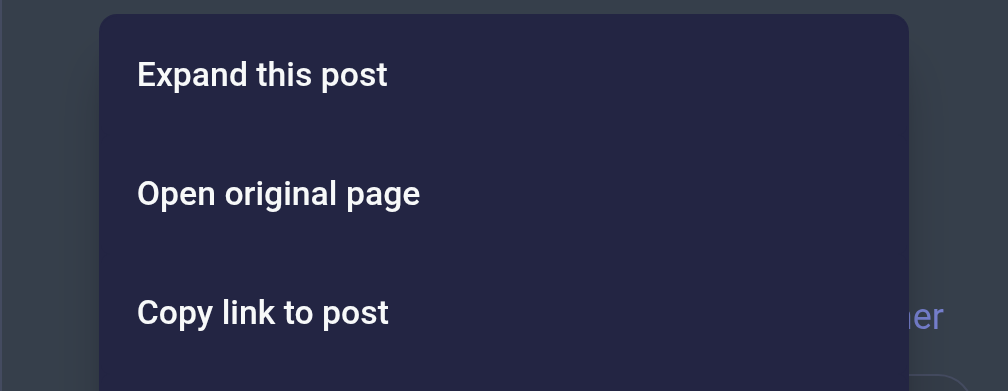
    I think I have identified a fairly significant flaw in how the #Fediverse currently operates. Hear me out.The Fediverse currently consists of all sorts of different systems - #Mastodon, #Friendica , #Pixelfed , #PeerTube, #BookWyrm , and so forth. And while they are all connected via the #ActivityPub protocol, they all have different functionalities and different ways of presenting themselves. Which is as it should be, because Diversity Is Our Strength(TM).However, it is here that the ActivityPub-based interactivity hits its limits - for usually, you can either experience the relevant system as it was intended, or you can interact with it, but not both - _unless_ you have an account on the same system (though not necessarily on the same instance).Let's say that you are a Mastodon user who looks at another person's BookWyrm page. You scroll through their books, posts, and comments. Then you see some comment you want to comment on yourself, but can you do so?Not directly. You need to figure out the URL of their comment, and then copy and paste that comment into the search bar of your Mastodon instance. Then it will show up in the same format as a Mastodon post, and you can interact with it - boost it, like it, comment on it.Sure, it works, but it's a whole lot of tedious effort.Or you can search for the user account in Mastodon and scroll through all their posts and comments as if they were a Mastodon user - and thus, you will miss out on all the unique user interface features of BookWyrm.So what is missing?Well, Mastodon already has an "Open original page" feature when looking at someone's post. What we need is an "Open original page AND AUTHENTICATE" feature. This way, the target instance (whatever software they are using) could acknowledge the viewer as an external user who could nevertheless fully interact with the local user interface, including the ability to boost, like, and make comments.This is something that should be theoretically possible to implement, right? #FediHelp
  • 0 Votes
    1 Posts
    10 Views
    #datocurioso ÂżCreĂ­as que el #fediverso se limitaba solo al microblogging de #Mastodon? ÂĄPiĂ©nsatelo de nuevo!El fediverso es un cosmos interconectado regido por el protocolo #ActivityPub, y alberga un sinfĂ­n de mundos mĂĄs allĂĄ de las publicaciones cortas. Puedes encontrar alternativas descentralizadas para casi cualquier servicio centralizado que conozcas: ¿Buscas compartir imĂĄgenes al estilo Instagram? Existe #Pixelfed.ÂżAnhelas un espacio para vĂ­deos como YouTube? Tienes a tu disposiciĂłn #PeerTube, que usa tecnologĂ­a P2P para aligerar la carga.Âż quieres compartir videos cortos al estilo tik Tok? Prueba #loops!ÂżPrefieres los agregadores de enlaces al estilo Reddit? #Lemmy es tu destino. ¿ buscas compartir tu #podcast? #funkwhale es a donde debes ir.Âż te gusta escribir o quieres hacer un blog? Intenta con #WriteAsÂĄY eso solo es la punta del iceberg!El fediverso no es un solo lugar, sino una constelaciĂłn de plataformas que interactĂșan entre sĂ­, una red de redes libres, abiertas y federadas, permitiendo a un usuario de Mastodon o de algĂșn otro servicio federado seguir e interactuar con alguien en PeerTube o Pixelfed, etc. ÂĄLa verdadera magia radica en la interoperabilidad y la libertad de elecciĂłn! #SoftwareLibre #Tecnologia #PrivacidadÂ âœšâ€â™‚ïžđŸŽ™ïž
  • 0 Votes
    1 Posts
    13 Views
    đŸ“ș PeerTube Co-op FAQ: Building a Member-Owned Alternative to YouTube The future of video doesn’t belong to platforms. It belongs to people. We’re building a PeerTube co-op: a member-owned, democratically governed video platform based in BC. No algorithms deciding what matters. No corporate choke points. No waiting for permission. This is about taking control of the infrastructure, the governance, and the culture—and doing it together. Why a co-op? Because co-ops give people ownership, governance rights, and collective resilience. Instead of handing data and control to a platform, members pool resources, share decision-making, and shape policies together. BC has a strong legal framework for co-operatives, which makes it a natural place to explore this seriously. Why PeerTube? PeerTube is federated, open-source, and already battle-tested as a decentralized alternative to YouTube. It’s not perfect—but it provides a solid foundation for a co-op structure to build on top of. The idea is to pair federated tech with co-operative governance, so neither corporate control nor a single admin dictates the rules. Who’s behind this? Right now, this is being organized by me (@atomicpoet@atomicpoet.org) and @Crissy@tech.lgbt, along with a growing group of interested folks: creators, privacy advocates, security experts, and co-op thinkers from around the world. We’re still early—think founding conversations, not bylaws and board elections. But the energy is real. How much does it cost to join? What follows is the proposed model, not something set in stone. The final structure will be decided by the member-owners once the co-op is formed. The idea is to keep membership affordable for individuals while ensuring the co-op is financially sustainable from the start—with no ads, no data harvesting, and no outside investors. Just members pooling resources to run the platform together. Base membership: C$5.95/month Medium tier (10–100 GB/month): +C$3 → C$8.95/month Heavy tier (100 GB+): +C$10 → C$15.95/month At scale, with a typical user mix (80% base / 15% medium / 5% heavy), this works out to about C$6.90 per member per month, which comfortably covers hosting and operational costs. There’s also a one-time buy-in of C$50, which funds initial setup (domain, CDN deposits, buffer) and helps keep the early months profitable without raising dues. When spread over the first year, that’s roughly C$4.17/month in effective cost coverage. What happens if the co-op grows faster than expected? The financial and technical model is step-wise, not linear. As membership increases, transcoding nodes, storage/CDN tiers, and egress commitments scale at defined traffic thresholds. The co-op’s development will unfold in three phases, with member-owners deciding collectively when to move from one to the next. Do I need technical skills to participate? No. Technical expertise is welcome but not required. Governance, policy, communications, creative, and community-building skills are just as valuable. Infrastructure will be professionally managed, with costs shared through dues. Will the co-op run its own infrastructure or rely on third parties? The proposal uses managed hosting as a baseline, scaling as membership grows. This provides reliability early on while retaining the ability to self-host more components later. How will moderation work? Moderation scales with user base and federation breadth: Member reporting and rotating stewards handle first-line triage Paid moderation begins once activity reaches 10–15+ hours/week Budget estimates: up to C$270/month for ~100 users; part-time moderation (~C$1,755/month) for ~500 users Will the instance federate with everyone or be selective? The proposal starts with a curated allowlist of trusted instances to control load. It will also: Adopt shared blocklists as a baseline Document defederation criteria and appeals to keep the process transparent As membership grows, federation posture can be revisited by member-owners. What’s the timeline for incorporation and launch? We’re not working toward rigid dates—we’re building deliberately, in three clear phases: Phase 1: Formation and groundwork. Incorporation, drafting bylaws, establishing MVP infrastructure, and setting out the core policies (ToS, AUP, takedown). Phase 2: Growth and refinement. Expanding membership, activating the hybrid pricing model, introducing stipends, and refining federation posture. Phase 3: Maturity and expansion. Adding part-time moderation, building reserves and insurance, and exploring potential expansion into other Fediverse services. Each phase builds on the last, and decisions about when to transition between them will be made collectively by member-owners. What drives costs the most? Egress and bandwidth dominate, not storage. P2P offload reduces egress as viewer concurrency rises, but outbound data remains the biggest expense. How does the pricing hold up financially? At as few as five members, the co-op becomes cash-flow positive, and margins scale significantly with growth. 100 members → estimated monthly surplus C$587 1,000 members → estimated monthly surplus C$6,870 I’ve never been in a co-op before. Will there be guidance? Yes. The initial bylaws and governance structure will include clear documentation. New members will be onboarded through AGMs, published policies, and transparent reporting, as required under BC Co-operative Association law. Will you use open-source tools for internal communications? That will ultimately be up to the member-owners to decide collectively. For now, tools like Google Docs are being used temporarily to get everyone aligned quickly. Yes, the irony isn’t lost—it’s like holding a union meeting in Jeff Bezos’ living room. But this is just to get the ball rolling, not a long-term choice. How will governance work? We’re still defining this collectively, but the plan is to follow BC co-op regulations while ensuring member governance is meaningful, not symbolic. Expect conversations around: Founding member structure Board or steering committee setup Decision-making processes Transparency and accountability measures I’m not a PeerTube user, but I’m interested in the co-op structure. Is that relevant? Yes—very. Some participants are here primarily because they’re passionate about co-operatives, not necessarily PeerTube. That expertise will be crucial for getting the legal, organizational, and governance frameworks right. Will non-members be able to watch videos? Yes. As with most PeerTube instances, most viewing will be public, but uploading and policy decisions are reserved for member-owners. The co-op’s primary responsibility is to its members, while still providing an open and accessible platform for viewers. What will the co-op be called? The official name and branding will be chosen collectively by the founding member-owners after incorporation. How do I get involved or stay informed? The next step will be setting up an initial coordination space (on open-source infrastructure, if members choose that path) to keep everyone looped in and start shaping this together. If you want to be kept informed, reach out privately or share your email so you can be included when that happens. Isn’t this ambitious? Yes. But the response so far has been incredible. The mix of skills and motivations showing up this early—technical, organizational, privacy, cultural—is exactly what’s needed to make something real. 📝 Closing Thought This is still early days. But something’s forming—a group of people who see the cracks in the platform world and want to build something better, together. If that resonates with you, you’re welcome here. #PeerTubeCoop #PeerTube #Cooperative
  • 0 Votes
    1 Posts
    5 Views
    Version audio de l'article éponyme publié le 30 novembre 2021, sur le Framablog. Lecture et réalisation audio : Sualtam, auteur du site lectureaudio.fr Texte : Framasoft (CC-By-Sa)