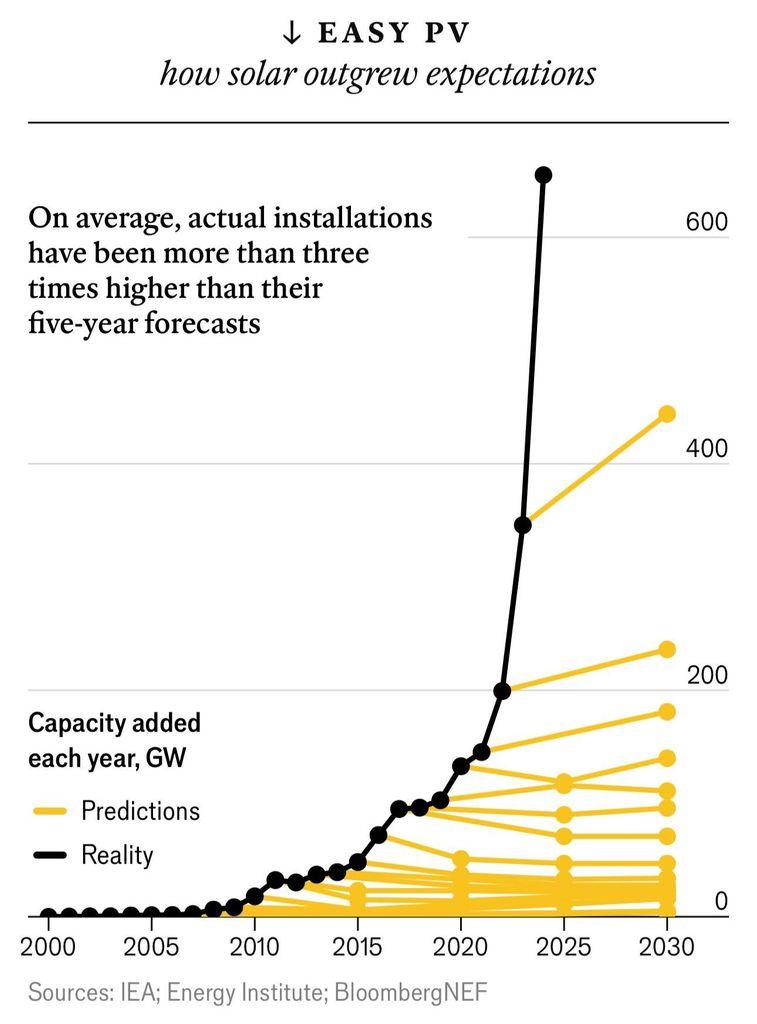
The world’s solar capacity reached 1,419 gigawatts in 2023, way beyond any predictions.
Uncategorized
57
Posts
29
Posters
0
Views
-
The world’s solar capacity reached 1,419 gigawatts in 2023, way beyond any predictions. 1 gigawatt = power for a medium sized city
@Information Is Beautiful Power for several hours a day. In winter time even weeks without power, sometimes. -
The world’s solar capacity reached 1,419 gigawatts in 2023, way beyond any predictions. 1 gigawatt = power for a medium sized city
@talexb and the imbecile running Ontario is all in on imaginary nuclear technology (SMRs)
-
The world’s solar capacity reached 1,419 gigawatts in 2023, way beyond any predictions. 1 gigawatt = power for a medium sized city
@infobeautiful A basic trend curve would have given a better prediction.
-
The world’s solar capacity reached 1,419 gigawatts in 2023, way beyond any predictions. 1 gigawatt = power for a medium sized city
@infobeautiful how big is a medium sized city, in population terms?
-
The world’s solar capacity reached 1,419 gigawatts in 2023, way beyond any predictions. 1 gigawatt = power for a medium sized city
@infobeautiful why were people predicting a /downslope/ for so long, seems like a bizarre forecast. “Oh, solar rates have been climbing modestly for the last few years but I’m sure it’s just a passing fad…”
-
The world’s solar capacity reached 1,419 gigawatts in 2023, way beyond any predictions. 1 gigawatt = power for a medium sized city
@infobeautiful the IEA is famous for denying what cannot be denied until the very last minute.
-
The world’s solar capacity reached 1,419 gigawatts in 2023, way beyond any predictions. 1 gigawatt = power for a medium sized city
@infobeautiful This might explain why I'm reading about prices of PV electricity sold to the grid plummeting (as there is barely any storage capacity).
-
@Information Is Beautiful Power for several hours a day. In winter time even weeks without power, sometimes.
@martin ??? Solar plus wind plus batteries provide power for free, reducing need for fossil fuel dependence by 80% or 100% in some places, what's not to like?
-
@infobeautiful A basic trend curve would have given a better prediction.
@aanee @infobeautiful while I'm 100% on board with you directionally, I suppose the counter argument would be that exponential growth has to tap out eventually, is just a question of when it turns into an S-curve.
-
@aanee @infobeautiful while I'm 100% on board with you directionally, I suppose the counter argument would be that exponential growth has to tap out eventually, is just a question of when it turns into an S-curve.
@tartley @infobeautiful True enough, but I still think the expectations in the graph are extremely pessimistic.
-
@aanee @infobeautiful while I'm 100% on board with you directionally, I suppose the counter argument would be that exponential growth has to tap out eventually, is just a question of when it turns into an S-curve.
@tartley @aanee @infobeautiful that's what the predictions assumed. But nobody expected the Chinese inquisition.
-
 undefined cwebber@social.coop shared this topic
-
@tartley @infobeautiful True enough, but I still think the expectations in the graph are extremely pessimistic.
@aanee @infobeautiful oh yes, you are absolutely right! Extremely well funded and insidious thumbs on the scales from the fossil fuel lobby.
-
The world’s solar capacity reached 1,419 gigawatts in 2023, way beyond any predictions. 1 gigawatt = power for a medium sized city
Soon this will need a log scale…
-
@aanee @infobeautiful while I'm 100% on board with you directionally, I suppose the counter argument would be that exponential growth has to tap out eventually, is just a question of when it turns into an S-curve.
@tartley @aanee @infobeautiful It will turn into an S-curve sometime after the full electrification of Africa, South and South-East Asia and Latin America.
-
@martin ??? Solar plus wind plus batteries provide power for free, reducing need for fossil fuel dependence by 80% or 100% in some places, what's not to like?
@Jonathan Hartley Nope. You need 100% backup(from about 50% of Ren share). Fossil backup.
That's why it's not cheap. and will not be. Never.
#^https://en.wikipedia.org/wiki/Dunkelflaute -
@infobeautiful This might explain why I'm reading about prices of PV electricity sold to the grid plummeting (as there is barely any storage capacity).
@dzwiedziu @infobeautiful storage capacity is artifically restrained. We have the tech to store electricity cheap and with a one-time low investment and minimal maintenance sosts, we have the millenia old tech to store heat, yet more and more legislatures are -lobbied- bribed to make cheap perpetual solutions illegal.
-
@dzwiedziu @infobeautiful storage capacity is artifically restrained. We have the tech to store electricity cheap and with a one-time low investment and minimal maintenance sosts, we have the millenia old tech to store heat, yet more and more legislatures are -lobbied- bribed to make cheap perpetual solutions illegal.
@ohir
[citation needed] -
@ohir
[citation needed]@dzwiedziu @infobeautiful are you asking about "lobbying" efforts (this would be R 2023/1542 and Digital Battery Passport kicking in next year). The whole regulations only skim non-patentable technologies, like lead-acid batteries. These can be operational for millenia, due to their simple chemistry. The only maintenance that must be done is on-site processing of sulfated battery plates. Something that once upon a time (1950-1990) was being done on the massive scale in Central/East Europe countries. Then lobbied country's legislative can bar mid-sized installations as unable to met the EU demands (tried recently in Poland afair).
-
The world’s solar capacity reached 1,419 gigawatts in 2023, way beyond any predictions. 1 gigawatt = power for a medium sized city
@infobeautiful The opposite of
-
@aanee @infobeautiful while I'm 100% on board with you directionally, I suppose the counter argument would be that exponential growth has to tap out eventually, is just a question of when it turns into an S-curve.
@tartley @aanee @infobeautiful Well, what would be a limitting factors that would make it more expensive/more difficult to keep expanding solar?
=> running out of physical space to build panels on:
Yes but this isn't happening anytime soon and we would have beaten current world energy production well before that point is reached=> running out or raw materials:
Plenty of time until then too, and recycling older panels could help too.



















Gli ultimi otto messaggi ricevuti dalla Federazione
-
@ALFA “andrò a dare un’occhiata” mi fa riderissimo 😁
-
@ALFA ingrossando il pene usano una tutta più larga e questo aiuta, così c’era scritto ma non è che io abbia capito molto bene.
-
@lasolitaLaura_
Ah, e quale sarebbe "l'effetto"? 🤔
-
-
@lasolitaLaura_@sociale.network Ma non è che sono gli stessi autori del furto al sexy shop? Qui una dichiarazione del proprietario 🤭
-
C'è tanto da fare, senza badare a chi è italiano e chi è straniero. Intervista a Mohamed Malih
https://vivere.me/gyj8-m
-
Un’ora di agonia. Mansouri poteva essere salvato | il manifesto
https://ilmanifesto.it/unora-di-agonia-mansouri-poteva-essere-salvato
> Milano (Italia) Poteva essere salvato Abderrahim Mansouri, il pusher 28enne ucciso lo scorso 26 gennaio nel boschetto di Rogoredo Milano da un colpo di pistola esploso dall’assistente capo della polizia Carmelo Cinturrino. L’inchiesta del sostituto procuratore Giovanni Tarzia ha ben chiari i tempi in cui è avvenuto il delitto, merito dell’incrocio degli accertamenti tecnici fatti sui telefoni
-
David Byrne vuole solo rendere il mondo un posto migliore | Rolling Stone Italia
> Siamo stati al primo concerto a Milano del musicista. Un'opera semplice e grandiosa fatta di umorismo, joie de vivre, attivismo (e tante canzoni dei Talking Heads) che ci ha ricordato come la musica possa ancora fare miracoli