This talk of 10x productivity makes me blink a bit.
Uncategorized
19
Posts
6
Posters
0
Views
-
This talk of 10x productivity makes me blink a bit.
I get paid for being a developer, but I'm a developer off in the Starts-with-X space; XML, XSD, XPath, XSLT, XQuery, that stuff. So probably not representative.
I have a short feedback loop; there's a small group of specific people who need to be happy with what I'm doing. I'm in meetings with them.
"How fast can I write code?" is rarely a bottleneck. "Have we got enough test coverage?", sometimes. "What should this do?", often.
Back in the day -- say, 1980 - 2000 when I did software -- the hardest question to get answered was asking the client, "What are you REALLY trying to accomplish?"
-
Back in the day -- say, 1980 - 2000 when I did software -- the hardest question to get answered was asking the client, "What are you REALLY trying to accomplish?"
@weekend_editor Still is!
Arguably worse, because the sense of possibility has expanded while experiencing some loss of precision.
-
Effective bug fixes remove code, as when the experience of having written the thing allows a change of approach to a more appropriate abstraction. Stuff like that.
It's hard to find any way to understand the claimed productivity increases that doesn't amount to "more lines of code! more! more!" and as a metric you couldn't find even a self-respecting abyss willing to advance that one today.
These people have stared into an abyss and dissipated their intellects beyond the tenuous aether.
@graydon I think 10x programmers are like AI - they're much much faster than the rest of us at creating bugs.
-
@graydon I think 10x programmers are like AI - they're much much faster than the rest of us at creating bugs.
@zeborah People who will tell you they are 10X programmers, yeah.
There are some people who really are much more productive than the norm in a coding domain, but they rarely describe themselves as such.
-
@zeborah People who will tell you they are 10X programmers, yeah.
There are some people who really are much more productive than the norm in a coding domain, but they rarely describe themselves as such.
@graydon Oh absolutely. Also as you note they're probably not writing 10x the code, they're fixing 10x the bugs.
-
@graydon Oh absolutely. Also as you note they're probably not writing 10x the code, they're fixing 10x the bugs.
@zeborah Or better design.
People don't talk about design much, on the whole and by and large, which is a pity, because design is where the amount of inescapable bugs lives. Software with a high inescapable bug threshold will never get all that debugged no matter how much work gets applied to it.
(E.g., trying to parse HTML with regular expressions. This is not capable of being a robust general case solution.)
-
@weekend_editor Still is!
Arguably worse, because the sense of possibility has expanded while experiencing some loss of precision.
I retired in 2020, working then as an applied statistician.
It was *always* the hardest to get people to back down from "Can you calculate this stat for me?" to describing what they were actually trying to do. Almost always, the stat they thought they wanted was not the most appropriate one.
So, pretty similar.
-
Effective bug fixes remove code, as when the experience of having written the thing allows a change of approach to a more appropriate abstraction. Stuff like that.
It's hard to find any way to understand the claimed productivity increases that doesn't amount to "more lines of code! more! more!" and as a metric you couldn't find even a self-respecting abyss willing to advance that one today.
These people have stared into an abyss and dissipated their intellects beyond the tenuous aether.
@graydon there's people as claim that "AI" (why is there no voice recognition software which works with sophisticated punctuation?) helps in the design phase, too, but I don't think it really does. I have a whole collection of articles discussing "AI" and productivity and it doesn't look like it makes a huge difference. They might get a 10 to 20% productivity increase from quick code generation, but I think that's about it.
https://shinycroak.blogspot.com/2025/09/ai-and-productivity.html
-
@graydon there's people as claim that "AI" (why is there no voice recognition software which works with sophisticated punctuation?) helps in the design phase, too, but I don't think it really does. I have a whole collection of articles discussing "AI" and productivity and it doesn't look like it makes a huge difference. They might get a 10 to 20% productivity increase from quick code generation, but I think that's about it.
https://shinycroak.blogspot.com/2025/09/ai-and-productivity.html
@graydon back when they did serious management studies on computing (which was in my youth and I'm an old bird) coding was about 15% of the time on a project. Still, I don't rule out the possibility that this technology might eventually contribute. Even a 10% increase in productivity is impressive, just not the "best thing with sliced bread, going to eliminate programmers forever" which "AI" developers are claiming.
-
@graydon I think 10x programmers are like AI - they're much much faster than the rest of us at creating bugs.
-
@zeborah Or better design.
People don't talk about design much, on the whole and by and large, which is a pity, because design is where the amount of inescapable bugs lives. Software with a high inescapable bug threshold will never get all that debugged no matter how much work gets applied to it.
(E.g., trying to parse HTML with regular expressions. This is not capable of being a robust general case solution.)
-
 undefined oblomov@sociale.network shared this topic on




Gli ultimi otto messaggi ricevuti dalla Federazione
-
@dmoonfire @FranklinFrank anyone can write bad code, even ai! 😆
What's going on is, people start giving work to ai thinking it gives back tested code
Like being relieved from working at all, ai gives that delusion
What will happen is, we'll be relieved from working, but from getting money too
-
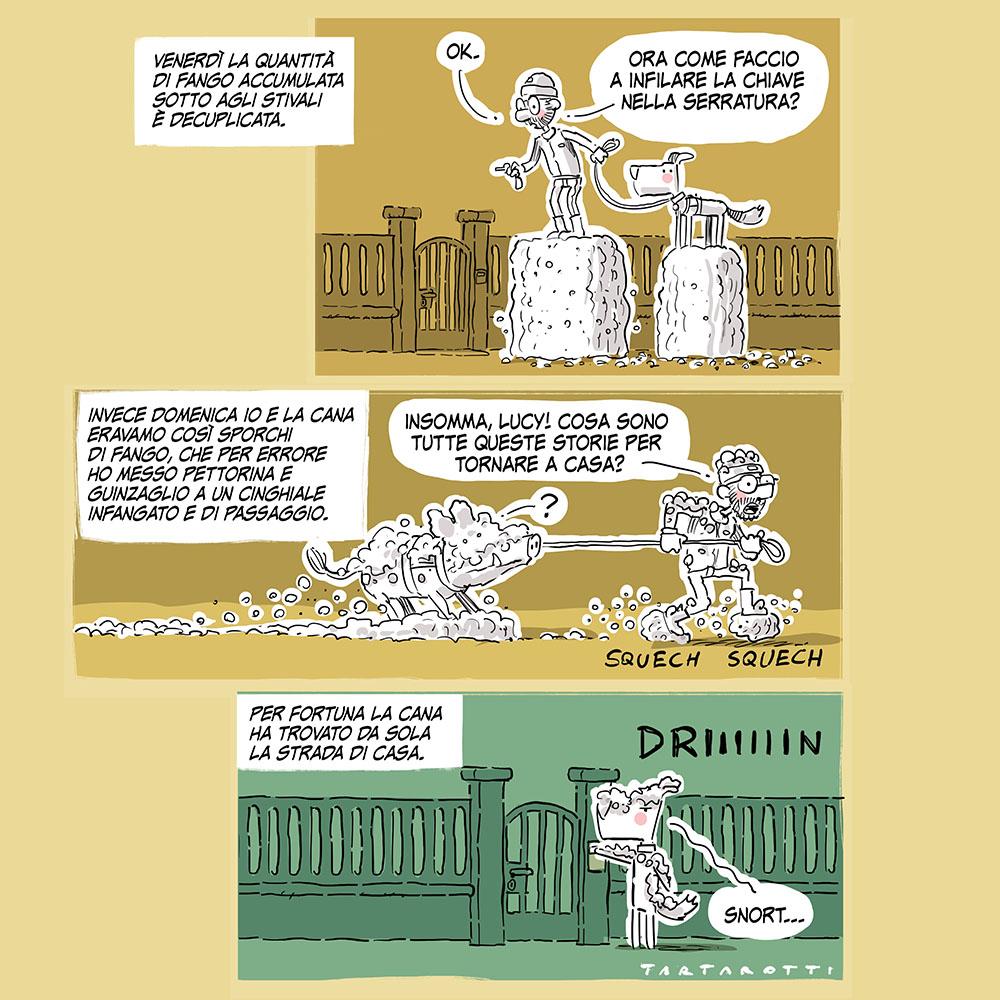
@tarta Questa è una striscia a fumetti italiana composta da tre vignette, con uno sfondo giallo chiaro. La vignetta superiore mostra un pendio boscoso con un sentiero tortuoso, e contiene il testo: "NELLE ULTIME SETTIMANE HA PIOVUTO MOLTO E I SENTIERI SULLA COLLINA DIETRO CASA SI SONO RIEMPITI DI FANGO." La vignetta centrale raffigura una persona e un cane ricoperti di fango; la persona chiede: "C'ERA FANGO SUL SENTIERO?" mentre il cane risponde: "FORSE-". La vignetta inferiore mostra la stessa persona e lo stesso cane in piedi su fango solidificato, etichettato "FANGO SOLIDIFICATO", con il testo: "MERCOLEDÌ HO FATTO L'ERRORE DI FERMARMI A GUARDARE IL PANORAMA E SIAMO SUBITO DIVENTATI DEI PERSONAGGI DEL SUBBUTO." Inoltre, la vignetta centrale include il testo: "LUNEDÌ SIAMO TORNATI A CASA CON PARECCHI CHILI DI FANGO ATTACCATI AGLI STIVALI E ALLE ZAMPE."
―
Una striscia a tre vignette con testo in italiano raffigura personaggi dei cartoni animati in situazioni fangose. La vignetta superiore mostra un personaggio in piedi su un mucchio di fango vicino a un cancello, che sta parlando con un robot; le caselle di testo recitano: "VENERDI LA QUANTITÀ DI FANGO ACCUMULATA SOTTO GLI STIVALI È DECUPLETA" e "ORA COME FACCO A INFISSARE LA CHIAVE NELLA SERRATURA?". La vignetta centrale presenta un personaggio che tiene in braccio una creatura simile a un maiale e una lumaca, entrambi nel fango, con un testo che dice: "INVECE DOMENICA IO E LA CANA ERAMO COSI SPORCHI DI FANGO, CHE PER ERRORE HO MESSO PETTORINA E GUINZAGLIO A UN CINGHIALE INFANGATO E DI PASSAGGIO" e "INSOMMA, LUCY! COSA SONO TUTTE QUESTE STORIE PER TORNARE A CASA?" insieme agli effetti sonori "SQUECH SQUECH". La vignetta inferiore ha uno sfondo verde, un personaggio che tiene una scopa vicino a un cancello, e un testo che dice: "PER FORTUNA LA CANA HA TROVATO DA SOLA LA STRADA DI CASA" con gli effetti sonori "DRIIIIIN", "SNORT...", e "TAATATATTI". Tutte le vignette utilizzano un disegno a linee semplici su sfondi marrone chiaro o verde per mostrare ambienti fangosi con dialoghi ed effetti sonori.Fornito da @altbot, generato localmente e privatamente utilizzando Qwen3-Vl:8b
🌱 Energia utilizzata: 1.647 Wh
-
-
-
Monsignor Savino al Congresso di Magistratura Democratica: parlerò di Costituzione e Dossetti
@giornalismo
articolo21.org/2026/02/monsign…
“Con quest’ultima intervista non parlo più dell’argomento fino al referendum, venite
-
Le passeggiate fangose delle ultime settimane.
-
Inflazione elettrica, minaccia per l’AI-merica
L'inflazione elettrica, spinta soprattutto dai data center, sarà sempre più centrale per gli esiti elettorali statunitensi. La Cina invece pare non avere problemi di colli di bottiglia. E l'Italia? Buona fortuna
https://phastidio.net/2026/02/18/inflazione-elettrica-minaccia-per-lai-merica/
-
Moldavia: la “strategia di sopravvivenza” contro l’assedio della guerra ibrida russa
@news
L’11 giugno 2025, l’aeroporto internazionale di Chișinău non sembrava un normale scalo europeo, ma un’arena di scontro politico. Tra urla e spintoni contro la polizia di frontiera, decine di passeggeri appena rientrati da Mosca hanno trasformato l’area arrivi in un