
Medieval Iron, Survivorship Bias and Modern Metallurgy
Uncategorized
1
Posts
1
Posters
2
Views

-
Medieval Iron, Survivorship Bias and Modern Metallurgy
When you hear it said that “Modern steel is disposable by design”, your ears perk up, as you just caught the unmistakable sound of faux romanticism along with ‘lost ancient technology‘ vibes. Although it happens sometimes that we did lose something important, as with for example the ancient Roman concrete that turns out to have self-healing properties as a result of so-called hot mixing, this is decidedly an exception.
We nearly lost that technology because of the technological and scientific bonfire that was the prelude to a thousand years of darkness over Europe: called the Dark Ages, Middle Ages as well as the medieval period. Thus when you come across a slideshow video with synthesized monotonal voice-over which makes the bold claim that somehow medieval iron was superior and today’s metallurgy both worse and designed to break, you really have to do a spit-take. The many corrections in the comment section further reinforces the feeling that it’s more slop than fact.
One of the claims made is that the bloomery furnace beats the blast furnace, due to beneficial additives to the iron. Considering that the video cites its sources, it’s at least worthy of a dive into the actual science here. Are modern iron and steel truly that inferior and disposable?
The Iron Age
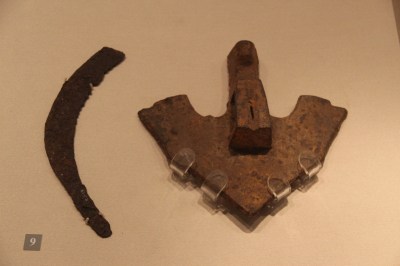
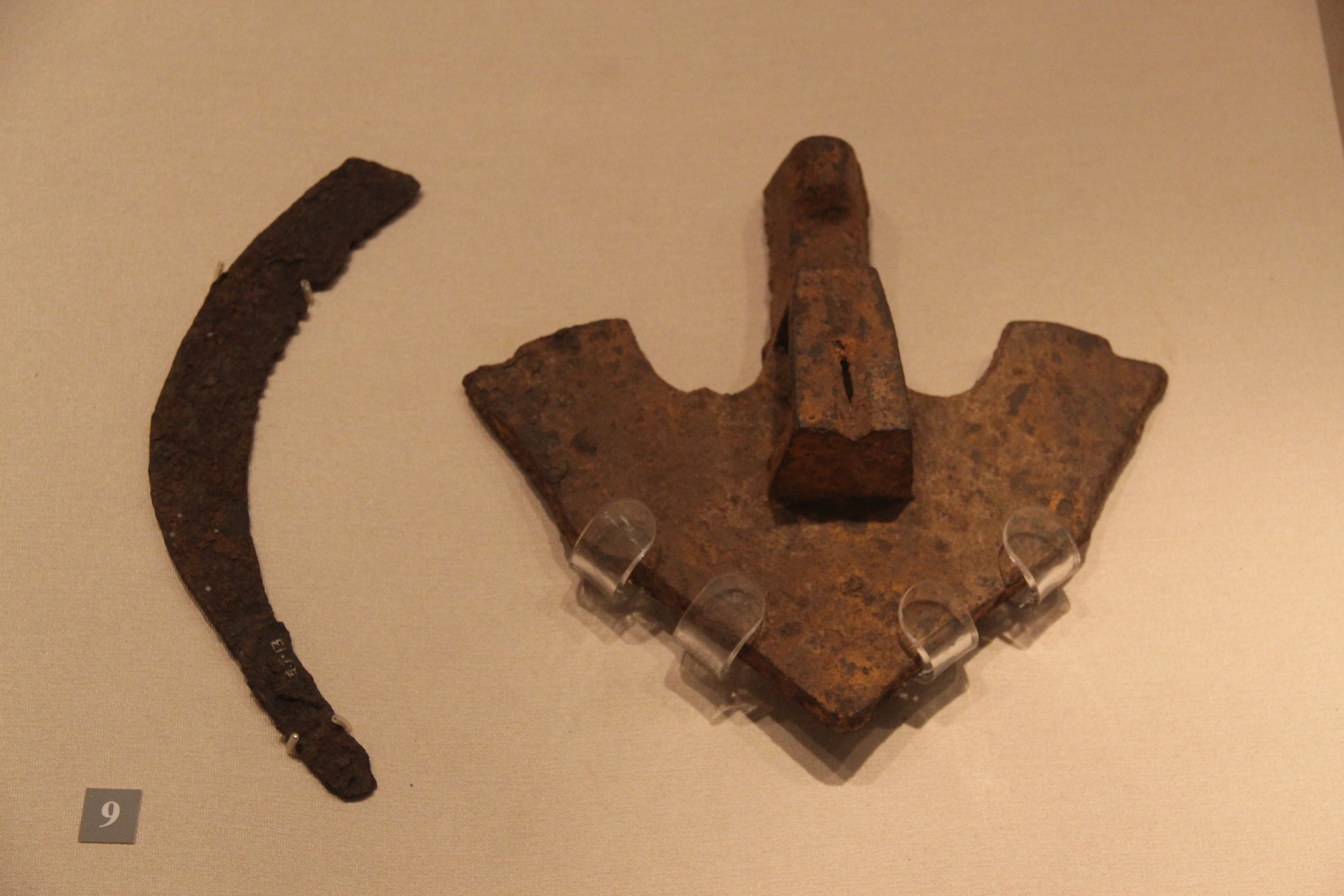
Han Dynasty iron sickle and plow. (Credit: Gary Todd, Wikimedia)
The Iron Age is defined as the point when a civilization begins to mass-produce tools and weapons made from processed iron ore rather than just the use of found meteoric iron. What makes this such a telling technological moment is because in order to smelt iron, you need to have a furnace capable of generating temperatures around 1,250 °C. The transition between the easier to process bronze and superior iron took place between 1,200 and 1,100 BCE in Europe, along with much of Asia, in particular India and China.Processing iron ore to turn it into any of the types of iron alloys possible can be done in a variety of ways, with direct reduction through smelting commonly being used throughout history, alongside blast furnaces. These latter became the most common approach in the 20th century, using a two-stage process involving refining in a converter. Electric arc furnaces can take both the pig iron from blast furnaces and scrap metal as input. Regardless of the method used, the iron ore has to have its impurities removed or reduced to the desired levels for the target alloy.
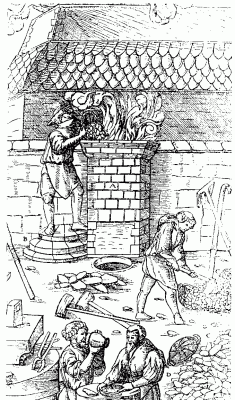
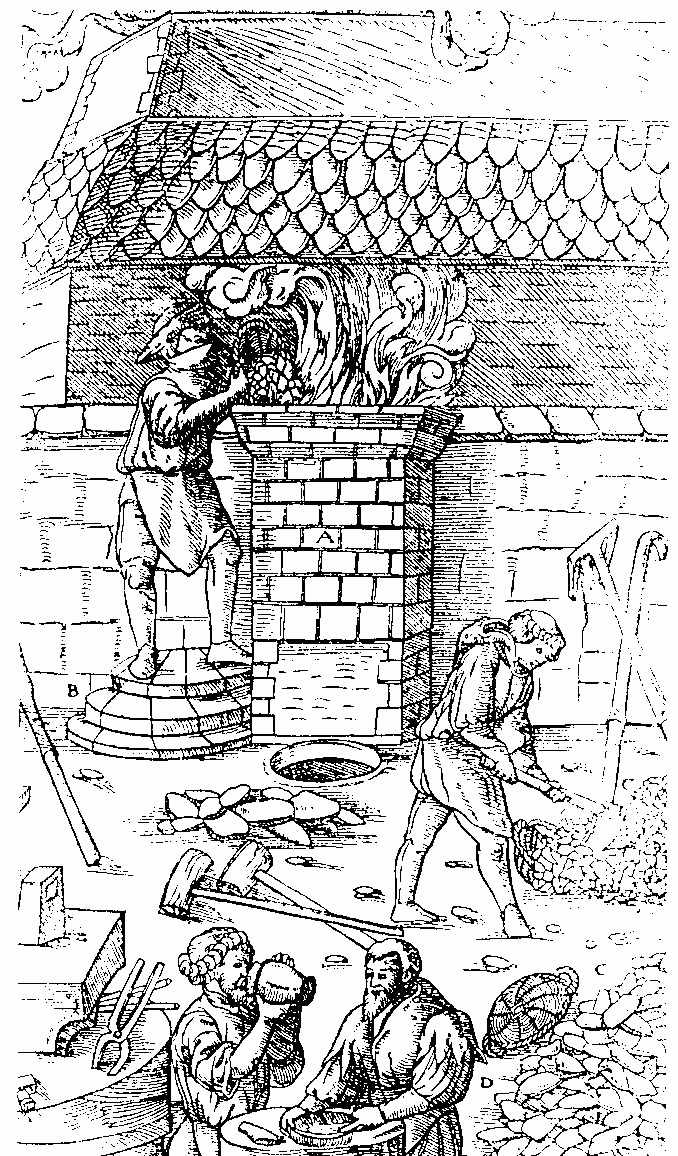
Bloomery smelting during the Middle Ages, as depicted in the De Re Metallica by Georgius Agricola, 1556 (Source: Wikimedia)
Pig iron is the output of blast furnaces and can be used for cast iron when melted. This is different from the wrought iron, which traditionally was produced using the output from a bloomery. This is a type of metallurgical furnace capable of smelting iron ore. Using direct reduction with a reduction gas like carbon monoxide, methane or hydrogen, it produces direct reduced iron, also called sponge iron, with the intended reduction in carbon content. This can then be processed by a blacksmith into wrought iron products.Blast furnaces also provide this carbon reduction, using coke or hydrogen as the redox agent, but as a continuous process the resulting pig iron has a carbon content of 3.8 – 4.7% compared to the higher purity of direct reduced iron that puts it on the level of scrap steel.
Currently blast furnaces and electric arc furnaces offer the most economical way to produce large amounts of steel. Modern direct reduction furnace types have been developed that while not directly competitive have certain advantages, such as being able to process certain ore types that blast furnaces struggle with.
That said, China in particular focused significantly on blast furnaces, with no significant use of bloomeries, but instead the use of finery forges to refine the pig iron from their blast furnaces. By using water power, the blast furnaces could produce massive amounts of pig iron, giving China a significant advantage over medieval Europe.
Archaeometallurgy
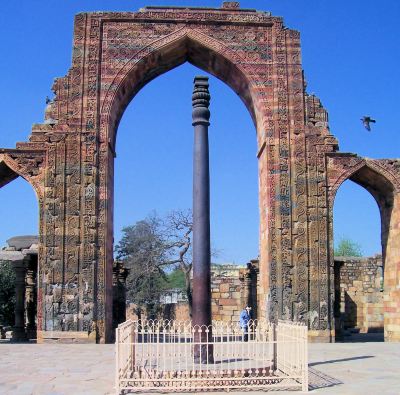
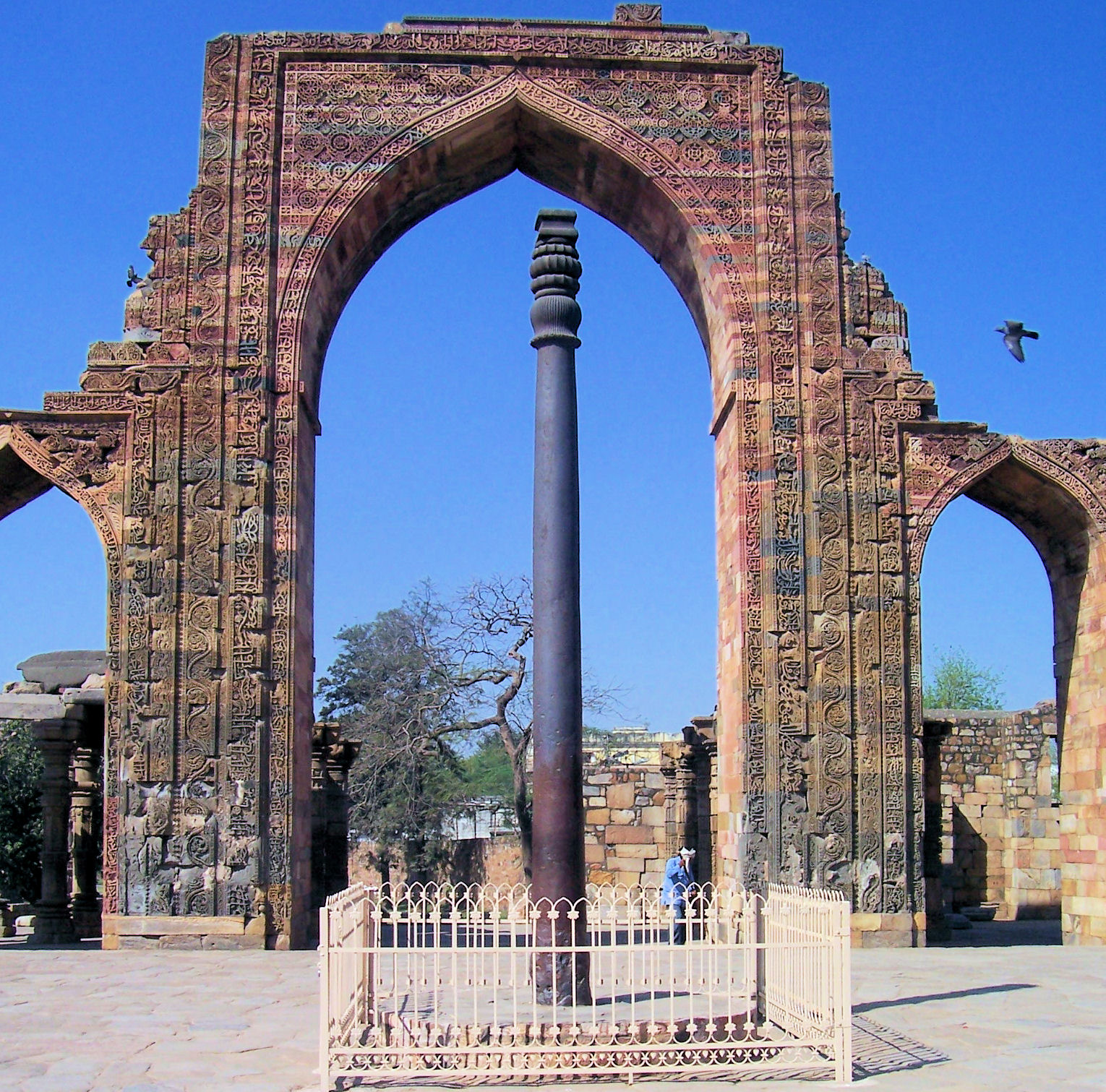
The Iron pillar of Delhi, erected around 400 CE. (Credit: Sujit Kumar, Wikimedia)
So how did medieval iron alloys differ from that during the early days of the Iron Age in Europe and China, never mind during the technological boom of the ancient Roman Empire? Unsurprisingly the Early Middle Ages (500 – 1000 CE) saw mostly a sharp decline in mining and metallurgy that took until the High Middle Ages (11th to 13th centuries) to begin to recover and the Late Middle Ages to see a strong push for innovation. This was however not an easy period, as famine, war and pestilence kept ravaging economies and its people. Compared to the relative peace and structured society of the Roman times, things couldn’t have been more different.The study of metallurgy from a historical context is called archaeometallurgy, which focuses on observable evidence such as slag and similar residues left over at former furnace and blacksmithing sites, as well as found metal artefacts. This latter aspect of found artefacts bears reminding, as these include the iron objects that survived often being buried for hundreds if not thousands of years. This risks indulging in survivorship bias, as we do not recover iron artefacts that did rust away, nor those that were tossed with other scrap metal into a furnace.
The iron pillar of Delhi is one such example. This six-ton, 7.21 m tall behemoth has drawn significant attention for its lack of corrosion despite having been exposed to the elements for more than a thousand years. After study of this pillar and other examples of Indian iron from roughly the same era, the levels of phosphor (P) were implicated in the formation of a corrosion resistant hydrate layer, as summarized in a 2000 article by R. Balasubramaniam in Corrosion Science. This is however a relatively thin and fragile layer. Before a protective cage was added, the constant touching of visitors would affect this layer, explaining why its bottom is rather rusty.
What this does however highlight is the importance of a passivation element in iron alloys to enable some level of corrosion resistance by preventing or slowing down the oxidation process. This, combined with environmental factors such as dry air and a low-oxygen environment can be key to the survival of an iron object.
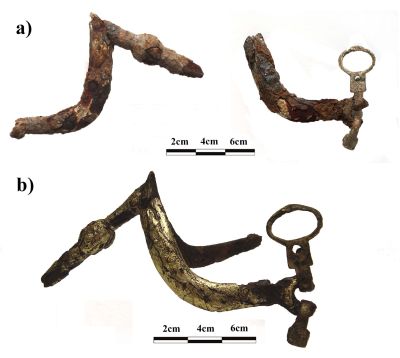
Spanish medieval gilded spur. 13th – 15th century as found (a) and preserved (b) (Credit: Marco Veneranda et al., 2016)
In the case of modern stainless steel, this passivation is provided primarily by chromium which helps form a protective layer. As pre-Industrial Revolution iron alloys tended to have significant amounts of slag and other contaminants embedded in them, this provided enough opportunities for such a passivation layer to be formed.A good study subject when it comes to medieval iron can be found in the surviving medieval structures, which are primarily churches and cathedrals. These have iron reinforcements that are exposed to various environments, ranging from an dry indoor climate to ones more conducive to corrosion. In a study of these iron rebars in the 13th century Bourges’ Cathedral attic, including a broken one, it was found that they were decidedly rusting away and that even these primarily indoor rebars need special preservation techniques to keep them from eventually failing.
During an excavation in a medieval necropolis in Spain, a gilded spur was uncovered. This was used for an experimental archaeological analysis method, detailing just how far this gilded, medieval iron object was decayed. While the gold layer provided some protection against corrosion, eventually moisture and oxygen managed to make its way past this layer and over the course of a few hundred years much of the spur decayed to the point where it was largely falling apart.
Modern Age
Although it’s tempting to hold modern day in contempt and indulge in romanticism of a past that never was, the fact of the matter is that these days we have ways to analyze and manipulate iron and other alloys in ways that the ancient Romans and medieval metallurgists could only dream of. While they had extensive institutional knowledge based on empirical findings, we can use methods like Raman spectroscopy to prod molecules to determine their identity and electron microscopes to find out their structure.Whereas for ancient Roman concrete we can definitely state that it’s better in certain ways than the concrete we have been using since the Industrial Revolution, there we have the hard to miss evidence of Roman concrete structures like ancient seawalls and the Pantheon in Rome seemingly oblivious to the elements and weather of the past two thousand-odd years.
As far as miraculous ancient iron goes, there are definitely a few oddities out there like certain types of Indian iron, and using modern metallurgy we should definitely do our utmost to understand the materials science behind their longevity. That said, modern metallurgy is already pretty good. If your tools are rusting away, or your stainless steel car is taking on a disquieting orange sheen, you probably should have picked that 304 stainless steel instead of cheapening out with a 200-series or 301 stainless steel. We have the technology.
-
 undefined andre123@snowfan.masto.host shared this topic on

Gli ultimi otto messaggi ricevuti dalla Federazione
-
@CmykStudent
The #Amiga4000 Tower!
-
Romagna mia fatti capanna / 2
@anarchia
Gli affitti esaaaaaaaaaagerati dell’ Azienda ASL. di Davide Fabbri (*) Una inchiesta sullo spreco di danaro pubblico dell‘Azienda USL della Romagna. Sono letteralmente vergognosi – quasi inverosimili – i canoni annui di locazione che l’Azienda USL della Romagna ha corrisposto...Vedi l'articolo
https://www.rivoluzioneanarchica.it/romagna-mia-fatti-capanna-2/
-
@thatgiga @ORSOrama
Però sono amici loro, avrei preferito fossero amici miei, con o senza scappellamento a destra... 🤷
-
I received a phone call from a rival company asking for a character reference for one of my staff. The employee in question is the worst in my team. Incompetent, always late, and not the nicest of people. So of course I gave the most glowing reference I've ever given.
-
Questa la capiscono solo i sardi
- Mio nonno dice che a Trump piacciono gli asparagi. Ogni volta che appare al telegiornale dice "cussu boli sparau"
-
@heals I have a 500 character limit when writing any kind of post including supplies. People who are not on stock mastodon often have a much higher character limit, and some of those people do not have the ability to say anything important in under 1000 words
-
Quick update since I rebased this branch for (eventual) 3.4 development. I cleaned up the channel code a bit so it now properly separates out the Key channel from the Cyan/Magenta/Yellow channels.
-
This year I am not having much luck with drains. After the #Crapturday in the office, a kitchen drain got clogged. I decided to rush to the rescue with my drain snake. I dismantled and cleaned all the local pipes, then inserted the five-meter snake and, after some persistence, managed to get through. In other words, I was quite satisfied.
After putting everything back together, I realized I had actually solved nothing. So I armed myself with two bottles of liquid drain cleaner and poured them down the drain. Then I prepared a small pot of boiling water to pour in afterward. As soon as I poured it, it started gurgling (as expected) and going down.
Just as I was about to celebrate victory, some sort of explosion happened, spraying all the drain cleaner back at me. Needless to say, since I had not expected anything like that (and it was an unplanned operation), I was wearing a pair of trousers and a shirt I care about.
The result: trousers and shirt permanently stained with drain cleaner, and the drain even more clogged than before.
Now both the shirt and the trousers are in the washing machine with dye. They will become blue 🙂










.jpg)

