Hardware Store Marauder’s Map is Clarkian Magic
Uncategorized
1
Posts
1
Posters
0
Views
-
Hardware Store Marauder’s Map is Clarkian Magic
The “Marauder’s Map” is a magical artifact from the Harry Potter franchise. That sort of magic isn’t real, but as Arthur C. Clarke famously pointed out, it doesn’t need to be — we have technology, and we can make our own magic now. Or, rather, [Dave] on the YouTube Channel Dave’s Armoury can make it.
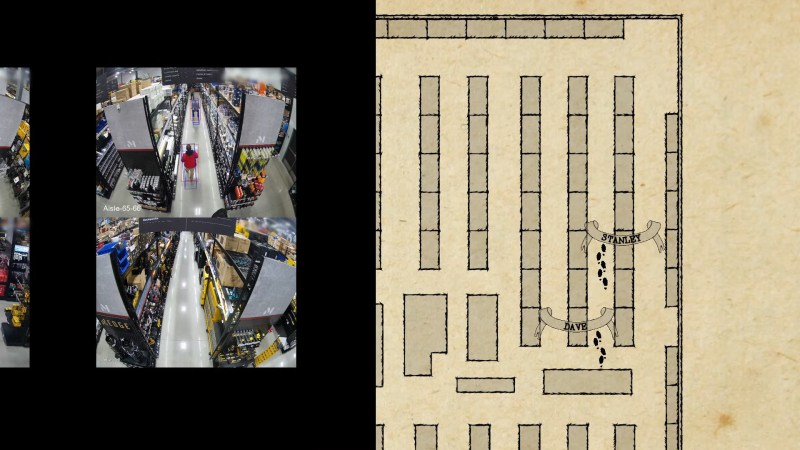
[Dave]’s hardware store might be in a rough neighborhood, since it has 50 cameras’ worth of CCTV coverage. In this case, the stockman’s loss is the hacker’s gain, as [Dave] has talked his way into accessing all of those various camera feeds and is using machine vision to track every single human in the store.
Of course, locating individuals in a video feed is easy — to locate them in space from that feed, one first needs an accurate map. To do that, [Dave] first 3D scans the entire store with a rover. The scan is in full 3D, and it’s no small amount of data. On the rover, a Jetson AGX is required to handle it; on the bench, a beefy HP Z8 Fury workstation crunches the point cloud into a map. Luckily it came with 500 GB of RAM, since just opening the mesh file generated from that point cloud needs 126 GB. That is processed into a simple 2D floor plan. While the workflow is impressive, we can’t help but wonder if there was an easier way. (Maybe a tape measure?)
Once an accurate map has been generated, it turns out NVIDIA already has a turnkey solution for mapping video feeds to a 2D spatial map. When processing so much data — remember, there are 50 camera feeds in the store — it’s not ideal to be passing the image data from RAM to GPU and back again, but luckily NVIDIA’s “Deep Stream” pipeline will do object detection and tracking (including between different video streams) all on the GPU. There’s also pose estimation right in there for more accurate tracking of where a person is standing than just “inside this red box”. With 50 cameras, it’s all a bit much for one card, but luckily [Dave]’s workstation has two GPUs.
Once the coordinates are spat out of the neural networks, it’s relatively simple to put footprints on the map in true Harry Potter fashion. It really is magic, in the Clarkian sense, what you can do if you throw enough computing power at it.
Unfortunately for show-accuracy (or fortunately, if you prefer to avoid gross privacy violations), it doesn’t track every individual by name, but it does demonstrate the possibility with [Dave] and his robot. If you want a map of something… else… maybe check out this backyard project.
youtube.com/embed/dO32ImnsX-4?…

Gli ultimi otto messaggi ricevuti dalla Federazione
-
@gam3 we are not
-
@gilmae that's interesting! Elaborate. What happened in 1959?
-
@bert_hubert @vitaut also it should be kept in mind that the ZX Spectrum was released before the IEEE-754 standard, and the standard itself was developed *because* the were a lot of incompatible and some honestly frankly horrid systems around, not just Sinclair's stuff.
-
@quinn you do your professional writing on bbedit?
-
Building a Multi-Channel Pipette for Parallel Experimentation
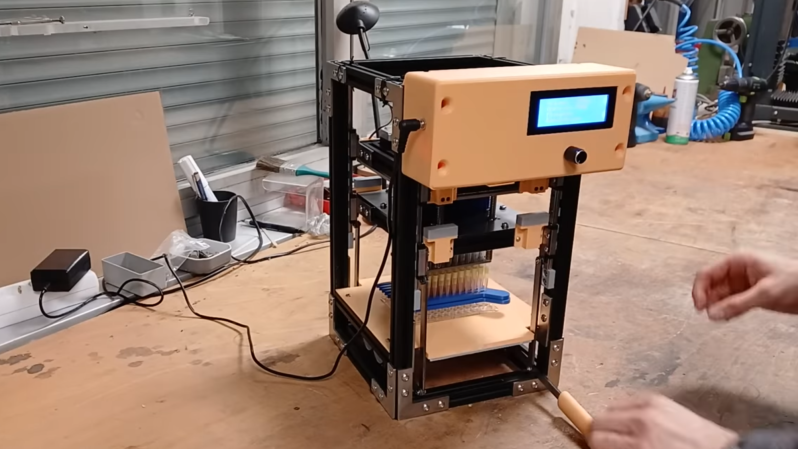
One major reason for the high cost of developing new drugs and other chemicals is the sheer number of experiments involved; designing a single new drug can require synthesizing and testing hundreds or thousands of chemicals, and a promising compound will go through many stages of testing. At this scale, simply performing sequential experiments is wasteful, and it’s better to run tens or hundreds of experiments in parallel. A multi-channel pipette makes this significantly simpler by collecting and dispensing liquid into many vessels at once, but they’re, unfortunately, expensive. [Triggy], however, wanted to run his own experiments, so he built his own 96-channel multi-pipette for a fiftieth of the professional price.
The dispensing mechanism is built around an eight-by-twelve grid of syringes, which are held in place by one plate and have their plungers mounted to another plate, which is actuated by four stepper motors. The whole syringe mechanism needed to move vertically to let a multi-well plate be placed under the tips, so the lower plate is mounted to a set of parallel levers and gears. When [Triggy] manually lifts the lever, it raises the syringes and lets him insert or remove the multi-well. An aluminium extrusion frame encloses the entire mechanism, and some heat-shrink tubing lets pipette tips fit on the syringes.
[Triggy] had no particularly good way to test the multi-pipette’s accuracy, but the tests he could run indicated no problems. As a demonstration, he 3D-printed two plates with parallel channels, then filled the channels with different concentrations of watercolors. When the multi-pipette picked up water from each channel plate and combined them in the multi-well, it produced a smooth color gradient between the different wells. Similarly, the multi-pipette could let someone test 96 small variations on a single experiment at once. [Triggy]’s final cost was about $300, compared to $18,000 for a professional machine, though it’s worth considering the other reason medical development is expensive: precision and certifications. This machine was designed for home experiments and would require extensive testing before relying on it for anything critical.
We’ve previously looked at the kind of miniaturization that made large-scale biology possible and some of the robots that automate that kind of lab work. Some are even homemade.
youtube.com/embed/2TTu-Lkz2Eo?…
Thanks to [Mark McClure] for the tip!
-
@impermanen_ I think I lost 20% of my hearing just looking at the image. ;-)
Must have been pretty loud for whoever took the photo!
-
Apache OpenOffice lists download information here, for everyone who is interested:
https://www.openoffice.org/stats/downloads.html
They say there have been about 390M downloads total. From the stats, I'm estimating somewhere in the low tens of thousands of downloads per day.
-
@evan I used Word most recently on Friday, working on a proposal.
But on the other hand I used Jupyter -> LaTeX -> Emacs -> pdf on Tuesday, a publishing system that gave me much more pleasure. Not something that my colleagues will realistically repeat though.