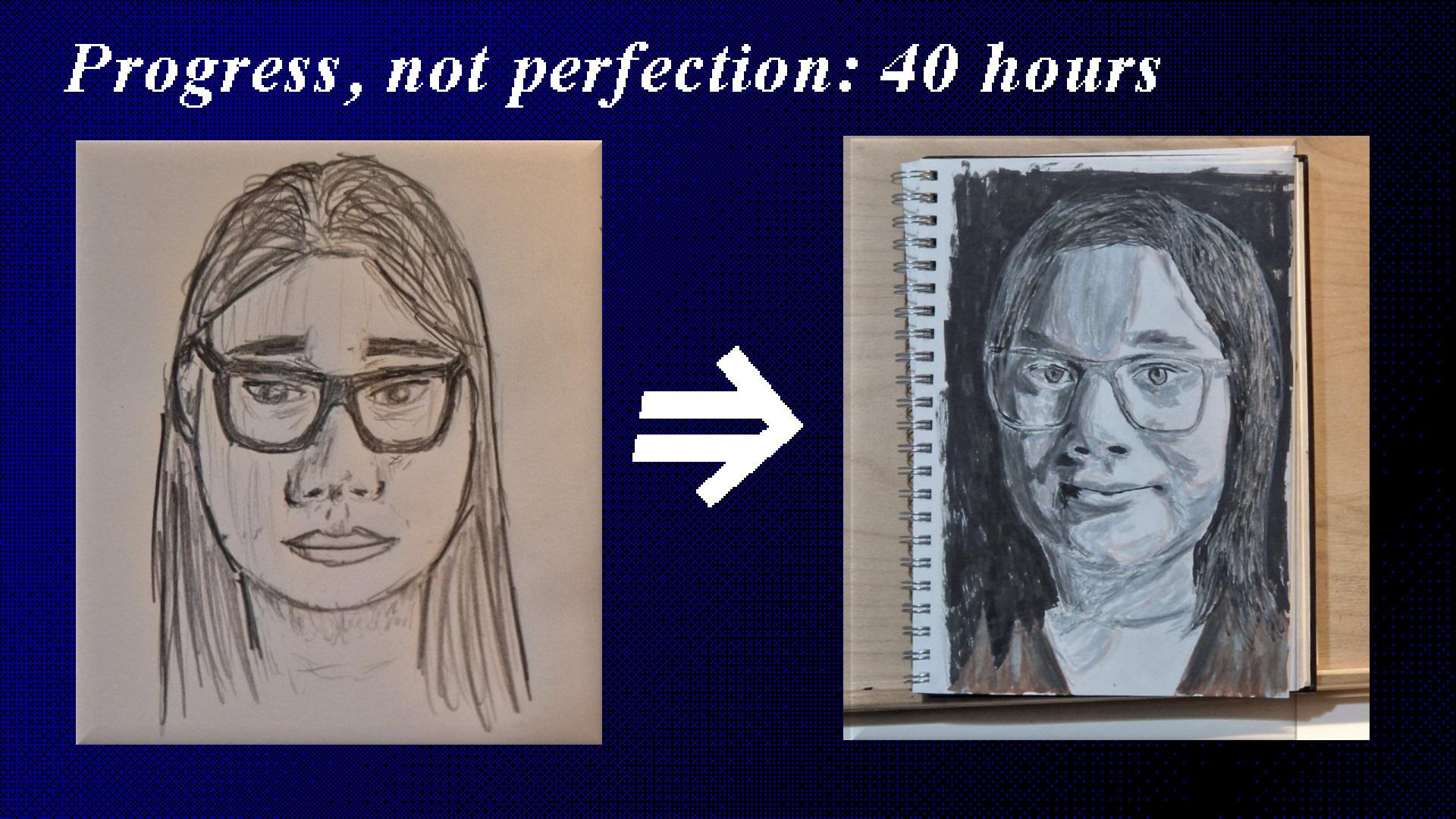
I wrote ~5000 words on what 40 hours of studying drawing can do.
Uncategorized
36
Posts
2
Posters
20
Views
-
@nina_kali_nina "Picture This" is a memoir on creativity. It explores various motivations she's had for making art over the years, why she rejected the more formal stuff she learned in school, in favor of a more loose and radical comic style, discusses burnout, and chases after this illusive thing she calls an Image which is the animating spirit of life that can be found in all art. These are all very visually dense texts, and this one probably the most so.
@nina_kali_nina "Picture This" is also not very instructive. I think it's notable for condensing a lot of her philosophy that is explored upon in more detail in other works. I found it helpful for clawing my way out of burnout in the past.
-
@nina_kali_nina "Picture This" is also not very instructive. I think it's notable for condensing a lot of her philosophy that is explored upon in more detail in other works. I found it helpful for clawing my way out of burnout in the past.
@nina_kali_nina "What It Is" is focused on exploring memory, and the latter half is entirely exercises. This is focused on writing not drawing, but it is a method that dill draw out Images (capital I), and I think the creative exercises in it are broadly applicable. This is a book about exploring the depths of your mind and creativity.
-
@nina_kali_nina "What It Is" is focused on exploring memory, and the latter half is entirely exercises. This is focused on writing not drawing, but it is a method that dill draw out Images (capital I), and I think the creative exercises in it are broadly applicable. This is a book about exploring the depths of your mind and creativity.
@nina_kali_nina "Syllabus: Notes From an Accidental Professor" is her notes from teaching a drawing class focused on students from a wide variety of backgrounds and inhibition about drawing, and is about unlearning shame and inhibition surrounding art making, and finding you voice and developing a style. Also good for getting out of creative ruts. The book is a mix of theory and exercises.
-
@nina_kali_nina "Syllabus: Notes From an Accidental Professor" is her notes from teaching a drawing class focused on students from a wide variety of backgrounds and inhibition about drawing, and is about unlearning shame and inhibition surrounding art making, and finding you voice and developing a style. Also good for getting out of creative ruts. The book is a mix of theory and exercises.
@nina_kali_nina "Making Comics" is another compilation of notes, theory, research, and structured course work much like Syllabus, and is the continuation of her research on adult learners. This one is nominally more specifically about making comics as the name implies, but it's really about hooking up a lightning rod to your creativity and animating The Creature
-
@nina_kali_nina "Making Comics" is another compilation of notes, theory, research, and structured course work much like Syllabus, and is the continuation of her research on adult learners. This one is nominally more specifically about making comics as the name implies, but it's really about hooking up a lightning rod to your creativity and animating The Creature
@nina_kali_nina and I'd say broadly the throughline of her pedagogical work is dismantling the widespread culture of learned helplessness and pretension surrounding art to work out what the biological function of art is, and how to draw that out of people. Her creative philosophy is radical and powerful. However, these books will not make you more proficient at the technical aspects of drawing, nor will they teach you how to make Correct art.
-
@nina_kali_nina and I'd say broadly the throughline of her pedagogical work is dismantling the widespread culture of learned helplessness and pretension surrounding art to work out what the biological function of art is, and how to draw that out of people. Her creative philosophy is radical and powerful. However, these books will not make you more proficient at the technical aspects of drawing, nor will they teach you how to make Correct art.
This post is deleted! -
@nina_kali_nina and I'd say broadly the throughline of her pedagogical work is dismantling the widespread culture of learned helplessness and pretension surrounding art to work out what the biological function of art is, and how to draw that out of people. Her creative philosophy is radical and powerful. However, these books will not make you more proficient at the technical aspects of drawing, nor will they teach you how to make Correct art.
@nina_kali_nina I'm reading through your blog post in earnest now, but need to take a break for dinner, but I want to emphasize this before I forget, that drawing should be a joyous activity, not one where you feel depressed, so I think your instincts are right that this is something psychological that you learned over time (and can also unlearn with time)
-
@nina_kali_nina I'm reading through your blog post in earnest now, but need to take a break for dinner, but I want to emphasize this before I forget, that drawing should be a joyous activity, not one where you feel depressed, so I think your instincts are right that this is something psychological that you learned over time (and can also unlearn with time)
@nina_kali_nina this painting I did last week was a practice piece https://mastodon.gamedev.place/@aeva/115880174021858716 and going off the social media numbers it wasn't a particularly successful work, and there are some technical problems with it, but it is one of my favorite things I've made recently, primarily because of how much fun I had making it. the image was completely alive under my stylus, and the only reason I stopped working on it was chronic pain flaring up and physical exhaustion
-
@nina_kali_nina this painting I did last week was a practice piece https://mastodon.gamedev.place/@aeva/115880174021858716 and going off the social media numbers it wasn't a particularly successful work, and there are some technical problems with it, but it is one of my favorite things I've made recently, primarily because of how much fun I had making it. the image was completely alive under my stylus, and the only reason I stopped working on it was chronic pain flaring up and physical exhaustion
@nina_kali_nina as I would have injured myself if I kept going. It's a lot of fun. I put on drum and bass music to groove along to it while I paint, I set my cintiq up like I'm standing at an easel, and I count it as my daily physical exercise. I call it "drawing and bass".
-
@nina_kali_nina as I would have injured myself if I kept going. It's a lot of fun. I put on drum and bass music to groove along to it while I paint, I set my cintiq up like I'm standing at an easel, and I count it as my daily physical exercise. I call it "drawing and bass".
@nina_kali_nina ok done with dinner, I have more thoughts on your post, maybe you will find some of them useful.
Some technical advice for pushing your drawing further:
I recommend experimenting with charcoal and conte chalk when you sketch. You'll be able to do more subtle gradients and more striking dynamic range, and a pink pearl eraser or a kneaded rubber eraser will lift it back up just fine if you don't like a mark, just like pencil.
-
@nina_kali_nina ok done with dinner, I have more thoughts on your post, maybe you will find some of them useful.
Some technical advice for pushing your drawing further:
I recommend experimenting with charcoal and conte chalk when you sketch. You'll be able to do more subtle gradients and more striking dynamic range, and a pink pearl eraser or a kneaded rubber eraser will lift it back up just fine if you don't like a mark, just like pencil.
@nina_kali_nina second, I noticed you are fond of the outline. In observational drawing, it is a good exercise to try to avoid drawing any outlines beyond light contour lines used for planning out sketches. This will look more naturalistic, because real life does not have outlines.
-
@nina_kali_nina second, I noticed you are fond of the outline. In observational drawing, it is a good exercise to try to avoid drawing any outlines beyond light contour lines used for planning out sketches. This will look more naturalistic, because real life does not have outlines.
@nina_kali_nina third, there is nothing correct about point perspective. it's a geometric convenience for planning out technically impressive works, but it is not optically accurate, nor is it how our brains process what our eyes see (it's so much weirder, I have some interesting reading to point you toward on that, but I can't seem to find it at the moment). there's also "zero-point" perspective which is generally more useful for naturalistic drawing when you are away from architecture
-
@nina_kali_nina third, there is nothing correct about point perspective. it's a geometric convenience for planning out technically impressive works, but it is not optically accurate, nor is it how our brains process what our eyes see (it's so much weirder, I have some interesting reading to point you toward on that, but I can't seem to find it at the moment). there's also "zero-point" perspective which is generally more useful for naturalistic drawing when you are away from architecture
@nina_kali_nina four, next time you go to an art museum, bring your sketch book and draw pictures of the art. I don't know if this is obvious or not, but you will not get in trouble for drawing in an art museum. If you see something that grabs you about the art, try to pin it down with a quick technical study.
-
@nina_kali_nina four, next time you go to an art museum, bring your sketch book and draw pictures of the art. I don't know if this is obvious or not, but you will not get in trouble for drawing in an art museum. If you see something that grabs you about the art, try to pin it down with a quick technical study.
@nina_kali_nina five, unfiltered objective reality is a fantasy. all art with no exceptions (even photography) is fundamentally contaminated by the subjective judgements and interpretation of the artist. this is, in my opinion, is a wondrous gift, because art allows us to see the world through another's eyes.
consider these two portraits of Charles Robert Leslie by two different professional artists who were contemporaries:
-
@nina_kali_nina five, unfiltered objective reality is a fantasy. all art with no exceptions (even photography) is fundamentally contaminated by the subjective judgements and interpretation of the artist. this is, in my opinion, is a wondrous gift, because art allows us to see the world through another's eyes.
consider these two portraits of Charles Robert Leslie by two different professional artists who were contemporaries:
@nina_kali_nina six, it is important to remember that the western tradition of making Correct Art developed due to a significant commercial aspect that is not there anymore: extraordinarily wealthy individuals and the church commissioned expensive objects for a variety of reasons ranging from propaganda and practical to entertainment. Many of these works that are credited to old masters were actually made by teams of people.
-
@nina_kali_nina six, it is important to remember that the western tradition of making Correct Art developed due to a significant commercial aspect that is not there anymore: extraordinarily wealthy individuals and the church commissioned expensive objects for a variety of reasons ranging from propaganda and practical to entertainment. Many of these works that are credited to old masters were actually made by teams of people.
@nina_kali_nina it is certainly possible to learn those techniques and apply them as an individual, but I think it is a bit like being dazzled by a video game and confusing the technical and creative power of a few dozen people for the work of a solo individual. Anything is possible with enough time and support.
-
@nina_kali_nina it is certainly possible to learn those techniques and apply them as an individual, but I think it is a bit like being dazzled by a video game and confusing the technical and creative power of a few dozen people for the work of a solo individual. Anything is possible with enough time and support.
@nina_kali_nina however the western tradition of art is a cultural anomaly, and contemporary western art in particular struggles with it because when you strip away all the whims of rich people and all the catholicism, what exactly is left? we are left to piece together our own cultural identity from the margins. for the majority of human history people did not make art like this, and did not have this existential problem
-
@nina_kali_nina however the western tradition of art is a cultural anomaly, and contemporary western art in particular struggles with it because when you strip away all the whims of rich people and all the catholicism, what exactly is left? we are left to piece together our own cultural identity from the margins. for the majority of human history people did not make art like this, and did not have this existential problem
@nina_kali_nina which is why Modern art is Like That
-
@nina_kali_nina which is why Modern art is Like That
@nina_kali_nina and I guess one last thing, because I can't help it, a great deal of learning observational drawing (as you've already been hard at work doing) is re-learning how to see the world, and developing the ability to deconstruct what you see into shapes and color that. This is also a process of training your mind's eye, as the visual deconstruction is a kind of second sight that you see in tandem with your real vision.
-
@nina_kali_nina and I guess one last thing, because I can't help it, a great deal of learning observational drawing (as you've already been hard at work doing) is re-learning how to see the world, and developing the ability to deconstruct what you see into shapes and color that. This is also a process of training your mind's eye, as the visual deconstruction is a kind of second sight that you see in tandem with your real vision.
@nina_kali_nina drawing from observation and from your imagination are not mutually exclusive, it is often the case that you imagine the forms you want to draw in isolation so you can draw them. As you practice observational drawing, you can develop a symbolic repertoire of forms that can aid you at more effective observational drawing, and is also a transferable skill to drawing from memory and/or imagination.
Gli ultimi otto messaggi ricevuti dalla Federazione
-
@FediThing I looked into it and I'm not worried at all. The fact they are "launching" in Davos says it all. Starting a new social media network from scratch is hard work. It's gonna fizzle out. The name alone makes it so ridiculous
-
@marcoboh @andre123 il nostro problema è comunque strutturale
Non possiamo fare niente così come siamo, siamo impotenti perche siamo come un'idra con le teste che litigano fra loro, al massimo come una barca con tanti remi che remano a caso seguiremo la corrente (in un mare di corazzate)
Il cambiamento diventa necessario ma non abbiamo tempo, è già tardi
(A prescindere dal fatto che un'Europa forte potrebbe essere colonialista pure lei, una macchina rimessa a nuovo e consegnata alle ultradestre)
-
@nina_kali_nina programming languages fade out of memory faster without use for me. I think that's probably because drawing and music are more fundamental
-
@nina_kali_nina and then I spaced on practicing for about two years, and was surprised I still had a song in my repertoire after that when I started playing again XD
-
@nina_kali_nina I think so too. I stopped taking piano lessons as a teenager, and I picked it back up somewhere about 15 years later give or take and it didn't take long for me to basically speed run 15 years of piano lessons and get back into playing more advanced pieces
-
@aeva I suspect it is similar to music making skills - it takes a while to remember things after a hiatus, but it's much faster than learning from scratch, and there's far more confidence in "I can do this"
-
@khleedril I believe it
-
@aeva The original two-factor authentication was a ruse to force you to give up your phone number.