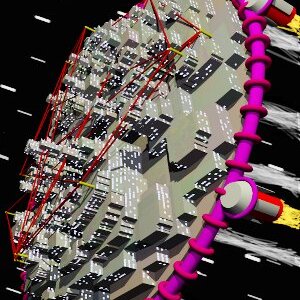
Shortwave "Discone" Antenna, AT&T High Seas Transmitter Site, Ocean Gate, NJ, 2009.
Uncategorized
16
Posts
9
Posters
7
Views
-
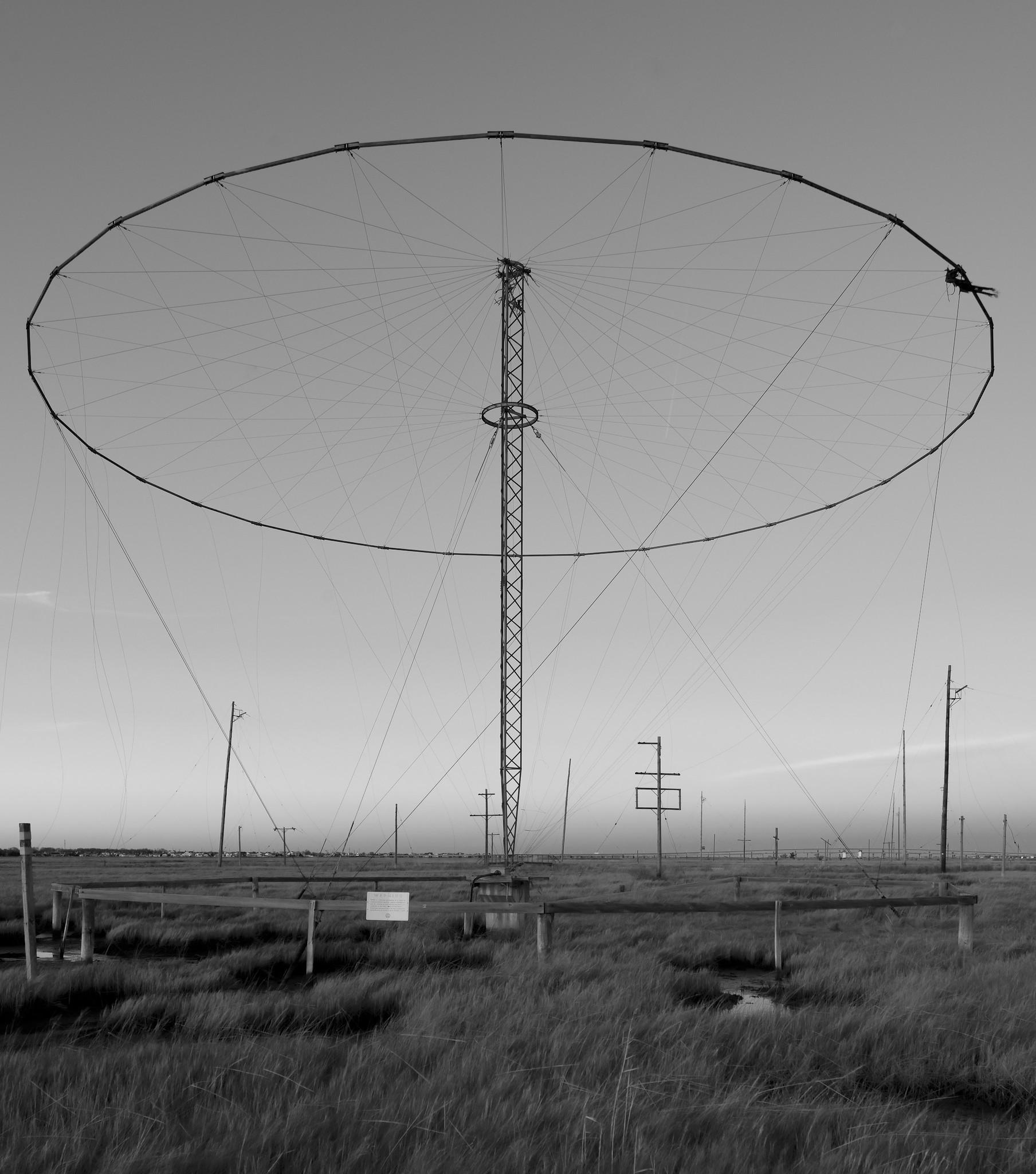
Shortwave "Discone" Antenna, AT&T High Seas Transmitter Site, Ocean Gate, NJ, 2009.
All the pixels, none of the risk of sea sickness or scurvy, at https://www.flickr.com/photos/mattblaze/4141766569
-
Shortwave "Discone" Antenna, AT&T High Seas Transmitter Site, Ocean Gate, NJ, 2009.
All the pixels, none of the risk of sea sickness or scurvy, at https://www.flickr.com/photos/mattblaze/4141766569
Captured with a DSLR and a 24mm shifting lens.
During the 20th century, AT&T operated a shortwave "radiotelephone" service for vessels on the high seas. Ships could contact an operator, who could connect them with any landline telephone number they wished.
The North Atlantic station, callsign WOO, occupied expansive transmit and receive "antenna farms" in marshlands near the shore in central New Jersey.
Rendered obsolete by satellites, the service ceased operation on November 9, 1999.
-
Captured with a DSLR and a 24mm shifting lens.
During the 20th century, AT&T operated a shortwave "radiotelephone" service for vessels on the high seas. Ships could contact an operator, who could connect them with any landline telephone number they wished.
The North Atlantic station, callsign WOO, occupied expansive transmit and receive "antenna farms" in marshlands near the shore in central New Jersey.
Rendered obsolete by satellites, the service ceased operation on November 9, 1999.
There were three AT&T radiotelephone sites in the continental US, each with its own transmit and receive antenna farms: Ocean Gate, NJ (shown here, serving the North Atlantic), Miami (serving the Caribbean and the Gulf), and Point Reyes, CA (serving the Pacific).
All the sites have by now been razed, either for redevelopment or as nature preserves. The antennas (including this one) are mostly gone now.
-
There were three AT&T radiotelephone sites in the continental US, each with its own transmit and receive antenna farms: Ocean Gate, NJ (shown here, serving the North Atlantic), Miami (serving the Caribbean and the Gulf), and Point Reyes, CA (serving the Pacific).
All the sites have by now been razed, either for redevelopment or as nature preserves. The antennas (including this one) are mostly gone now.
Ships on the high seas still occasionally make some use of shortwave radio, but its importance has greatly diminished over the last few decades. The Coast Guard still maintains a "watch" on emergency shortwave frequencies, listening for distress calls, but most transoceanic ships are now equipped with more modern, higher-bandwidth satellite communications systems.
Places like this are what the Internet looked like a century ago. Infrastructure is often heroic, and occasionally looks the part.
-
Ships on the high seas still occasionally make some use of shortwave radio, but its importance has greatly diminished over the last few decades. The Coast Guard still maintains a "watch" on emergency shortwave frequencies, listening for distress calls, but most transoceanic ships are now equipped with more modern, higher-bandwidth satellite communications systems.
Places like this are what the Internet looked like a century ago. Infrastructure is often heroic, and occasionally looks the part.
I should note that while the site (and its cousins) had a number of large discone antennas like this one, they were mostly there as backups in case the main antennas (which included truly massive wire rhombics oriented toward various oceanic regions) or transmitter combiners failed.
The old Bell System did not mess around.
-
Shortwave "Discone" Antenna, AT&T High Seas Transmitter Site, Ocean Gate, NJ, 2009.
All the pixels, none of the risk of sea sickness or scurvy, at https://www.flickr.com/photos/mattblaze/4141766569
@mattblaze crazy that the antenna was still standing in 2009!
-
Captured with a DSLR and a 24mm shifting lens.
During the 20th century, AT&T operated a shortwave "radiotelephone" service for vessels on the high seas. Ships could contact an operator, who could connect them with any landline telephone number they wished.
The North Atlantic station, callsign WOO, occupied expansive transmit and receive "antenna farms" in marshlands near the shore in central New Jersey.
Rendered obsolete by satellites, the service ceased operation on November 9, 1999.
@mattblaze That is so interesting. Thanks for posting.
-
Shortwave "Discone" Antenna, AT&T High Seas Transmitter Site, Ocean Gate, NJ, 2009.
All the pixels, none of the risk of sea sickness or scurvy, at https://www.flickr.com/photos/mattblaze/4141766569
@mattblaze
Burn, baby burn! Discone inferno! Burn, baby burn.... -
 undefined oblomov@sociale.network shared this topic on
-
Shortwave "Discone" Antenna, AT&T High Seas Transmitter Site, Ocean Gate, NJ, 2009.
All the pixels, none of the risk of sea sickness or scurvy, at https://www.flickr.com/photos/mattblaze/4141766569
@mattblaze That's pretty amazing. Were you ever there on a windy day? I'm wondering if they moved about very much...
-
Captured with a DSLR and a 24mm shifting lens.
During the 20th century, AT&T operated a shortwave "radiotelephone" service for vessels on the high seas. Ships could contact an operator, who could connect them with any landline telephone number they wished.
The North Atlantic station, callsign WOO, occupied expansive transmit and receive "antenna farms" in marshlands near the shore in central New Jersey.
Rendered obsolete by satellites, the service ceased operation on November 9, 1999.
@mattblaze
Had a SSB license as crew on a sailing yacht in the Caribbean, ‘71. You called on the radio and were asked your location in latitude & longitude. They focused an antenna on that location and then placed your telephone call, 2,100 miles away.
Used LORAN and another radio system that gave a bearing from counting dots and dash tones with headphones in ‘65, as return crew from Bermuda. -
I should note that while the site (and its cousins) had a number of large discone antennas like this one, they were mostly there as backups in case the main antennas (which included truly massive wire rhombics oriented toward various oceanic regions) or transmitter combiners failed.
The old Bell System did not mess around.
@mattblaze nice shot! Shifting lens to counter keystone distortion?
-
Shortwave "Discone" Antenna, AT&T High Seas Transmitter Site, Ocean Gate, NJ, 2009.
All the pixels, none of the risk of sea sickness or scurvy, at https://www.flickr.com/photos/mattblaze/4141766569
@mattblaze Not sure off the top of my head what the name for that type of antenna is, but it’s not a discone—there’s no cone. A discone involves a radiating disk, then a cone with its apex at the center of the disk as the counterpoise.
Still really neat history.
-
@mattblaze Not sure off the top of my head what the name for that type of antenna is, but it’s not a discone—there’s no cone. A discone involves a radiating disk, then a cone with its apex at the center of the disk as the counterpoise.
Still really neat history.
@bob_zim It’s a discone.
The tip of the conical section is at the base of the tower (from the ring). The “disc” is the buried ground system.
-
@bob_zim It’s a discone.
The tip of the conical section is at the base of the tower (from the ring). The “disc” is the buried ground system.
@mattblaze Huh. I think this is the first I’ve even heard of oriented that way. So the suspended ring is just to hold the counterpoise?
Seems like the guy wires would interfere too much for such a system to be usable. I guess that’s why they’re running at weird angles rather than directly to the closest segment of the ring.
-
@mattblaze Huh. I think this is the first I’ve even heard of oriented that way. So the suspended ring is just to hold the counterpoise?
Seems like the guy wires would interfere too much for such a system to be usable. I guess that’s why they’re running at weird angles rather than directly to the closest segment of the ring.
@bob_zim This is a pretty standard design for lower frequency discone antennas used in commercial facilities. The guy wires have to be insulated, as I recall.
The military uses a version that’s oriented more like a familiar VHF/UHF discone, which they call a “disc-cage”. It’s a more complex design, because the entire base of the conical has to be isolated from ground.
Discones are basically half of a biconical dipole.
-
I should note that while the site (and its cousins) had a number of large discone antennas like this one, they were mostly there as backups in case the main antennas (which included truly massive wire rhombics oriented toward various oceanic regions) or transmitter combiners failed.
The old Bell System did not mess around.
@mattblaze I got to tour the USCG Middletown, CA LORAN facility before it was decommissioned. Fascinating older technology.








Gli ultimi otto messaggi ricevuti dalla Federazione
-
@jerzone we have had rain and melting temps for a week now. Trails are gone, just slush. Waiting for freezing temps so I can go and ride anywhere and everywhere.
-
@lesley yes, but in the case of @riley that's not the same issue: if foo has-a bar, there's no way to do the casting _implicitly_, as far as a I know. It would be possible with references by defining an implicit constructor of bar from foo, but this won't be applied to pointers.
The only work around I can think of is to define an overloaded function
bar * get_bar(bar * o) { return o; }
bar * get_bar(foo * o) { return &o->bar_element; }and wrap pointer arguments with that function.
-
@boostmediaaps davvero complimenti per l'iniziativa!
-
@kenobit argh io avevo un abbonamento online a scimmia yoga fino a qualche mese fa - e avevo condiviso le credenziali con tante altre persone ehe siccome non c’era limite di accessi! stavo gusto pensando se riabbonarmi
anche se magari per cominciare cominciare non sarebbe comunque andato bene
-
@jeypawlik @OhJoySexToy Oh you're here! I love what you do!
-
@OhJoySexToy As a bonus I also drew this "Jey timeline". My usual visual shorthands for flashbacks, etc!
-
A finger numbing 2°F (-17C) morning at 7am, but the light was beautiful and trails were amazing. Short video of one of the downhill sections with friends.
https://youtu.be/GwJzWq6aPI0
#BikeTooter #FatBiking #NHwx
-
@LisaBanana excellent ! I can’t wait ☺️ @CypherSephiroth