Moving Mousepad Is An Elegant Aimbot
Uncategorized
1
Posts
1
Posters
1
Views
-
Moving Mousepad Is An Elegant Aimbot
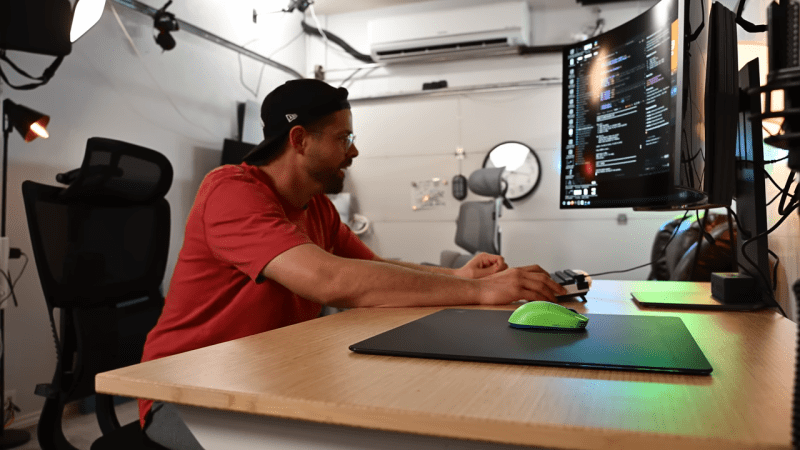
These days, it can be hard to remain competitive in online shooters without spending your entire life dedicated to the sport. This leads some to explore the world of competitive aids. (AKA: cheating.) A great example is [Nick], who built a mechanical aimbot to help in this regard.
[Nick’s] build moves a mousepad underneath the mouse opposite to the desired movement direction, in order to simulate the mouse movements required to aim at targets in game. This is achieved with the aid of a XDraw A4 pen plotter, which served as a cheap prebuilt X-Y motion platform. The plotter responds to simple serial commands, which makes it easy to control. The X-Y gantry was mounted underneath the desk so the mousepad sits seamlessly on top of the desk, sliding neatly on low-friction mouse skate stickers.
With the mousepad control system built, it was then necessary to figure out how to turn it into an aimbot. [Nick] already had a machine vision tool to detect enemies in shooting game, so it was merely modified to make the right mousepad movements to get the crosshairs right where they needed to be before firing. In testing, it proved more than capable at helping a new player achieve far superior aim, as a good aimbot should.
We’ve featured similar projects before that use complex mechanical contraptions to aim for you. Yes, it’s still cheating, but it’s a lot harder to detect than a traditional aimbot. That doesn’t make it right, per se, just more subtle. Video after the break.
youtube.com/embed/T4rrcw_oRVs?…

Gli ultimi otto messaggi ricevuti dalla Federazione
-
-
@leanderlindahl @_elena @EUCommission
I did it too!
-
@anna_addis brilliant! 🙌 @adamsfan @leanderlindahl @EUCommission
-
@shom thank you for all the encouragement 🥰
-
Sta "guida" attacca frontarmente er governo focalizzandose solo su probblemi! 😡 💢
Ce sò stati pure grossi successi! Tipo i rave sò stati debbellati e de utero in affitto nun sene parla manco più 🏆
https://pagellapolitica.it/articoli/manuale-autodifesa-politica-feste-famiglia
-
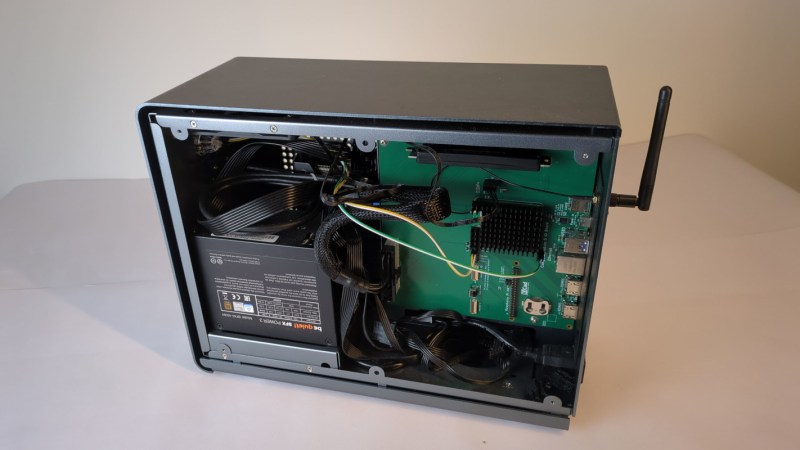
Raspberry Pi Gets Desktop Form Factor
Before the Raspberry Pi came out, one cheap and easy way to get GPIO on a computer with a real operating system was to manipulate the pins on an old parallel port, then most commonly used for printers. Luckily, as that port became obsolete we got the Raspberry Pi, which has the GPIO and a number of other advantages over huge desktop computers from the 90s and 00s as well. But if you really miss that form factor or as yearn for the days of the old parallel port, this build which puts a Raspberry Pi into a mini ITX desktop case is just the thing for you.
There are a few features that make this build more than just a curiosity. The most obvious is that the Pi actually has support for PCIe and includes a single PCIe x1 slot which could be used for anything from a powerful networking card to an NVMe to a GPU for parallel computing in largely the same way that any desktop computer might them. The Pi Compute Module 5 that this motherboard is designed for doesn’t provide power to the PCIe slots automatically though, but the power supply that can be installed in the case should provide power not only to the CM5 but to any peripherals or expansion cards, PCIe or otherwise, that you could think of to put in this machine.
Of course all the GPIO is also made easily accessible, and there are also pins for installing various hats on the motherboard easily as well. And with everything installed in a desktop form factor it also helps to improve the cable management and alleviate the rats-nest-of-wires problems that often come with Pi-based projects. There’s also some more information on the project’s Hackaday.io page. And, if you’re surprised that Raspberry Pis can use normal graphics cards now, make sure to take a look at this build from a few years ago that uses completely standard gaming GPUs on the Pi 5.
-
La Cina avanza su una strada minata dal debito
Cina bifronte: da un lato la corsa forsennata verso il primato tecnologico mondiale; dall'altro un debito, pubblico e privato, in crescita inarrestabile e che rischia di produrre gravi conseguenze
https://phastidio.net/2025/12/28/la-cina-avanza-su-una-strada-minata-dal-debito/
-
È il silicio dei chip che governa la nuova geopolitica
Per vedere altri post come questo, segui la comunità @informatica
Chi stabilirà i rapporti di forza e le geografie dell’Intelligenza Artificiale nei prossimi anni? L'analisi di Alessandro Aresu tratta dall'ultimo numero del quadrimestrale di startmag.it/innovazione/geopol…