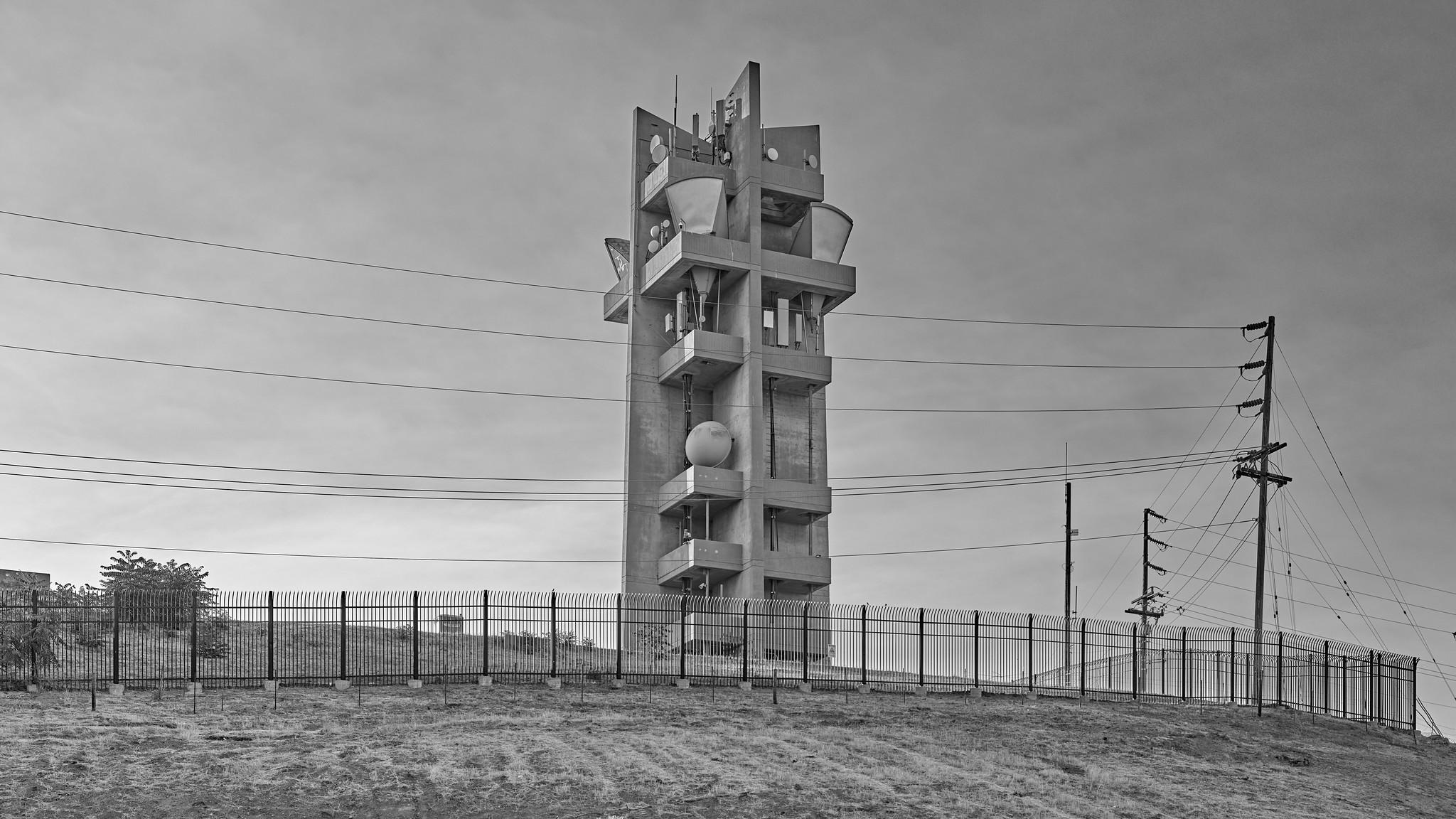
AT&T Long Lines "Oak Hill" Tower, San Jose, CA. 2021.
Uncategorized
18
Posts
6
Posters
3
Views
-
AT&T Long Lines "Oak Hill" Tower, San Jose, CA. 2021.
All the pixels, with no static or fading, at https://www.flickr.com/photos/mattblaze/51261791084
-
AT&T Long Lines "Oak Hill" Tower, San Jose, CA. 2021.
All the pixels, with no static or fading, at https://www.flickr.com/photos/mattblaze/51261791084
Captured with the Rodenstock 50mm/4.0 HR Digaron-W lens (@ f/4.5) on a Cambo WRS-1600 camera (with about 15mm of vertical shift to preserve the geometry), the Phase One IQ4-150 back (@ ISO 50) in dual exposure mode (which preserves a couple stops of additional dynamic range into the shadows).
The tower's shape is irregular; it tapers slightly.
The wide angle and panoramic orientation give a bit of context, alone on a hill (which is being rapidly encroached by adjacent residential development).
-
Captured with the Rodenstock 50mm/4.0 HR Digaron-W lens (@ f/4.5) on a Cambo WRS-1600 camera (with about 15mm of vertical shift to preserve the geometry), the Phase One IQ4-150 back (@ ISO 50) in dual exposure mode (which preserves a couple stops of additional dynamic range into the shadows).
The tower's shape is irregular; it tapers slightly.
The wide angle and panoramic orientation give a bit of context, alone on a hill (which is being rapidly encroached by adjacent residential development).
For much of the 20th century, the backbone of the AT&T "Long Lines" long distance telephone network consisted primarily of terrestrial microwave links (rather than copper or fiber cables). Towers with distinctive KS-15676 "horn" antennas could be seen on hilltops and atop switching center buildings across the US; they were simply part of the American landscape.
Most of the relay towers were simple steel structures. This brutalist concrete platform in San Jose was, I believe, of a unique design.
-
For much of the 20th century, the backbone of the AT&T "Long Lines" long distance telephone network consisted primarily of terrestrial microwave links (rather than copper or fiber cables). Towers with distinctive KS-15676 "horn" antennas could be seen on hilltops and atop switching center buildings across the US; they were simply part of the American landscape.
Most of the relay towers were simple steel structures. This brutalist concrete platform in San Jose was, I believe, of a unique design.
The San Jose Oak Hill Tower is unique in a number of ways. This particular concrete brutalist design appears not to have been exactly replicated elsewhere; it was site-specific. It sits atop an underground switching center (that was partly used for a military contract), which explains the relatively hardened design.
Today the underground switch is still there, owned by AT&T, but the tower space is leased to land mobile and cellular providers. The old horn antennas at top are disconnected.
-
The San Jose Oak Hill Tower is unique in a number of ways. This particular concrete brutalist design appears not to have been exactly replicated elsewhere; it was site-specific. It sits atop an underground switching center (that was partly used for a military contract), which explains the relatively hardened design.
Today the underground switch is still there, owned by AT&T, but the tower space is leased to land mobile and cellular providers. The old horn antennas at top are disconnected.
With a few exceptions (mostly towers atop downtown switching offices in populated areas), no one was trying to make any of this utilitarian communications infrastructure beautiful. It was form strictly following function, built to be reliable and rugged.
But there was, I think, quite a bit of beauty to find in it. Perhaps we'll look at our current neighborhood cellular towers, now often regarded as visual blight, the same way decades after they're (inevitably) gone.
Infrastructure is heroic.
-
AT&T Long Lines "Oak Hill" Tower, San Jose, CA. 2021.
All the pixels, with no static or fading, at https://www.flickr.com/photos/mattblaze/51261791084
@mattblaze I was 11 and living in nearby Almaden Valley when this was built. We thought it was ugly.
-
With a few exceptions (mostly towers atop downtown switching offices in populated areas), no one was trying to make any of this utilitarian communications infrastructure beautiful. It was form strictly following function, built to be reliable and rugged.
But there was, I think, quite a bit of beauty to find in it. Perhaps we'll look at our current neighborhood cellular towers, now often regarded as visual blight, the same way decades after they're (inevitably) gone.
Infrastructure is heroic.
@mattblaze That evolution of use, owners, makes it look like an antenna museum display.
-
With a few exceptions (mostly towers atop downtown switching offices in populated areas), no one was trying to make any of this utilitarian communications infrastructure beautiful. It was form strictly following function, built to be reliable and rugged.
But there was, I think, quite a bit of beauty to find in it. Perhaps we'll look at our current neighborhood cellular towers, now often regarded as visual blight, the same way decades after they're (inevitably) gone.
Infrastructure is heroic.
Bonus microwave tower photo: Western Union Tenleytown Tower, Washington, DC, 2020.
The first commercial terrestrial microwave network wasn't actually AT&T, but rather Western Union (the telegraph/telegram company).
A few remnants of the network survive. This hexagonal concrete tower, built in 1947 down an alley in Tenleytown, Washington, DC, was part of the first experimental link in the network. The cupola of the tower is actually a plexiglass radome concealing microwave antennas.
-
Bonus microwave tower photo: Western Union Tenleytown Tower, Washington, DC, 2020.
The first commercial terrestrial microwave network wasn't actually AT&T, but rather Western Union (the telegraph/telegram company).
A few remnants of the network survive. This hexagonal concrete tower, built in 1947 down an alley in Tenleytown, Washington, DC, was part of the first experimental link in the network. The cupola of the tower is actually a plexiglass radome concealing microwave antennas.
(Western Union today is mostly a retail money remitter and check cashing outlet for the unbanked, but back in the day was a significant part of US telecom infrastructure, providing data communications including telegraph, teletype, and telegram services).
-
 undefined oblomov@sociale.network shared this topic
-
(Western Union today is mostly a retail money remitter and check cashing outlet for the unbanked, but back in the day was a significant part of US telecom infrastructure, providing data communications including telegraph, teletype, and telegram services).
@mattblaze I thought the only purpose of Western Union today is as a vehicle for scamming elderly seniors out of money. 🤔
-
@mattblaze I thought the only purpose of Western Union today is as a vehicle for scamming elderly seniors out of money. 🤔
@ai6yr Pretty much. Whatever was left of their original business model collapsed with the Internet.
-
Bonus microwave tower photo: Western Union Tenleytown Tower, Washington, DC, 2020.
The first commercial terrestrial microwave network wasn't actually AT&T, but rather Western Union (the telegraph/telegram company).
A few remnants of the network survive. This hexagonal concrete tower, built in 1947 down an alley in Tenleytown, Washington, DC, was part of the first experimental link in the network. The cupola of the tower is actually a plexiglass radome concealing microwave antennas.
@mattblaze Have you been out to visit the old Atomic Physics Observatory in DC?
-
@mattblaze Have you been out to visit the old Atomic Physics Observatory in DC?
@20002ist I have not! Where? What?
-
@20002ist I have not! Where? What?
-
@20002ist Neat. Will have to check it out. I love "Department of Terrestrial Magnetism". So specific.
-
@20002ist @mattblaze Ooh, and right near Rock Creek Park.
-
@20002ist @mattblaze Ooh, and right near Rock Creek Park.
-
@20002ist Neat. Will have to check it out. I love "Department of Terrestrial Magnetism". So specific.
@mattblaze @20002ist That department is referenced several times in Rhodes' "The Making of the Atomic Bomb".




Gli ultimi otto messaggi ricevuti dalla Federazione
-
Parisi: "Vorreste i premi Nobel estratti a sorte? Ecco. Io voto no"
-
-
-
Dire Straits, Brothers In Arms, 1985
These mist covered mountains
Are a home now for me
But my home is the lowlands
And always will be ... https://cctm.website/dire-straits-uk/
-
@simonperry apperò
-
Referendum: don Ciotti, Costituzione non da riformare ma da rispettare
@giornalismo
articolo21.org/2026/02/referen…
“Più che riformare la Costituzione è opportuno rispettarla e applicarla”. Lo ha detto don Luigi Ciotti, fondatore e presidente del Gruppo Abele e di Libera, ieri sera
-
@G3rt ma perché non li aiutiamo noi come loro ci hanno aiutato durante il COVID?
-
Zelensky furioso






Post suggeriti
-
-
-
608/730📷 Fujifilm XT-5#fujiFilm #fuji #sooc #photography #fotografie #730Project #dailyPhoto #obxPhoto #retro #80svibe #80s #SilentSunday
Uncategorized 1
1
-
#SilentSunday #photography #photo #fotografie #photographie #fotografia #naturelovers #naturephotography #nature #mosstodon #forest
Uncategorized 1
1