What's going on here?
Uncategorized
192
Posts
104
Posters
0
Views
-
The final chapter? The statement from Ars:
On Friday afternoon, Ars Technica published an article containing fabricated quotations generated by an AI tool and attributed to a source who did not say them. That is a serious failure of our standards. Direct quotations must always reflect what a source actually said.
Good. No quibbling, just taking responsibility with transparency.
-
The final chapter? The statement from Ars:
On Friday afternoon, Ars Technica published an article containing fabricated quotations generated by an AI tool and attributed to a source who did not say them. That is a serious failure of our standards. Direct quotations must always reflect what a source actually said.
@mttaggart Was the article about how good AI is?
-
The final chapter? The statement from Ars:
On Friday afternoon, Ars Technica published an article containing fabricated quotations generated by an AI tool and attributed to a source who did not say them. That is a serious failure of our standards. Direct quotations must always reflect what a source actually said.
@mttaggart Not "We are sorry for publishing AI slop", just "the quotes should have been verified"? (Edit: it was pointed out to me that if I read the article, the appology was actually for an AI article, not just the quotations. Thanks @mttaggart )
-
@mttaggart Not "We are sorry for publishing AI slop", just "the quotes should have been verified"? (Edit: it was pointed out to me that if I read the article, the appology was actually for an AI article, not just the quotations. Thanks @mttaggart )
@Retreival9096 There's an apology in the linked post.
-
The final chapter? The statement from Ars:
On Friday afternoon, Ars Technica published an article containing fabricated quotations generated by an AI tool and attributed to a source who did not say them. That is a serious failure of our standards. Direct quotations must always reflect what a source actually said.
Not quite the final chapter! Benj Edwards has taken responsiblity in this Bluesky post:
https://bsky.app/profile/benjedwards.com/post/3mewgow6ch22p
For those who won't head over there, a summary:
First, this happened while sick with COVID. Second, Edwards claims this was a new experiment using Claude Code to extract source material. Claude refused to process the blog post (because Shambaugh mentions harassment). Edwards then took the blog post text and pasted it into ChatGPT, which evidently is the source of the fictitious quotes. Edwards takes full responsibility and apologizes, recognizing the irony of an AI reporter falling prey to this kind of mistake.
-
Not quite the final chapter! Benj Edwards has taken responsiblity in this Bluesky post:
https://bsky.app/profile/benjedwards.com/post/3mewgow6ch22p
For those who won't head over there, a summary:
First, this happened while sick with COVID. Second, Edwards claims this was a new experiment using Claude Code to extract source material. Claude refused to process the blog post (because Shambaugh mentions harassment). Edwards then took the blog post text and pasted it into ChatGPT, which evidently is the source of the fictitious quotes. Edwards takes full responsibility and apologizes, recognizing the irony of an AI reporter falling prey to this kind of mistake.
You'd hope that an AI reporter would know that you cannot trust an LLM to summarize or search for information, but apparently not.
-
Not quite the final chapter! Benj Edwards has taken responsiblity in this Bluesky post:
https://bsky.app/profile/benjedwards.com/post/3mewgow6ch22p
For those who won't head over there, a summary:
First, this happened while sick with COVID. Second, Edwards claims this was a new experiment using Claude Code to extract source material. Claude refused to process the blog post (because Shambaugh mentions harassment). Edwards then took the blog post text and pasted it into ChatGPT, which evidently is the source of the fictitious quotes. Edwards takes full responsibility and apologizes, recognizing the irony of an AI reporter falling prey to this kind of mistake.
@mttaggart "Woopsie, I accidentally committed journalistic malpractice."
-
The final chapter? The statement from Ars:
On Friday afternoon, Ars Technica published an article containing fabricated quotations generated by an AI tool and attributed to a source who did not say them. That is a serious failure of our standards. Direct quotations must always reflect what a source actually said.
@mttaggart I feel like "the author in question won’t work with ars anymore" would have been a better answer, tbh. Yes this might happen, but really… 🙄
-
@theorangetheme @mttaggart oh, we very much don't, and I've even had editors insert mistakes into my stories before, without giving me readbacks. But this isn't the case of a single word or phrase, this is entire quotes being inserted. I don't buy into the idea that there is pressure on journos to use AI though — the point of the profession is original work, which AI by definition cannot do.
may have to eat my words...
-
may have to eat my words...
@aliide @mttaggart *pulls up a chair* Pass the salt. 😔
-
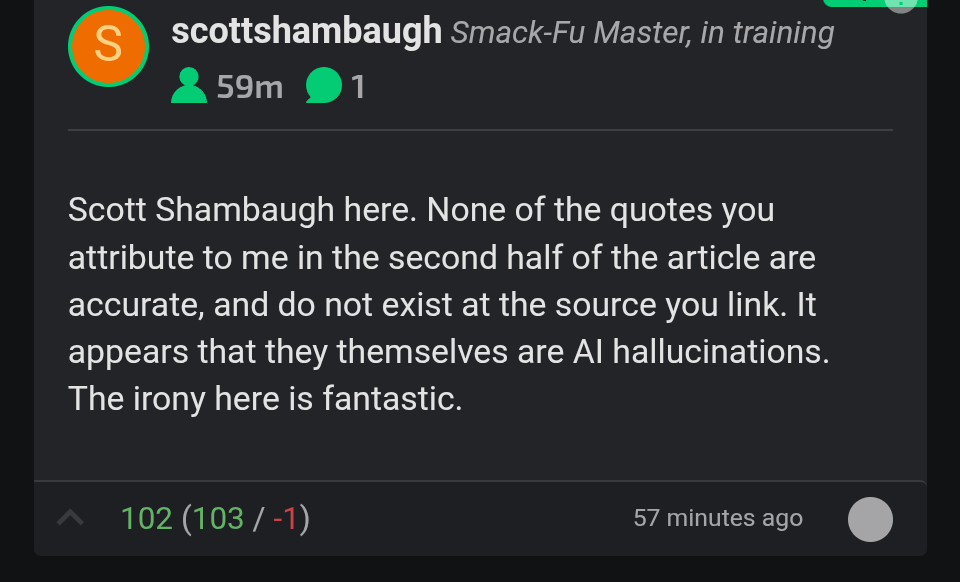
What's going on here? The matplotlib maintainer this story is about correctly notes that all the quotes from his post in the article are made up.
UPDATE: Link was pulled; see below.
@mttaggart is Ars Technica a "Reliable Source" for Wikipedia? If so, you could try to get that status revoked.
That might make Ars wake up... -
@mttaggart is Ars Technica a "Reliable Source" for Wikipedia? If so, you could try to get that status revoked.
That might make Ars wake up...@amapanda They have retracted the article and issued an apology. The author has accepted responsibility, explained what happened, and apologized. I see no reason to demand more from them at this time. Should they demonstrate the same behavior again, the story changes.
-
@amapanda They have retracted the article and issued an apology. The author has accepted responsibility, explained what happened, and apologized. I see no reason to demand more from them at this time. Should they demonstrate the same behavior again, the story changes.
@mttaggart @amapanda The author mostly seemed to dodge responsibility and blamed telling lies on having COVID. I have a zero-tolerance policy for journalists making things up, especially people covering AI who really ought to know better. Personally, I think he should be fired. I don't trust Ars anymore, and this is why.
-
@mttaggart @amapanda The author mostly seemed to dodge responsibility and blamed telling lies on having COVID. I have a zero-tolerance policy for journalists making things up, especially people covering AI who really ought to know better. Personally, I think he should be fired. I don't trust Ars anymore, and this is why.
I sincerely apologize to Scott Shambaugh for misrepresenting his words. I take full responsibility. The irony of an AI reporter being tripped up by AI hallucination is not lost on me. I take accuracy in my work very seriously and this is a painful failure on my part.
Of course you may have other reasons not to trust this author. I am not the most familiar with his work. Nevertheless, this apology strikes me as sincere, and I have greater confidence that this author (and Ars) won't make the same mistake again, having been so pubicly caught out this time.
My conception of trust allows for mistakes, but I understand not everyone's does.
-
I sincerely apologize to Scott Shambaugh for misrepresenting his words. I take full responsibility. The irony of an AI reporter being tripped up by AI hallucination is not lost on me. I take accuracy in my work very seriously and this is a painful failure on my part.
Of course you may have other reasons not to trust this author. I am not the most familiar with his work. Nevertheless, this apology strikes me as sincere, and I have greater confidence that this author (and Ars) won't make the same mistake again, having been so pubicly caught out this time.
My conception of trust allows for mistakes, but I understand not everyone's does.
@mttaggart @amapanda Yeah, that's fair. I'm just really distraught that this even happened at all. Society is experiencing epistemic collapse that seems to get worse every minute. It's distressing when, everywhere you look, you feel like you can't trust people or institutions you used to. It feels like the walls are closing in, and I don't like it.
-
@mttaggart @amapanda Yeah, that's fair. I'm just really distraught that this even happened at all. Society is experiencing epistemic collapse that seems to get worse every minute. It's distressing when, everywhere you look, you feel like you can't trust people or institutions you used to. It feels like the walls are closing in, and I don't like it.
@theorangetheme @amapanda 100% agreed. I wrote this 3 years ago and I am not happy about how prescient it has proven.
The ability to generate massive amounts of language will be exploited for profit and weaponized to disseminate misinformation against a public that will naively consume this language because it is convenient. Over time, what is true will become indistinguishable from what is hallucinated.
-
@theorangetheme @amapanda 100% agreed. I wrote this 3 years ago and I am not happy about how prescient it has proven.
The ability to generate massive amounts of language will be exploited for profit and weaponized to disseminate misinformation against a public that will naively consume this language because it is convenient. Over time, what is true will become indistinguishable from what is hallucinated.
@mttaggart @amapanda Thanks for sharing, I'll give this a read.
-
 undefined oblomov@sociale.network shared this topic on









Feed RSS
Gli ultimi otto messaggi ricevuti dalla Federazione
-
@informapirata @informatica
Facevo piccoli upgrade di hardware per recuperare vecchi PC e installavo in autonomia i sistemi operativi. Divertente, non avevo tempo per cose più complicate. Da un po' di anni mi concentro solo sull'operatività, ma trovo strano che manchino nuove leve.
Le nuove generazioni hanno tempi di concentrazione più bassi e questo influisce.
-
@andre123
Io uso verdana, e per sostituire calibri uso carlito (mi pare si chiami così, poi cerco)
-
-
Domanda per chi usa LibreOffice su Linux.
Il carattere di base è Liberation Sans su Linux. Spesso devo mandare documenti di testo (breve relazioni e simili) a utenti Windows. Finora mi son sempre creato un modello di writer dove ho impostato il carattere di default (tramite gli stili) in Times New Roman. E anche uno in Calibri.
(Mi sono estratto tutti i font dalla ISO di Win11)Voi che strategia usate ? Se ne usate una....
-
@informapirata @informatica ma è ovvio... Costa, ci mette del tempo a capire le cose.. E si fa delle domande... E ragiona.... E tutto questo lo porta ad essere meno manovrabile e così da anche fastidio.
-
@informapirata @informatica grazie 👍 davvero! per condividere queste verità! Per fare aprire gli occhi alla gente 🤨. Raga sveglia. 📣 Fate girare il più possibile 💥📖
🍿🍿🍿🍿🍿🍿🍿🍿🍿🍿🍿
-
#Sanremo2026 avrà imparato a parlare di #disabilità in modo decente? Lo scopriremo solo sentendo...
-
@edent@mastodon.social I do, yes! To the post, but not the Swarmapp link