Vecchia password addio.
Uncategorized
1
Posts
1
Posters
1
Views

Feed RSS
Gli ultimi otto messaggi ricevuti dalla Federazione
-
@evan Ran across *Darkest Hour* clips on YouTube a couple of months ago. Grabbed my copy of *Five Days in London: May 1940* to check a few things and ended up re-reading it.
-
@gordoooo_z With this show it's important to recognize that during the mid-2000s the sheer tenacity and refusal to bend to the societal expectations of her husband's death was practically unheard of in reality and in HBO media. It is visually dated, but that's inevitable.
Part of her refusal is due to her innate personality, but so much is done out of absolute exhaustion and desperation mixed with a deep seated sadness and sense of the system failing her decades of efforts as a 'stay at home' mother — ostensibly she did everything right (much like Catherine Zeta-Jones' character in Traffic (similar time period as well), where she was faced with arguably greater potential for failure, or prison, assassination from the rival cartel and her dead husband's cartel employers - or perhaps accepting homelessness instead, losing everything.
Back to Weeds, Nancy is inherently imperfect, like all people, though she represents so many (too many) personifications of women's struggles from that era. Three women from my social group back then went through very similar events, including narco topics not limited to the name of that show. Desperation makes some mothers turn into a lioness they never knew existed within... and that is how I see Nancy's character evolution. FWIW, my friends got out of that life eventually, finally able to raise their children safely.
Cultural sentiments of the era nearly required comedy to be sprinkled in as needed, but the show is more than its sum, it's a statement on the systemic failures then-normative American family culture and marriage/gender-role adversity.
So who is this "SoCal basic-bitch never-criminal turned ruthless murderer and international trafficker"? The script draws from the real life experiences of Griselda Blanco (https://en.wikipedia.org/wiki/Griselda_Blanco featured in the documentary "Cocaine Cowboys II: Hustlin' With the Godmother"), and later echoes strongly in the more recent TV series "Ozark" with Laura Linney ("..married couple who moves their family to the Lake of the Ozarks to continue their work laundering money for a Mexican drug cartel. ((she too rises in the ranks of the syndicate, orders assassinations, a modality of cold ruthlessness which she never considered herself capable))).
I can go on and on with this topic. Media aside, breakouts like this are an often unfortunate reality for women who are required to operate outside of their polished veneers, pushed past regular life's normal limits.
Looking back, doesn't everyone wonder what could have been with slightly different inputs and outputs; those turning points during periods of strife and a threatened existence?
-
@evan finished? it's been about a year. I started Troyat's biography of Tolstoy this fall but family stuff side-tracked me and now I'm distracted by computer books and Bram Stoker's Dracula (pretty historical tbh). Last one I finished was Margaret MacMillan's War: How Conflict Shaped Us, earlier this Spring.
-
-
> But her managers are not fools, and they immediately sent her home to rest and take care of her loved ones.
Damn, did I tell that I like this part of european work culture? No 996 or overtimes as usual thing, only the attention to the your own employees

Thanks God, I'm working in the same company. One minus – we don't have sabbaticals – but this is because Labor laws in my country completely ignore that people may burn out.
At least we don't have a criminal punishment for being late for work, like it was in USSR since 1940 till 1956…

-
-
@wschenk I'm sorry that happened to you.
-
Your Supercomputer Arrives in the Cloud
For as long as there have been supercomputers, people like us have seen the announcements and said, “Boy! I’d love to get some time on that computer.” But now that most of us have computers and phones that greatly outpace a Cray 2, what are we doing with them? Of course, a supercomputer today is still bigger than your PC by a long shot, and if you actually have a use case for one, [Stephen Wolfram] shows you how you can easily scale up your processing by borrowing resources from the Wolfram Compute Services. It isn’t free, but you pay with Wolfram service credits, which are not terribly expensive, especially compared to buying a supercomputer.
[Stephen] says he has about 200 cores of local processing at his house, and he still sometimes has programs that run overnight. If your program already uses a Wolfram language and uses parallelism — something easy to do with that toolbox — you can simply submit a remote batch job.
What constitutes a supercomputer? You get to pick. You can just offload your local machine using a single-core 8GB virtual machine — still a supercomputer by 1980s standards. Or you get machines with up to 1.5TB of RAM and 192 cores. Not enough for your mad science? No worries, you can map a computation across more than one machine, too.
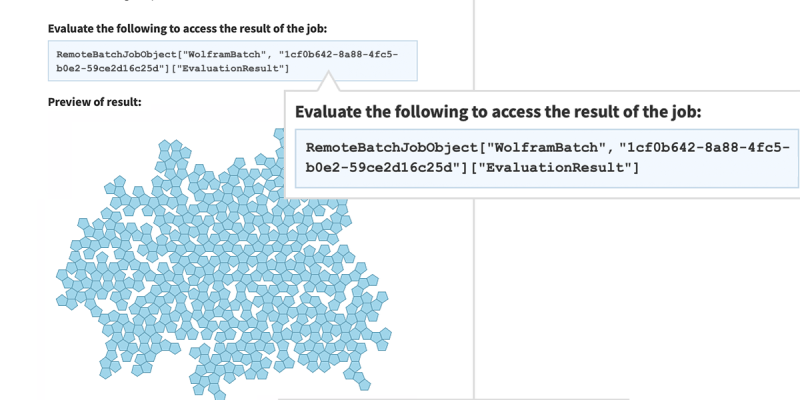
As an example, [Stephen] shows a simple program that tiles pentagons:
When the number of pentagons gets large, a single line of code sends it off to the cloud:
RemoteBatchSubmit[PentagonTiling[500]]
The basic machine class did the work in six minutes and 30 seconds for a cost of 5.39 credits. He also shows a meatier problem running on a 192-core 384GB machine. That job took less than two hours and cost a little under 11,000 credits (credit cost from just over $4/1000 to $6/1000, depending on how many you buy, so this job cost about $55 to run). If two hours is too much, you can map the same job across many small machines, get the answer in a few minutes, and spend fewer credits in the process.
Supercomputers today are both very different from old supercomputers and yet still somewhat the same. If you really want that time on the Cray you always wanted, you might think about simulation.