TL;DR Most EV batteries will last longer than the cars they’re in.
Uncategorized
77
Posts
45
Posters
8
Views
-
This also means that buying a used EV is perfectly fine. If the used car is „younger“ than 5-7 years, the battery will be fine for years to come.
„How long do EV batteries last?
The average lifespan of EV batteries will be around 13 years or more based on observed degradation rates.“
I noticed after 10 years, the EV batteries on my plug in hybrid still have full range after high mileage and heavy use. I verified by plugging the computer into the canbus and checking the battery ECU, all cells still have a very low internal resistance and perfectly balanced. I am planning on another 10 years. Charge cycles are daily 100% to 20% from solar.
-
TL;DR Most EV batteries will last longer than the cars they’re in. Battery degradation is at better (meaning: lower) rates than expected. Slow charging is better. Drive EV and don’t worry about your battery.
„Our 2025 analysis of over 22,700 electric vehicles, covering 21 different vehicle models, confirms that overall, modern EV batteries are robust and built to last beyond a typical vehicle’s service life.“
@jwildeboer I had doubts at the outset of Hybrids, but I observed at the time that nearly every taxi in the city had already switched, so clearly the economics made sense on some level.
Now it's been about twenty years since Hybrids showed up, and I have not read about any major work being needed for batteries, certainly not a "had to replace them all in five years" scenario, which I did think was possible.
I'm fully confident about my next car being electric. Less so about the enshittified aspects of all cars these days.
-
TL;DR Most EV batteries will last longer than the cars they’re in. Battery degradation is at better (meaning: lower) rates than expected. Slow charging is better. Drive EV and don’t worry about your battery.
„Our 2025 analysis of over 22,700 electric vehicles, covering 21 different vehicle models, confirms that overall, modern EV batteries are robust and built to last beyond a typical vehicle’s service life.“
@jwildeboer I haven't heard an update on it for years, but my friend bought a Tesla and the battery deteriorated after I think 2 years. Turns out he was plugging it in to charge every day. I wonder how long it would have lasted if he was aware that would cause problems.
-
TL;DR Most EV batteries will last longer than the cars they’re in. Battery degradation is at better (meaning: lower) rates than expected. Slow charging is better. Drive EV and don’t worry about your battery.
„Our 2025 analysis of over 22,700 electric vehicles, covering 21 different vehicle models, confirms that overall, modern EV batteries are robust and built to last beyond a typical vehicle’s service life.“
@jwildeboer
Very interesting read. I need time to digest everything, but I already got some interesting nuggets out of it. Thanks! -
TL;DR Most EV batteries will last longer than the cars they’re in. Battery degradation is at better (meaning: lower) rates than expected. Slow charging is better. Drive EV and don’t worry about your battery.
„Our 2025 analysis of over 22,700 electric vehicles, covering 21 different vehicle models, confirms that overall, modern EV batteries are robust and built to last beyond a typical vehicle’s service life.“
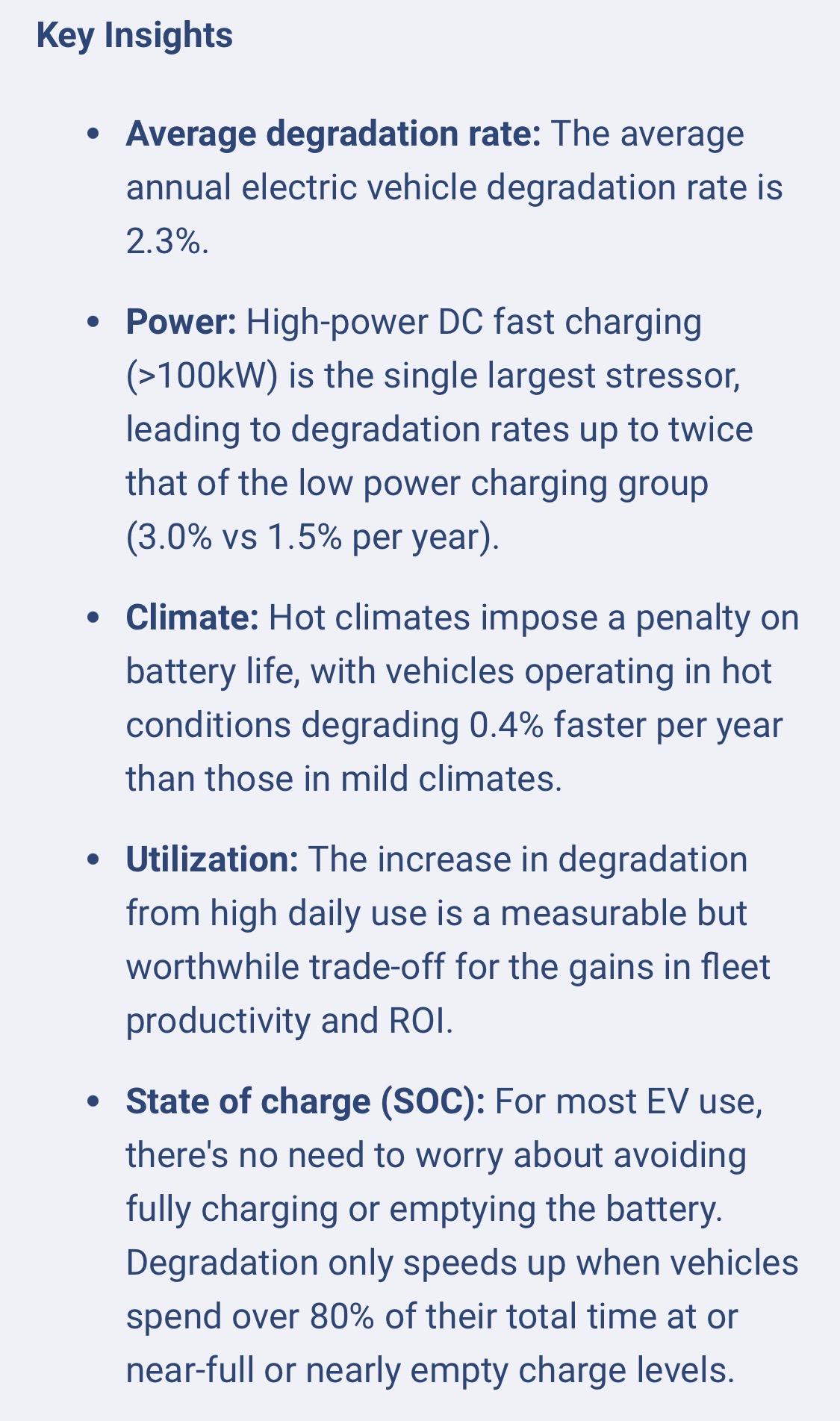
@jwildeboer in the key facts they did mention only hot climate, but nothing about cold one. Any data about it?
-
This also means that buying a used EV is perfectly fine. If the used car is „younger“ than 5-7 years, the battery will be fine for years to come.
„How long do EV batteries last?
The average lifespan of EV batteries will be around 13 years or more based on observed degradation rates.“
@jwildeboer There are some companies now recycling EV batteries for home storage. For fixed locations, the efficiency Is a bit less important (space and weight are at less if a premium than in a car), but cost remains important.
-
@jwildeboer in the key facts they did mention only hot climate, but nothing about cold one. Any data about it?
@madduci From the article: "Our current dataset lacked sufficient “cold-only” samples – vehicles in consistently cold climates without a warm season – to isolate the impact of extreme cold on long-term degradation." But let's just say that Norway is at almost 90% EV for new car sales and experience there shows the (expected) range reduction in cold weather, but no faster battery degradation, as far as I can see.
-
TL;DR Most EV batteries will last longer than the cars they’re in. Battery degradation is at better (meaning: lower) rates than expected. Slow charging is better. Drive EV and don’t worry about your battery.
„Our 2025 analysis of over 22,700 electric vehicles, covering 21 different vehicle models, confirms that overall, modern EV batteries are robust and built to last beyond a typical vehicle’s service life.“
@jwildeboer Does that mean that someone who doesn't use their car a whole lot should NOT fully charge the battery when recharging it?
-
@jwildeboer There are some companies now recycling EV batteries for home storage. For fixed locations, the efficiency Is a bit less important (space and weight are at less if a premium than in a car), but cost remains important.
@david_chisnall @jwildeboer With cars being so expensive to repair, EVs get totaled by insurance pretty readily. With the cells lasting so long, there’s very little demand for used EV batteries. As a result, they tend to be really cheap from junkyards.
I was recently looking up how much a replacement battery pack for a particular hybrid costs. Turns out it’s about $1800 for an 11 kWh pack, but while looking I also found a local wrecker selling a 75 kWh pack from a Mustang Mach-E for about $3k.
-
@jwildeboer Does that mean that someone who doesn't use their car a whole lot should NOT fully charge the battery when recharging it?
@npt_writes @jwildeboer It depends on the car. Most now reserve some capacity from the top for longevity reasons. That is, the vehicle only charges the pack to 90% of the pack’s nominal charge, and calls that 100%. This both helps the actual capacity to degrade slower and hides the degradation for a while.
Plug-in hybrids also typically reserve about 10% of the capacity for KERS, which similarly keeps the charge above the minimum.
-
TL;DR Most EV batteries will last longer than the cars they’re in. Battery degradation is at better (meaning: lower) rates than expected. Slow charging is better. Drive EV and don’t worry about your battery.
„Our 2025 analysis of over 22,700 electric vehicles, covering 21 different vehicle models, confirms that overall, modern EV batteries are robust and built to last beyond a typical vehicle’s service life.“
Not only long lasting, but safe. Last October, a parking garage fire destroyed 30 vehicles. It begun from an Audi Q7 hybrid which caught fire while charging, but when every EV destroyed was inspected, none were found to have any damage to their battery packs.
https://www.linkedin.com/posts/max-lakkonen-b5a23868_evfire-lithiumabrion-tulipalo-activity-7397263851001511936-EZDt
@jwildeboer -
@jwildeboer Does that mean that someone who doesn't use their car a whole lot should NOT fully charge the battery when recharging it?
@npt_writes @jwildeboer The very standard advice coming from Tesla for the battery in my Tesla is to charge only to 80% unless an occasion needs a fuller charge. (That advice may be different for more modern battery chemistry.) For people whose daily driving depletes only small fraction of the charge, I think yes it’s better to avoid charging daily; my commute is long though so I’m charging back to 80% before every workday.
-
TL;DR Most EV batteries will last longer than the cars they’re in. Battery degradation is at better (meaning: lower) rates than expected. Slow charging is better. Drive EV and don’t worry about your battery.
„Our 2025 analysis of over 22,700 electric vehicles, covering 21 different vehicle models, confirms that overall, modern EV batteries are robust and built to last beyond a typical vehicle’s service life.“
@jwildeboer This is going to hinder me from driving my Tesla until it’s dead. Clearly I need another plan to be rid of this vehicle.
-
@jwildeboer I had doubts at the outset of Hybrids, but I observed at the time that nearly every taxi in the city had already switched, so clearly the economics made sense on some level.
Now it's been about twenty years since Hybrids showed up, and I have not read about any major work being needed for batteries, certainly not a "had to replace them all in five years" scenario, which I did think was possible.
I'm fully confident about my next car being electric. Less so about the enshittified aspects of all cars these days.
@jpaskaruk @jwildeboer Early hybrids did have battery longevity problems. The first few Prius versions used a big, heavy NiMH pack which could store around 0.8 kWh (exact capacity differed over the models). It lasted around seven years before showing significant degradation in capacity, manifesting as steadily declining fuel economy.
They switched to lithium batteries a while ago, and those are both lighter (and “Lightness makes you [more efficient] everywhere.”) and longer-lived.
-
TL;DR Most EV batteries will last longer than the cars they’re in. Battery degradation is at better (meaning: lower) rates than expected. Slow charging is better. Drive EV and don’t worry about your battery.
„Our 2025 analysis of over 22,700 electric vehicles, covering 21 different vehicle models, confirms that overall, modern EV batteries are robust and built to last beyond a typical vehicle’s service life.“
@jwildeboer I like a different conception of the EV. My industrial 3 phase motors a bomb proof, they last decades. I think the mechanicals of an EV can be profoundly more simple and durable that internal combustion vehicles. I am okay with the idea of leasing a battery and replacing it periodically. I think the focus should on standardization, re-use and recycle of batteries and the EV vehicle should be lifetime hardware.
-
@jpaskaruk @jwildeboer Early hybrids did have battery longevity problems. The first few Prius versions used a big, heavy NiMH pack which could store around 0.8 kWh (exact capacity differed over the models). It lasted around seven years before showing significant degradation in capacity, manifesting as steadily declining fuel economy.
They switched to lithium batteries a while ago, and those are both lighter (and “Lightness makes you [more efficient] everywhere.”) and longer-lived.
@bob_zim I think I do recall that, actually, but to be fair, anyone who ever tried to keep a ghetto blaster going on NiMH D-cells knows that was doomed from the start.
-
TL;DR Most EV batteries will last longer than the cars they’re in. Battery degradation is at better (meaning: lower) rates than expected. Slow charging is better. Drive EV and don’t worry about your battery.
„Our 2025 analysis of over 22,700 electric vehicles, covering 21 different vehicle models, confirms that overall, modern EV batteries are robust and built to last beyond a typical vehicle’s service life.“
@jwildeboer i used to own a fifty-year-old Volvo.
-
This also means that buying a used EV is perfectly fine. If the used car is „younger“ than 5-7 years, the battery will be fine for years to come.
„How long do EV batteries last?
The average lifespan of EV batteries will be around 13 years or more based on observed degradation rates.“
@jwildeboer 13 jaar valt me iets tegen. Mijn benzine-auto's zijn 18 en 24 jaar oud en doen het nog goed. Dagelijks woon-werk doe ik elektrisch met een Mini uit 2021. Tot volle tevredenheid, maar het kan gebeuren dat die eerder op is dan de andere 2.
-
TL;DR Most EV batteries will last longer than the cars they’re in. Battery degradation is at better (meaning: lower) rates than expected. Slow charging is better. Drive EV and don’t worry about your battery.
„Our 2025 analysis of over 22,700 electric vehicles, covering 21 different vehicle models, confirms that overall, modern EV batteries are robust and built to last beyond a typical vehicle’s service life.“
@jwildeboer my brain wiped Geotab until I saw the URL you shared. Thanks for bringing back some memories lol
-
@jwildeboer I like a different conception of the EV. My industrial 3 phase motors a bomb proof, they last decades. I think the mechanicals of an EV can be profoundly more simple and durable that internal combustion vehicles. I am okay with the idea of leasing a battery and replacing it periodically. I think the focus should on standardization, re-use and recycle of batteries and the EV vehicle should be lifetime hardware.
@IronManIV @jwildeboer Unfortunately, a lot of the cost of a car is the frame and body, and techniques which have dramatically lowered the cost of entry have also dramatically increased the cost of repair. Unibody construction is simpler and cheaper (and lower-rattle, etc.) than body-on-chassis-on-frame, but if it bends in a collision, good luck straightening it out and restoring it to spec strength.















Gli ultimi otto messaggi ricevuti dalla Federazione
-
Tempio di Esculapio - Villa Borghese (1 gennaio 2017)
Esculapio è un dio guaritore che le autorità romane importano dalla Grecia. Il dio greco è Asclepio, figlio di Apollo e medico degli dei. La madre Coronide durante la gravidanza cede all’amore di un mortale e Apollo la uccide, ma salva il bambino strappandolo vivo dal suo seno. Lo affida al centauro Chirone che gli insegna la medicina, mentre Atena gli da il sangue della Gorgone che lui utilizza per restituire la vita ai morti. Zeus lo fulmina per questo e Apollo per vendicarlo uccide i Ciclopi. L’arte medica è praticata dai suoi sacerdoti negli Asclepeion, luoghi dove il malato rimane a dormire per ricevere la visita del dio che lo guarisce dandogli un sogno.
@testgroup@poliverso.org
-
-
@thomas where'd you hear that?
-
-
@zaebucca it's really cool, well done! Is it your recorder or the framrate is low?
-
@lritter ^_^
-
I've been playing around with Crocotile 3D!
Here's a little basic scene with my pixel art asset packs. :'P
-
We report: we chance a last look at the sky before going to sleep, out of habit. We think we know it will be too cloudy to see anything, but we can never go to bed without a last look. We remember why that it is upon seeing the stars. A bit of fog moves between constellations.