very cool.
Uncategorized
27
Posts
14
Posters
0
Views
-
@whitequark @ariadne @lina well, but that's exactly the problem i think. we built a fully granular permissions model where we really actually wanted a bimodal permissions model. and because the granular permissions model is so *incredibly fucking complicated*, the browser vendors go way out of their way to hide it, so it's not very useful.
browser vendors snowed us with the useless notifications/locations requests, and now are terrified to add perm popups because they got bad feedback on that.
@whitequark @ariadne @lina why is webrtc locked behind the microphone permission. i know what the web browsers *claim* is the answer to this question but imo the real reason is that they set out to make a fully granular permissions model, immediately discovered that had downsides, and have been backpedaling ever since
(I acknowledge the fully granular model is what works best for your goal of shipping an FPGA programmer)
-
@mcc @ariadne @lina i think this is a reasonable way to view the problem domain but i don't entirely agree—i think the web is about as close to "fully granular permission model, without vendor lock-in" as we ever got and perhaps will ever get, and that it's valuable that i can give a webpage access to a USB device while denying it everything else on the computer, like "filesystem"
unfortunately, i cannot in good faith say that the fully granular permission model works. technically it could be made to work, sure, but getting people to understand the exact consequences of granting X permission is probably a lost cause—it would take someone a lot smarter than me to figure out how to do it
unfortunately#2 the actual, real-world alternative to doing that is "download and run an .exe" or "curl | bash" which is strictly worse. so i just don't know
@whitequark @mcc @ariadne @lina Flatpak has a bunch of permissions one can grant, just saying ...
-
@whitequark @ariadne @lina a problem is we use the web browser for two totally separate purposes: as a way of looking at transient text/image/video content; and as the only surviving application platform. we want two totally opposite things out of these two different platforms ("control the computer" vs "touch nothing"), but insist on not delineating the two website metacategories. and microsoft/apple/android are only gonna keep making it harder to offload applications back onto "computers"
@mcc @whitequark @ariadne @lina I want to know if anybody is working on separating the web into those two things. It can only make things better for everyone. We can get hypertext documents that load fast and look better than ever, and network-sourced applications with runtimes that are performant on a potato.
-
@ariadne @lina it's not a reason to expose information useful to, like, 1 site you might maybe use, to every of them, and frankly i am not aware of any material benefit from running more than 4 of p&r threads in parallel so it could probably be capped to that. but i think this is a legitimate reason
@whitequark @ariadne @lina This seems like a reasoning I've seen in the late 90s, where some browser would send your OS login password along to literally every web request. Sure, there *could* be some where it's useful, but they can ask for it explicitly, and I can give them permission. The default should always be not to send those things.
-
@ariadne @lina i ship an FPGA toolchain in the browser. it can* use multithreading. it needs to know how many threads to run to not contend on resources uselessly
* currently not built in that configuration for a variety of reasons that is not specifically tied to the web
@whitequark @ariadne @lina Uh - cool, but it tells me "web assembly JSPI is not enabled". After enabling it in Firefox' about:config, it still says it's not enabled. Any ideas?
-
@whitequark @mcc @ariadne @lina Flatpak has a bunch of permissions one can grant, just saying ...
@hruske @whitequark @mcc @ariadne @lina
yeah and everything just gets full read write access to your home directory making because devs are lazy and body cares -
very cool. this is why i hate the modern web.
@ariadne oh that's nothing. Check this out
-
@whitequark @mcc @ariadne @lina Flatpak has a bunch of permissions one can grant, just saying ...
@hruske @whitequark great, now you can ship your app to… desktop Linux users (but NOT to Ubuntu systems which are the most common ones)
-
@hruske @whitequark @mcc @ariadne @lina
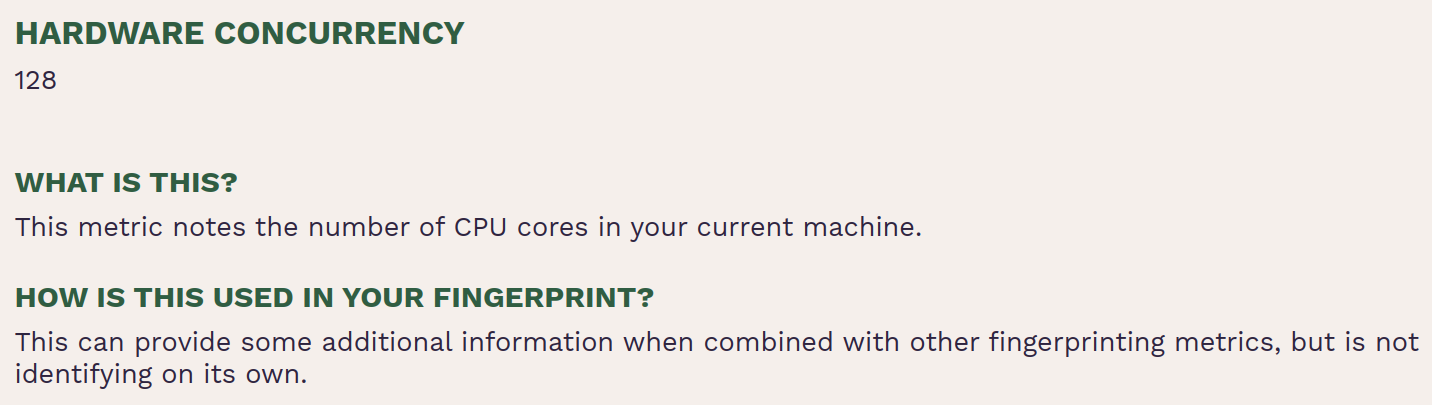
yeah and everything just gets full read write access to your home directory making because devs are lazy and body cares@tthbaltazar @hruske @whitequark @mcc @ariadne @lina regarding fingerprint metrics imma just throw in https://amiunique.org/fingerprint
-
@whitequark @mcc @ariadne @lina Flatpak has a bunch of permissions one can grant, just saying ...
@hruske flatpak takes granular permissions but it does not make them usable. Unless you expect the user to understand what "uses a legacy window system" means in terms of permissions. Sandboxing isn't easy, nor is seamlessly injecting permission prompts into applications which weren't designed for it, but the actually hard part is the permissions model. It needs to somehow be comprehensible by ordinary folks, while not overly constricting for 'power users'.
-
@whitequark @ariadne @lina why is webrtc locked behind the microphone permission. i know what the web browsers *claim* is the answer to this question but imo the real reason is that they set out to make a fully granular permissions model, immediately discovered that had downsides, and have been backpedaling ever since
(I acknowledge the fully granular model is what works best for your goal of shipping an FPGA programmer)
@mcc @whitequark @ariadne @lina I haven't really paid attention to what android and apple are doing these days, but i think a lot of this would be solvable by having some permissions be aggregates. e.g. "The web page wants to get the video calling and streaming permissions (fine print: which expand to blah blah blah and blah)". You unfortunately can't really let the application control the aggregate, but I think you could do a good job of simplifying the common use-cases for both apps and users.
-
 undefined oblomov@sociale.network shared this topic









Feed RSS
Gli ultimi otto messaggi ricevuti dalla Federazione
-
@chris holding you and her in the light.
-
-
-
-
-
send healing hugs for my wife @Tree
she had a bad seizure.
We're at the H.
First really bad one for a few weeks :(
Still haven't been able to see a neurologist to really figure then out :(
#health
-
@stefano In the Chateau maybe ??
-
@monsieuricon I hate this.