Agnostics claim to know that the existence of a deity is plausible.
Uncategorized
15
Posts
4
Posters
30
Views
-
@oblomov so agnostic is based on the presumption that deities do exist?
@selzero no, agnosticism is the claim that it's impossible to know, regardless of existence.
This can be a basis for strong atheism («it's impossible to know, therefore it doesn't exist», which is basically Russell's teapot argument), but is also compatible with weak atheism («it's impossible to know, and/so I don't have a particular opinion about its existence»), but also with theism («it's impossible to know, but I still believe it exists», which is actually the basis of pure faith).
-
@nitpicking @oblomov ok so in that case my original statement does stand, agnostics claim to know that an existence of deities is possible.
-
@nitpicking @oblomov ok so in that case my original statement does stand, agnostics claim to know that an existence of deities is possible.
@selzero @nitpicking hm, no? They claim that it is unknowable.
-
@selzero @nitpicking hm, no? They claim that it is unknowable.
-
@nitpicking @oblomov it's not a play on words.
If the question is "is it possible that a deity exists", according to your definition, the agnostic answer is "yes"
Am I misunderstanding?
-
@nitpicking @oblomov it's not a play on words.
If the question is "is it possible that a deity exists", according to your definition, the agnostic answer is "yes"
Am I misunderstanding?
@selzero @nitpicking yes, you are misunderstanding.
«Does a deity exists?»
The agnostic answer is «it's impossible to know». This is not a yes, it's not a no, and it's not even a maybe.
Which is why agnostic strong atheism is a thing (it's impossible to know THEREFORE there are no gods), which, I'll remark, does NOT contemplate the possibility that they do exist, but is still agnostic (in fact, it relies on agnosticism as a rationale to deny the existence of the gods).
-
@selzero @nitpicking yes, you are misunderstanding.
«Does a deity exists?»
The agnostic answer is «it's impossible to know». This is not a yes, it's not a no, and it's not even a maybe.
Which is why agnostic strong atheism is a thing (it's impossible to know THEREFORE there are no gods), which, I'll remark, does NOT contemplate the possibility that they do exist, but is still agnostic (in fact, it relies on agnosticism as a rationale to deny the existence of the gods).
My question is not "does a deity exist".
My question is
Is it possible that a deity *could* exist.
What is the agnostic answer to that?
-
My question is not "does a deity exist".
My question is
Is it possible that a deity *could* exist.
What is the agnostic answer to that?
«it's impossible to know»
-
«it's impossible to know»
@oblomov @nitpicking I have never heard the definition of agnostic to entail that it is impossible to know if it is possible for a deity to exist.
Only that is it impossible to know that a deity does exist.
Where is your definition from?
-
@oblomov @nitpicking I have never heard the definition of agnostic to entail that it is impossible to know if it is possible for a deity to exist.
Only that is it impossible to know that a deity does exist.
Where is your definition from?
https://en.wikipedia.org/wiki/Agnosticism#Strong_agnosticism
> Also called "hard", "closed", "strict", or "permanent agnosticism", strong agnosticism is the view that the question of the existence or nonexistence of a deity or deities, and the nature of ultimate reality is unknowable
-
Agnostics claim to know that the existence of a deity is plausible.
As an atheist, I'm agnostic to that.
I'm an apatheist these days, there might be a deity or deities, but what've they done for me lately?
-
 undefined oblomov@sociale.network shared this topic on



Gli ultimi otto messaggi ricevuti dalla Federazione
-
Quizzino della domenica: a,b
@matematica - Non sbagliatevi con le operazioni aritmetiche..
-
@dubito_ergo_sum @sport ma soprattutto perché l'arabo che alle olimpiadi invernali è pressoché inesistente e non il cinese per esempio?
-
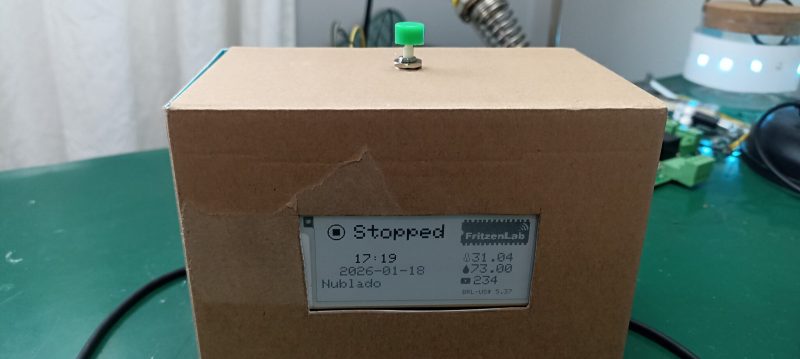
A Simple Desktop Pomodoro Timer
Pomodoro timers are a simple productivity tool. They help you work in dedicated chunks of time, usually 25 minutes in a sitting, before taking a short break and then beginning again. [Clovis Fritzen] built just such a timer of his own, and added a few bonus features to fill out its functionality.
The timer is based around the popular ESP32-S2 microcontroller, which has the benefit of onboard WiFi connectivity. This allows the project to query the Internet for things like time and date updates via NTP, as well as weather conditions, and the value of the Brazilian Real versus the American dollar. The microcontroller is paired with an SHT21 sensor for displaying temperature and humidity in the immediate environment, and an e-paper display for showing timer status and other relevant information. A button on top of the device allows cycling between 15, 30, 45, and 60 minute Pomodoro cycles, and there’s a buzzer to audibly call time. It’s all wrapped up in a cardboard housing that somehow pairs rather nicely with the e-paper display aesthetic.
If Pomodoro is your chosen method of productivity hacking, a project like this could suit you very well. We’ve featured a few similar builds before, too.
-
My favorite recent snarky slogan.
-
Venerdì sciopero internazionale dei porti. è la prima mobilitazione unitaria di portuali europei e mediterranei nella storia
@anarchia
“I portuali non lavorano per la guerra“. E’ con queste parole che i sindacati di Enedep di Grecia, Lab dei Paesi Baschi, Liman-Is di Turchia, ODT del Marocco e USB in Italia hanno
-
@MLE_online @brouhaha specifically, it is an ER32 collet wrench.
-
@j_l_meek yep! sidenotes 🙂
-
@swelljoe @MLE_online
Looks like a wrench to me.