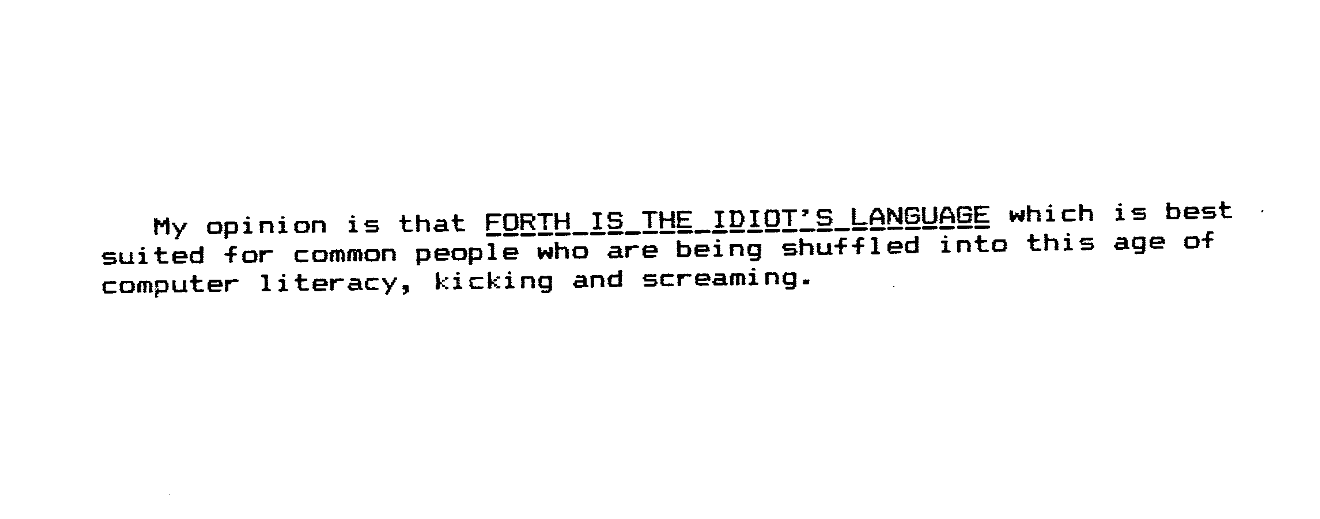
https://www.forth.org/Ting/Forth-for-the-Complete-Idiot/Forth-for-the-Complete-Idiot.pdf#forth
Uncategorized
27
Posts
6
Posters
2
Views
-
-
-
@AlgoCompSynth @neauoire @mcc except with creative tools, sooner or later fixed function is not enough. word, excel, blender, they're all user-programmable.
-
 undefined oblomov@sociale.network shared this topic
-
-
@oblomov @neauoire @lritter The thing is that programming is ultimately not about syntax but about framing what it is you want in an unambiguous way. The reason why slopcoding will always fail is that not only are you framing what you want ambiguously, the machine is incapable of interpreting it unambiguously. But the thing the slopcoders *want* is to be freed from the mental labor of deciding what it is they want. They want to make ambiguous requests and have it do the right thing anyway.
-
@oblomov @neauoire @mcc just looked at some inform 7 code and it's a neat DSL. very consequently avoids special characters and, like SQL, goes by speech patterns people already know.
the question is if this suffices for problems that are better expressed in some kind of gentle mathematical notation.
-
@oblomov @neauoire @lritter The thing is that programming is ultimately not about syntax but about framing what it is you want in an unambiguous way. The reason why slopcoding will always fail is that not only are you framing what you want ambiguously, the machine is incapable of interpreting it unambiguously. But the thing the slopcoders *want* is to be freed from the mental labor of deciding what it is they want. They want to make ambiguous requests and have it do the right thing anyway.
@mcc @oblomov @neauoire @lritter it's been possible to rigorously say what you want and have the computer find a program that does that for a long time. that's called program synthesis. you can even use a language model to make the optimizer that does this more efficient. no one seems to want that, they want to literally put a feature request written by a user at one end and get a program out the other
-
@mcc @oblomov @neauoire @lritter it's been possible to rigorously say what you want and have the computer find a program that does that for a long time. that's called program synthesis. you can even use a language model to make the optimizer that does this more efficient. no one seems to want that, they want to literally put a feature request written by a user at one end and get a program out the other
-
@oblomov @neauoire @lritter The thing is that programming is ultimately not about syntax but about framing what it is you want in an unambiguous way. The reason why slopcoding will always fail is that not only are you framing what you want ambiguously, the machine is incapable of interpreting it unambiguously. But the thing the slopcoders *want* is to be freed from the mental labor of deciding what it is they want. They want to make ambiguous requests and have it do the right thing anyway.
@mcc @neauoire @lritter Oh absolutely, I don't expect NPL to actually do anything for slopcoders. But I have a feeling, with some of the people I've been working with recently, that not having to learn a new syntax would be of non trivial help to them to help resolve any ambiguities, because the issue isn't so much with the reasoning as it is with translating it into the syntax. It is something I still have to actually test, though.
-
@mcc @neauoire @lritter Oh absolutely, I don't expect NPL to actually do anything for slopcoders. But I have a feeling, with some of the people I've been working with recently, that not having to learn a new syntax would be of non trivial help to them to help resolve any ambiguities, because the issue isn't so much with the reasoning as it is with translating it into the syntax. It is something I still have to actually test, though.
-
@oblomov @neauoire @mcc just looked at some inform 7 code and it's a neat DSL. very consequently avoids special characters and, like SQL, goes by speech patterns people already know.
the question is if this suffices for problems that are better expressed in some kind of gentle mathematical notation.
-
@mcc @oblomov @neauoire @lritter this was true to a lesser extent for executives a decade ago with "big data". you don't have to take a position if the computer gives it to you. the most dysfunctional companies have the biggest analytics teams, because analytics is what you do when you can't build consensus.





Feed RSS
Gli ultimi otto messaggi ricevuti dalla Federazione
-
Fowler starting out chubby was the winning move all along. Overcoming Projects by being thick.
-
L’UE riscopre che l’Unione fa la forza, il vertice straordinario dei leader parte da qui. Grazie a Trump
@news
https://www.eunews.it/2026/01/22/ue-unione-fa-forza-vertice-leader-trump/
Praticamente tutti i capi di Stato e di governo all'arrivo a Bruxelles hanno sottolineato l'importanza di rimanere compatti e fermi di fronte alle sfide, incluse quelle dell'alleato americano. La Finlandia: "Solo così siamo rispettati". Macron non si fida di Trump: "Restiamo vigili"
-
Most UNIX people know the bash(1) fork bomb :(){:|:&} code.
If you wnat to check the graphical equivalent then try this one :)
FreeBSD # pkg install -y mesa-demos
FreeBSD # pkg info -l mesa-demos | grep /bin | while read I; do ${I} & doneNot really fork bomb - just 300+ :)
-
Ah, broken tooth is the end for Megan. No shame in that. At least it wasn't Projects or Boat, which would be embarrassing.
Seems like the next medical checkup visit should take both of the remaining two people home. How're they gonna decide that?
-
@vitaut is that because of a behind the scenes float-to-double conversion?
-
Le facce dei due immobiliaristi americani dicono, purtroppo, tutto
-
@mcc BRICK is such a good movie, holy shit.
-
@mcc fucking amazing movie
Definitely made me a fan of Rian Johnson and Joseph Gordon-Levitt