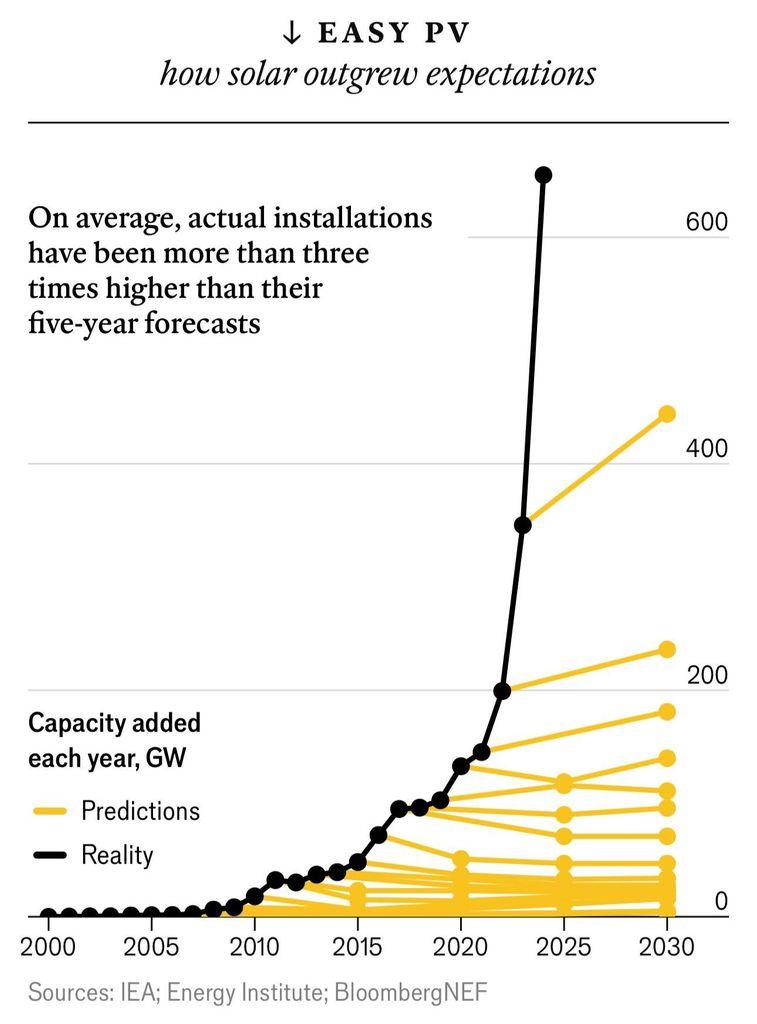
The world’s solar capacity reached 1,419 gigawatts in 2023, way beyond any predictions.
Uncategorized
57
Posts
29
Posters
0
Views
-
@martin ??? Solar plus wind plus batteries provide power for free, reducing need for fossil fuel dependence by 80% or 100% in some places, what's not to like?
@Jonathan Hartley Nope. You need 100% backup(from about 50% of Ren share). Fossil backup.
That's why it's not cheap. and will not be. Never.
#^https://en.wikipedia.org/wiki/Dunkelflaute -
@infobeautiful This might explain why I'm reading about prices of PV electricity sold to the grid plummeting (as there is barely any storage capacity).
@dzwiedziu @infobeautiful storage capacity is artifically restrained. We have the tech to store electricity cheap and with a one-time low investment and minimal maintenance sosts, we have the millenia old tech to store heat, yet more and more legislatures are -lobbied- bribed to make cheap perpetual solutions illegal.
-
@dzwiedziu @infobeautiful storage capacity is artifically restrained. We have the tech to store electricity cheap and with a one-time low investment and minimal maintenance sosts, we have the millenia old tech to store heat, yet more and more legislatures are -lobbied- bribed to make cheap perpetual solutions illegal.
@ohir
[citation needed] -
@ohir
[citation needed]@dzwiedziu @infobeautiful are you asking about "lobbying" efforts (this would be R 2023/1542 and Digital Battery Passport kicking in next year). The whole regulations only skim non-patentable technologies, like lead-acid batteries. These can be operational for millenia, due to their simple chemistry. The only maintenance that must be done is on-site processing of sulfated battery plates. Something that once upon a time (1950-1990) was being done on the massive scale in Central/East Europe countries. Then lobbied country's legislative can bar mid-sized installations as unable to met the EU demands (tried recently in Poland afair).
-
The world’s solar capacity reached 1,419 gigawatts in 2023, way beyond any predictions. 1 gigawatt = power for a medium sized city
@infobeautiful The opposite of
-
@aanee @infobeautiful while I'm 100% on board with you directionally, I suppose the counter argument would be that exponential growth has to tap out eventually, is just a question of when it turns into an S-curve.
@tartley @aanee @infobeautiful Well, what would be a limitting factors that would make it more expensive/more difficult to keep expanding solar?
=> running out of physical space to build panels on:
Yes but this isn't happening anytime soon and we would have beaten current world energy production well before that point is reached=> running out or raw materials:
Plenty of time until then too, and recycling older panels could help too. -
The world’s solar capacity reached 1,419 gigawatts in 2023, way beyond any predictions. 1 gigawatt = power for a medium sized city
war and conflict is unfortunately a likely major contributor to this, though I'm glad the shift is happening
just look at what happened to Cuba lately, without fuel the society goes to a standstill, they desperately need more green tech and everyone will know that unless they also make the shift, the unpredictability of fossil fuel politics may hit them hard at some point, adding to all the other existing arguments to shift
-
@aanee @infobeautiful while I'm 100% on board with you directionally, I suppose the counter argument would be that exponential growth has to tap out eventually, is just a question of when it turns into an S-curve.
@tartley The Total Addressable Market of solar panels is anywhere that can have a reasonable ROI on a solar panel given local electricity demand. As panels get cheaper they become economical in cloudier places.
-
@tartley @aanee @infobeautiful Well, what would be a limitting factors that would make it more expensive/more difficult to keep expanding solar?
=> running out of physical space to build panels on:
Yes but this isn't happening anytime soon and we would have beaten current world energy production well before that point is reached=> running out or raw materials:
Plenty of time until then too, and recycling older panels could help too.@dryak @aanee @infobeautiful I totally agree. I suppose the black-pilled establishment energy industry might expect another limiting factor would be running out of loony environmentalists to sell them too, if they could only sway public opinion sufficiently. But I agree with you, they were holding back the tide.
-
@Jonathan Hartley Nope. You need 100% backup(from about 50% of Ren share). Fossil backup.
That's why it's not cheap. and will not be. Never.
#^https://en.wikipedia.org/wiki/Dunkelflaute@martin you might need access to 100% backup while still being able to reduce your need for fossil generated energy by a majority amount - those aren't incompatible.
-
@dzwiedziu @infobeautiful are you asking about "lobbying" efforts (this would be R 2023/1542 and Digital Battery Passport kicking in next year). The whole regulations only skim non-patentable technologies, like lead-acid batteries. These can be operational for millenia, due to their simple chemistry. The only maintenance that must be done is on-site processing of sulfated battery plates. Something that once upon a time (1950-1990) was being done on the massive scale in Central/East Europe countries. Then lobbied country's legislative can bar mid-sized installations as unable to met the EU demands (tried recently in Poland afair).
@ohir
So you're saying that to solve energy and heat storage we need sites that will have large amounts of a poisonous, bio-accumulative heavy metal working in an highly hazardous acid, and all that working within daily deep-cycling, on an industrial scale, plus constant industrial-scale recycling, and that it will be cheap and safe?Yeah, no citations (not counting regulation existing alone) means I'll pass.
-
@tartley @aanee @infobeautiful Well, what would be a limitting factors that would make it more expensive/more difficult to keep expanding solar?
=> running out of physical space to build panels on:
Yes but this isn't happening anytime soon and we would have beaten current world energy production well before that point is reached=> running out or raw materials:
Plenty of time until then too, and recycling older panels could help too.@TechConnectify has a take on that: https://youtu.be/KtQ9nt2ZeGM
-
The world’s solar capacity reached 1,419 gigawatts in 2023, way beyond any predictions. 1 gigawatt = power for a medium sized city
@infobeautiful More than enough to power a DeLorean back to the future :)
-
@infobeautiful the IEA is famous for denying what cannot be denied until the very last minute.
@infobeautiful the IEA is traditionally very nuclear friendly and of course aware that solar and wind are pushing nuclear from „expensive but with enough subsidies and imperialism it might work“ into „are you ducking nuts?!?“ territory
-
@martin you might need access to 100% backup while still being able to reduce your need for fossil generated energy by a majority amount - those aren't incompatible.
@Jonathan Hartley
That's true. But it will be expensive. Even with zero price for FV panels.
Or we could have a stable ☢️ and not have installations with 200% of the required performance, right... -
@ohir
So you're saying that to solve energy and heat storage we need sites that will have large amounts of a poisonous, bio-accumulative heavy metal working in an highly hazardous acid, and all that working within daily deep-cycling, on an industrial scale, plus constant industrial-scale recycling, and that it will be cheap and safe?Yeah, no citations (not counting regulation existing alone) means I'll pass.
@dzwiedziu @infobeautiful [...] Yes! Almost every point of anti-storage propaganda repeated (the one omitted is about hydrogen being flammable).
Debunking:
1. All components of lead-acid batteries are curently _byproducts_ of other indispensable industries. Lead itself accompanies copper ores. Sulfur is a byproduct of natural gas/oil purification. Whether "waste" byproducts end up in landfills or in batteries matters.
2. Battery plates can be renovated on-site using very simple machines. 50yrs ago operated by humans, now can be entirely autonomous. Very small storages (house) can be renovated by mobile semi-van mounted machine.
3. "Highly hazardous" acid somehow is not that hazardous if used in the car battery. Nor it was when used in warehouse lifters since 1890. -
@ohir
So you're saying that to solve energy and heat storage we need sites that will have large amounts of a poisonous, bio-accumulative heavy metal working in an highly hazardous acid, and all that working within daily deep-cycling, on an industrial scale, plus constant industrial-scale recycling, and that it will be cheap and safe?Yeah, no citations (not counting regulation existing alone) means I'll pass.
As for the heat storage: mid-temperature heat accumulator can store around 500kWh per 1 cubic meter of gravel. Insulated by the very same gravel turned into the mineral wool. My house heat accu (I can not build on my own land) is designed to the tune of 7MWh, co it could store heat from 30kW solar installation operating from March to September. This fits into the 6m diameter rotunde. In 2020 was expected to cost around €15000. 4/5 of that the insulation. In non-lobbied regulatory environment this insulation could be made on-site from the gravel (and some amount of aluminium) by simple machine known for two centuries now.
Edit: checked project. The nearest unsorted bedding was 1700kg/m³ , 0.3kWh/°C/kg. The accu core has 38m³ of bedding (way cheaper than gravel) and can store up to 7MWh at edge temperature of 560°C (60-560). Long-term safe capacity is 7MWh. Accu core is almost cylindrical cone 4m diameter x 3m height. 150m³ insulation. Fully loaded gives ~8kW at the collector with all vents closed so heat all goes thru insulation. Empty (60°C) with all vents open outputs around 6.5kW. -
@infobeautiful why were people predicting a /downslope/ for so long, seems like a bizarre forecast. “Oh, solar rates have been climbing modestly for the last few years but I’m sure it’s just a passing fad…”
@bitprophet @infobeautiful there is a whole book by @solar_chase from bloombergNEF on the subject.
-
The world’s solar capacity reached 1,419 gigawatts in 2023, way beyond any predictions. 1 gigawatt = power for a medium sized city
It’s almost like there’s an entrenched, wealthy, and powerful special interest group with a vested interest in discouraging investments in solar … 🤷♂️
-
The world’s solar capacity reached 1,419 gigawatts in 2023, way beyond any predictions. 1 gigawatt = power for a medium sized city
@infobeautiful Welp, Marty and Doc Brown ought to be happy.
















Gli ultimi otto messaggi ricevuti dalla Federazione
-
@repubblica @economia-la-repubblica-repubblica vergogna e code alla Caritas
-
Sanremo d’oro: dal festival un impatto da 250 milioni. Comune, tv e artisti: ecco quanto guadagnano
https://www.repubblica.it/economia/2026/02/22/news/quando_si_guadagna_sanremo_cantanti_tv_comune-425175865/?utm_source=flipboard&utm_medium=activitypubPubblicato su Economia - La Repubblica @economia-la-repubblica-repubblica
-
My books cartoon for this week’s @theguardian.com@bsky.brid.gy
-
-
Story time.
You may or may not know this, because I have not made much effort to be in the public view of my past chosen social circles since about 2016, but I am trans.....something. I go both ways, guy, gurl, down the middle most days. I don't really care for labels, but whatever it is I am doesn't really matter. The point of this story is my sister. My sister was one of the first people who truly accepted me for who I am, with no baggage. That'll matter later.
One night, very early after I had come out, we were hanging out at a local pub. Chilling with friends, singing karaoke, and generally being merry.
I would like to point out that I have a deep voice, no ability to disguise that aspect of myself, and my preferred footwear is platform stilettos that make me stand over 6'8 tall. Sandy blonde hair down to my ass with a bleach blonde stripe framing my face. In other words, I'm a towering amazon wearing sunglasses at night in skintight jeans...... often singing Billy Idol karaoke. Just to paint a picture, you'd have to be exceedingly drunk to mistake me for a genetic woman.
Side note, I once heard someone explain to someone else at a hacker convention when asked, "nuintari? who is that?"
They replied, "heels."
"Ohhhhhh!"
Those black and red thigh highs.... I still have them. Anyways, back to it.
This drunk man comes up to me, and starts laying it on _thick_. Saying some really crude stuff I am sure he thought was pure poetry. It was basically the verbal equivalent of an unsolicited dick pic. "Oh baby, you come home with me, I kiss you where you like it." Yes, he was exceedingly drunk.
I tried repeatedly to brush him off, but as I got more aggressive about my denials he just got closer. At one point I even stated coldly, "Dude, you don't understand, I have a PENIS, you don't want this."
He simply replied, "Awww baby, it ain't no thang," and then he started getting handsy.
Cue my sister, who at this point, I need to make sure you are all aware of her stature. My sister is a former gymnast. She is 4'11, 90 lbs soaking wet, holding a cinder block. She is not a big person by any measure. This fella was significantly shorter than me, but that was true for anything in the bar including most of the neon signs. He was taller than her, and most definitely heavier.
But that doesn't stop her. No sir, she squeezes right between me and this overbearing sweatbag, pushes him back a step, looks him right in the eyes and states very firmly, "Back off, she's mine."
And.... it fucking worked. He backed down. He walked away, defeated. I could hear him ranting to his friends later on, "Oh, that bitch was such a tease, but she a fucking dyke! I was gonna get me some of that"
The best part was, his friends were laughing at him, and one even apologized for his behavior and bought my sister and I a beer.
My sister forgot my birthday this year. It was three weeks ago and she has yet to say so much as say happy birthday via text. But another post I saw here on the Fedi inspired me to tell this story. Telling it made me realize, for all she has ever done for me, for how much she has always been there for me, I can forgive her forgetting a stupid date. I'm gonna wish her a happy birthday after all. It's today.
-
GeoQuest #1464 5/7
🟩🟩🟩🟩🟥🟩🟥
-
#pastpuzzle en-243
🟩🟩🟩🟥 (+3)
🟩🟩🟩🟥 (+4)
🟩🟩🟥🟥 (-8)
🟩🟩🟩🟥 (+5)x/4 🟥
https://www.pastpuzzle.deGli errori costano...
-
ABBIAMO TOCCATO IL FONDO E NON È LO SCI DI CORTINA
@news
Il titolo è pessimista solo in apparenza. In realtà è un convinto segnale di ottimismo, una sorta di dichiarazione universale di negazionismo a proposito dell'ineludibile destino che le cose potranno andare ancor peggio...
L'articolo ABBIAMO TOCCATO IL FONDO E NON È LO SCI DI CORTINA proviene da GIANO NEWS.