Skip to content

Piero Bosio Social Web Site Personale Logo Fediverso

Social Forum federato con il resto del mondo. Non contano le istanze, contano le persone

Secondo me sta storia dei droni sugli aeroporti è una sporca faccenda dei lobbisti delle locomotive a vapore.

Uncategorized
1 1 2

Gli ultimi otto messaggi ricevuti dalla Federazione
  • So It Begins (ebook)

    @bibri@feddit.it - La guerra nella fantascienza

    https://wp.me/p6hcSh-92x

    read more

  • @wschenk I'm sorry that happened to you.

    read more

  • Your Supercomputer Arrives in the Cloud

    For as long as there have been supercomputers, people like us have seen the announcements and said, “Boy! I’d love to get some time on that computer.” But now that most of us have computers and phones that greatly outpace a Cray 2, what are we doing with them? Of course, a supercomputer today is still bigger than your PC by a long shot, and if you actually have a use case for one, [Stephen Wolfram] shows you how you can easily scale up your processing by borrowing resources from the Wolfram Compute Services. It isn’t free, but you pay with Wolfram service credits, which are not terribly expensive, especially compared to buying a supercomputer.

    [Stephen] says he has about 200 cores of local processing at his house, and he still sometimes has programs that run overnight. If your program already uses a Wolfram language and uses parallelism — something easy to do with that toolbox — you can simply submit a remote batch job.

    What constitutes a supercomputer? You get to pick. You can just offload your local machine using a single-core 8GB virtual machine — still a supercomputer by 1980s standards. Or you get machines with up to 1.5TB of RAM and 192 cores. Not enough for your mad science? No worries, you can map a computation across more than one machine, too.

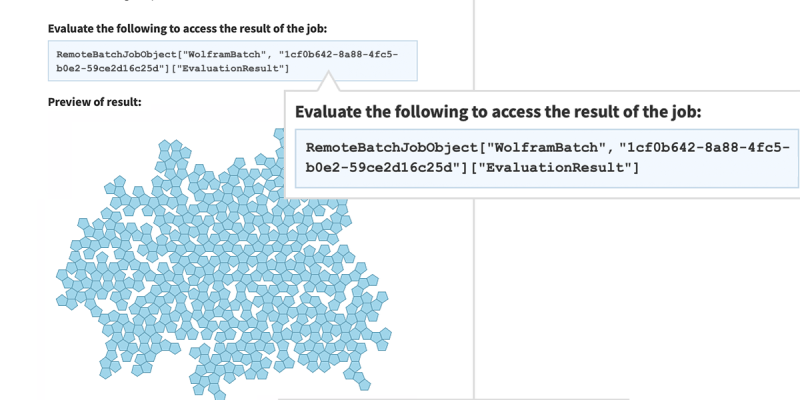
    As an example, [Stephen] shows a simple program that tiles pentagons:

    When the number of pentagons gets large, a single line of code sends it off to the cloud:

    RemoteBatchSubmit[PentagonTiling[500]]

    The basic machine class did the work in six minutes and 30 seconds for a cost of 5.39 credits. He also shows a meatier problem running on a 192-core 384GB machine. That job took less than two hours and cost a little under 11,000 credits (credit cost from just over $4/1000 to $6/1000, depending on how many you buy, so this job cost about $55 to run). If two hours is too much, you can map the same job across many small machines, get the answer in a few minutes, and spend fewer credits in the process.

    Supercomputers today are both very different from old supercomputers and yet still somewhat the same. If you really want that time on the Cray you always wanted, you might think about simulation.

    hackaday.com/2025/12/10/your-s…

    read more

  • RE: https://infosec.exchange/@codinghorror/114355800643182191

    If we do not stop to help each other, what will we become?

    read more

  • @gerardocanfora purtroppo nemmeno il successo di "c'è ancora domani" ha convinto gli elettori a tornare a votare

    read more

  • @quephird huzzah for antiseizure meds and cats!

    read more

  • @jackemled @danirabbit the law of mechanical reproduction also applies here: if you take something apart and put it back together again enough times eventually you will have two of them.

    read more

  • You ordered a pizza, cash on delivery. 35 minutes later, a cop car pulls up to your door. The cop knocks on your door. The cop is holding a pizza.

    What do you do?

    read more
Post suggeriti
  • Your Supercomputer Arrives in the Cloud

    Uncategorized
    1
    3
    0 Votes
    1 Posts
    0 Views
    Your Supercomputer Arrives in the CloudFor as long as there have been supercomputers, people like us have seen the announcements and said, “Boy! I’d love to get some time on that computer.” But now that most of us have computers and phones that greatly outpace a Cray 2, what are we doing with them? Of course, a supercomputer today is still bigger than your PC by a long shot, and if you actually have a use case for one, [Stephen Wolfram] shows you how you can easily scale up your processing by borrowing resources from the Wolfram Compute Services. It isn’t free, but you pay with Wolfram service credits, which are not terribly expensive, especially compared to buying a supercomputer.[Stephen] says he has about 200 cores of local processing at his house, and he still sometimes has programs that run overnight. If your program already uses a Wolfram language and uses parallelism — something easy to do with that toolbox — you can simply submit a remote batch job.What constitutes a supercomputer? You get to pick. You can just offload your local machine using a single-core 8GB virtual machine — still a supercomputer by 1980s standards. Or you get machines with up to 1.5TB of RAM and 192 cores. Not enough for your mad science? No worries, you can map a computation across more than one machine, too.As an example, [Stephen] shows a simple program that tiles pentagons:When the number of pentagons gets large, a single line of code sends it off to the cloud:RemoteBatchSubmit[PentagonTiling[500]]The basic machine class did the work in six minutes and 30 seconds for a cost of 5.39 credits. He also shows a meatier problem running on a 192-core 384GB machine. That job took less than two hours and cost a little under 11,000 credits (credit cost from just over $4/1000 to $6/1000, depending on how many you buy, so this job cost about $55 to run). If two hours is too much, you can map the same job across many small machines, get the answer in a few minutes, and spend fewer credits in the process.Supercomputers today are both very different from old supercomputers and yet still somewhat the same. If you really want that time on the Cray you always wanted, you might think about simulation.hackaday.com/2025/12/10/your-s…
  • 0 Votes
    1 Posts
    1 Views
    RE: https://infosec.exchange/@codinghorror/114355800643182191If we do not stop to help each other, what will we become?
  • You ordered a pizza, cash on delivery.

    Uncategorized poll
    1
    0 Votes
    1 Posts
    0 Views
    You ordered a pizza, cash on delivery. 35 minutes later, a cop car pulls up to your door. The cop knocks on your door. The cop is holding a pizza.What do you do?#poll
  • 0 Votes
    3 Posts
    1 Views
    @jackemled @danirabbit the law of mechanical reproduction also applies here: if you take something apart and put it back together again enough times eventually you will have two of them.