The good thing about first person pronouns is that there's so many different ones to choose from.
Uncategorized
1
Posts
1
Posters
0
Views
-
The good thing about first person pronouns is that there's so many different ones to choose from.
-
 undefined oblomov@sociale.network shared this topic

Feed RSS
Gli ultimi otto messaggi ricevuti dalla Federazione
-
@brouhaha Next time someone asks, "What is Mastodon?" I'm showing them this.
-
@globalistIT ma invece nei confronti delle occupazioni abusive di stabili e delle manifestazioni e saluti nazisti di "💩paund&co"😠come si pongono?,ovviamente la domanda è retorica🤐
-
@_elena still no simple FTP server that doesn't require 287302723 different config files with 0xDEADBEEF command line options.
Honestly if a ftp server is more complicated than `ftpserver $HOME --write --read` then it is a failed one.
-
-
Plug Into USB, Read Hostname and IP Address
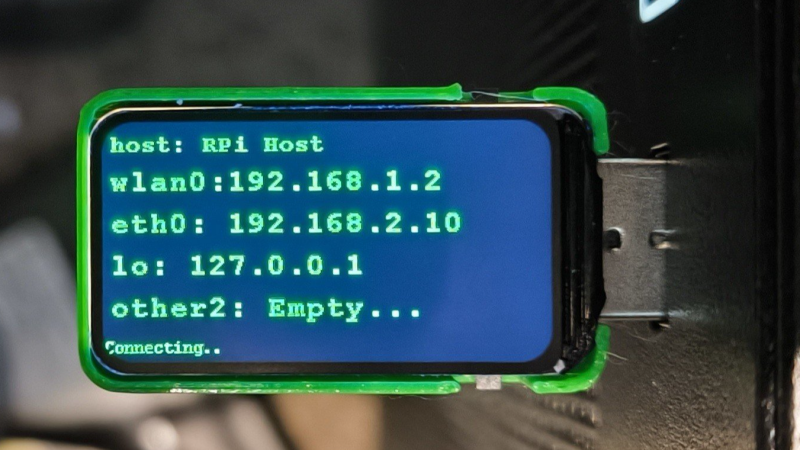
Ever wanted to just plug something in and conveniently read the hostname and IP addresses of a headless board like a Raspberry Pi? Chances are, a free USB port is more accessible than digging up a monitor and keyboard, and that’s where [C4KEW4LK]’s rpi_usb_ip_display comes in. Plug it into a free USB port, and a few moments later, read the built-in display. Handy!
The device is an RP2350 board and a 1.47″ Waveshare LCD, with a simple 3D-printed enclosure. It displays hostname, WiFi interface, Ethernet interface, and whatever others it can identify. There isn’t even a button to push; just plug it in and let it run.
Here’s how it works: once plugged in, the board identifies itself as a USB keyboard and a USB serial port. Then it launches a terminal with Ctrl-Alt-T, and from there it types and runs commands to do the following:
Find the serial port that the RP2350 board just created.Get the parsed outputs of hostname, ip -o -4 addr show dev wlan0, ip -o -4 addr show dev eth0, and ip -o -4 addr show to gather up data on active interfaces.Send that information out the serial port to the RP2350 board.Display the information on the LCD.Update periodically.The only catch is that the host system must be able to respond to launching a new terminal with Ctrl-Alt-T, which typically means the host must have someone logged in.
It’s a pretty nifty little tool, and its operation might remind you, in concept, of how BadUSB attacks happen: a piece of hardware, once plugged into a host, identifies itself to the host as something other than what it appears to be. Then it proceeds to input and execute actions. But in this case, it’s not at all malicious, just convenient and awfully cute.
-
Had baked beans with dinner, and now having some more. I guess it's dessert.
-
Current* conditions near Alpena, MI:
-
Tante trasformazioni ha l'animo umano che, sarà ererno, ma è di eterno mutamento