I’m building a new tool and looking for volunteers to test it!
General Discussion
57
Posts
55
Posters
9
Views
-
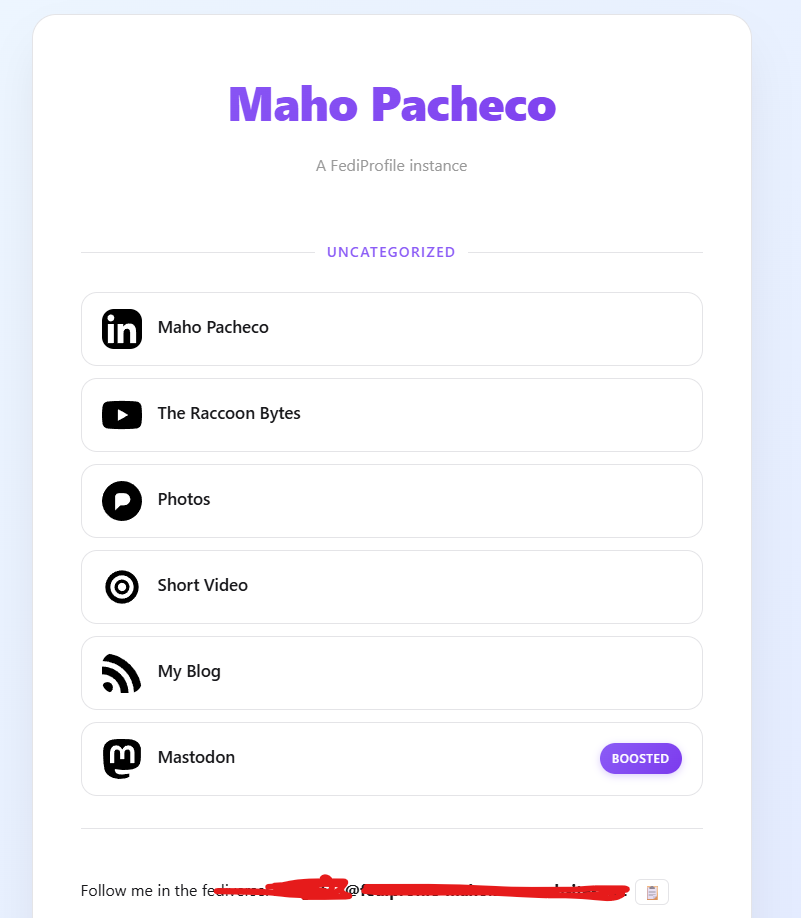
I’m building a new tool and looking for volunteers to test it! A #fediverse linktree.
It’s designed for two types of people:
Normies / newcomers – Think of it like a free, privacy-respecting Linktree. No trackers, no ads. But here's the cool par: it's a Trojan horse for the fediverse. Your profile link is itself an ActivityPub actor. That means people can interact with it directly in the fediverse, and it encourages exploration of open platforms.
Fediverse users, If you have multiple accounts (#Mastodon, #Pixelfed, Loops, a federated blog…), you know the struggle: sometimes you just want one persona to follow. This tool gives you that. It doesn’t post on its own (read-only), but it boosts all your other accounts and even has its own #ActivityPub inbox. PLUS it can receive and show your badges issued by @badgefed !
Interested in testing? Reply here.
-
I’m building a new tool and looking for volunteers to test it! A #fediverse linktree.
It’s designed for two types of people:
Normies / newcomers – Think of it like a free, privacy-respecting Linktree. No trackers, no ads. But here's the cool par: it's a Trojan horse for the fediverse. Your profile link is itself an ActivityPub actor. That means people can interact with it directly in the fediverse, and it encourages exploration of open platforms.
Fediverse users, If you have multiple accounts (#Mastodon, #Pixelfed, Loops, a federated blog…), you know the struggle: sometimes you just want one persona to follow. This tool gives you that. It doesn’t post on its own (read-only), but it boosts all your other accounts and even has its own #ActivityPub inbox. PLUS it can receive and show your badges issued by @badgefed !
Interested in testing? Reply here.
@mapache@hachyderm.io .... okay I'm game. What do I do?
-
I’m building a new tool and looking for volunteers to test it! A #fediverse linktree.
It’s designed for two types of people:
Normies / newcomers – Think of it like a free, privacy-respecting Linktree. No trackers, no ads. But here's the cool par: it's a Trojan horse for the fediverse. Your profile link is itself an ActivityPub actor. That means people can interact with it directly in the fediverse, and it encourages exploration of open platforms.
Fediverse users, If you have multiple accounts (#Mastodon, #Pixelfed, Loops, a federated blog…), you know the struggle: sometimes you just want one persona to follow. This tool gives you that. It doesn’t post on its own (read-only), but it boosts all your other accounts and even has its own #ActivityPub inbox. PLUS it can receive and show your badges issued by @badgefed !
Interested in testing? Reply here.
-
I’m building a new tool and looking for volunteers to test it! A #fediverse linktree.
It’s designed for two types of people:
Normies / newcomers – Think of it like a free, privacy-respecting Linktree. No trackers, no ads. But here's the cool par: it's a Trojan horse for the fediverse. Your profile link is itself an ActivityPub actor. That means people can interact with it directly in the fediverse, and it encourages exploration of open platforms.
Fediverse users, If you have multiple accounts (#Mastodon, #Pixelfed, Loops, a federated blog…), you know the struggle: sometimes you just want one persona to follow. This tool gives you that. It doesn’t post on its own (read-only), but it boosts all your other accounts and even has its own #ActivityPub inbox. PLUS it can receive and show your badges issued by @badgefed !
Interested in testing? Reply here.
-
I’m building a new tool and looking for volunteers to test it! A #fediverse linktree.
It’s designed for two types of people:
Normies / newcomers – Think of it like a free, privacy-respecting Linktree. No trackers, no ads. But here's the cool par: it's a Trojan horse for the fediverse. Your profile link is itself an ActivityPub actor. That means people can interact with it directly in the fediverse, and it encourages exploration of open platforms.
Fediverse users, If you have multiple accounts (#Mastodon, #Pixelfed, Loops, a federated blog…), you know the struggle: sometimes you just want one persona to follow. This tool gives you that. It doesn’t post on its own (read-only), but it boosts all your other accounts and even has its own #ActivityPub inbox. PLUS it can receive and show your badges issued by @badgefed !
Interested in testing? Reply here.
-
I love it! I also believe in the power of the alternatives and collaboration, the more open alternatives the merrier.
I would also need a very specific activitypub integration to allow to among other things show badges. As far as I understand Linkstack does not have an activitypub implementation? Maybe I am wrong.
I also love PHP, but I wanted to host it in other stack, so that is why to build the alternative.
-
I’m building a new tool and looking for volunteers to test it! A #fediverse linktree.
It’s designed for two types of people:
Normies / newcomers – Think of it like a free, privacy-respecting Linktree. No trackers, no ads. But here's the cool par: it's a Trojan horse for the fediverse. Your profile link is itself an ActivityPub actor. That means people can interact with it directly in the fediverse, and it encourages exploration of open platforms.
Fediverse users, If you have multiple accounts (#Mastodon, #Pixelfed, Loops, a federated blog…), you know the struggle: sometimes you just want one persona to follow. This tool gives you that. It doesn’t post on its own (read-only), but it boosts all your other accounts and even has its own #ActivityPub inbox. PLUS it can receive and show your badges issued by @badgefed !
Interested in testing? Reply here.
@mapache very interested, would love to take a look!
-
I love it! I also believe in the power of the alternatives and collaboration, the more open alternatives the merrier.
I would also need a very specific activitypub integration to allow to among other things show badges. As far as I understand Linkstack does not have an activitypub implementation? Maybe I am wrong.
I also love PHP, but I wanted to host it in other stack, so that is why to build the alternative.
-
I’m building a new tool and looking for volunteers to test it! A #fediverse linktree.
It’s designed for two types of people:
Normies / newcomers – Think of it like a free, privacy-respecting Linktree. No trackers, no ads. But here's the cool par: it's a Trojan horse for the fediverse. Your profile link is itself an ActivityPub actor. That means people can interact with it directly in the fediverse, and it encourages exploration of open platforms.
Fediverse users, If you have multiple accounts (#Mastodon, #Pixelfed, Loops, a federated blog…), you know the struggle: sometimes you just want one persona to follow. This tool gives you that. It doesn’t post on its own (read-only), but it boosts all your other accounts and even has its own #ActivityPub inbox. PLUS it can receive and show your badges issued by @badgefed !
Interested in testing? Reply here.
@mapache
Very cool idea and I can immediately see how wide adoption of this can help make the Fediverse more visible. Sign me up! -
I’m building a new tool and looking for volunteers to test it! A #fediverse linktree.
It’s designed for two types of people:
Normies / newcomers – Think of it like a free, privacy-respecting Linktree. No trackers, no ads. But here's the cool par: it's a Trojan horse for the fediverse. Your profile link is itself an ActivityPub actor. That means people can interact with it directly in the fediverse, and it encourages exploration of open platforms.
Fediverse users, If you have multiple accounts (#Mastodon, #Pixelfed, Loops, a federated blog…), you know the struggle: sometimes you just want one persona to follow. This tool gives you that. It doesn’t post on its own (read-only), but it boosts all your other accounts and even has its own #ActivityPub inbox. PLUS it can receive and show your badges issued by @badgefed !
Interested in testing? Reply here.
-
@Wtebbens This is great
-
I’m building a new tool and looking for volunteers to test it! A #fediverse linktree.
It’s designed for two types of people:
Normies / newcomers – Think of it like a free, privacy-respecting Linktree. No trackers, no ads. But here's the cool par: it's a Trojan horse for the fediverse. Your profile link is itself an ActivityPub actor. That means people can interact with it directly in the fediverse, and it encourages exploration of open platforms.
Fediverse users, If you have multiple accounts (#Mastodon, #Pixelfed, Loops, a federated blog…), you know the struggle: sometimes you just want one persona to follow. This tool gives you that. It doesn’t post on its own (read-only), but it boosts all your other accounts and even has its own #ActivityPub inbox. PLUS it can receive and show your badges issued by @badgefed !
Interested in testing? Reply here.
@mapache im in where do I join?
-
I’m building a new tool and looking for volunteers to test it! A #fediverse linktree.
It’s designed for two types of people:
Normies / newcomers – Think of it like a free, privacy-respecting Linktree. No trackers, no ads. But here's the cool par: it's a Trojan horse for the fediverse. Your profile link is itself an ActivityPub actor. That means people can interact with it directly in the fediverse, and it encourages exploration of open platforms.
Fediverse users, If you have multiple accounts (#Mastodon, #Pixelfed, Loops, a federated blog…), you know the struggle: sometimes you just want one persona to follow. This tool gives you that. It doesn’t post on its own (read-only), but it boosts all your other accounts and even has its own #ActivityPub inbox. PLUS it can receive and show your badges issued by @badgefed !
Interested in testing? Reply here.
-
I’m building a new tool and looking for volunteers to test it! A #fediverse linktree.
It’s designed for two types of people:
Normies / newcomers – Think of it like a free, privacy-respecting Linktree. No trackers, no ads. But here's the cool par: it's a Trojan horse for the fediverse. Your profile link is itself an ActivityPub actor. That means people can interact with it directly in the fediverse, and it encourages exploration of open platforms.
Fediverse users, If you have multiple accounts (#Mastodon, #Pixelfed, Loops, a federated blog…), you know the struggle: sometimes you just want one persona to follow. This tool gives you that. It doesn’t post on its own (read-only), but it boosts all your other accounts and even has its own #ActivityPub inbox. PLUS it can receive and show your badges issued by @badgefed !
Interested in testing? Reply here.
Hiya, yes, I would like to test this. I currently use @linkstack for this, so it'll be great to see how your system works. I will need to self-host though - will that be possible?
-
I’m building a new tool and looking for volunteers to test it! A #fediverse linktree.
It’s designed for two types of people:
Normies / newcomers – Think of it like a free, privacy-respecting Linktree. No trackers, no ads. But here's the cool par: it's a Trojan horse for the fediverse. Your profile link is itself an ActivityPub actor. That means people can interact with it directly in the fediverse, and it encourages exploration of open platforms.
Fediverse users, If you have multiple accounts (#Mastodon, #Pixelfed, Loops, a federated blog…), you know the struggle: sometimes you just want one persona to follow. This tool gives you that. It doesn’t post on its own (read-only), but it boosts all your other accounts and even has its own #ActivityPub inbox. PLUS it can receive and show your badges issued by @badgefed !
Interested in testing? Reply here.
@mapache I’ll take it for a spin.
-
 undefined _elena@mastodon.social shared this topic
-
I’m building a new tool and looking for volunteers to test it! A #fediverse linktree.
It’s designed for two types of people:
Normies / newcomers – Think of it like a free, privacy-respecting Linktree. No trackers, no ads. But here's the cool par: it's a Trojan horse for the fediverse. Your profile link is itself an ActivityPub actor. That means people can interact with it directly in the fediverse, and it encourages exploration of open platforms.
Fediverse users, If you have multiple accounts (#Mastodon, #Pixelfed, Loops, a federated blog…), you know the struggle: sometimes you just want one persona to follow. This tool gives you that. It doesn’t post on its own (read-only), but it boosts all your other accounts and even has its own #ActivityPub inbox. PLUS it can receive and show your badges issued by @badgefed !
Interested in testing? Reply here.
-
I’m building a new tool and looking for volunteers to test it! A #fediverse linktree.
It’s designed for two types of people:
Normies / newcomers – Think of it like a free, privacy-respecting Linktree. No trackers, no ads. But here's the cool par: it's a Trojan horse for the fediverse. Your profile link is itself an ActivityPub actor. That means people can interact with it directly in the fediverse, and it encourages exploration of open platforms.
Fediverse users, If you have multiple accounts (#Mastodon, #Pixelfed, Loops, a federated blog…), you know the struggle: sometimes you just want one persona to follow. This tool gives you that. It doesn’t post on its own (read-only), but it boosts all your other accounts and even has its own #ActivityPub inbox. PLUS it can receive and show your badges issued by @badgefed !
Interested in testing? Reply here.
-
I’m building a new tool and looking for volunteers to test it! A #fediverse linktree.
It’s designed for two types of people:
Normies / newcomers – Think of it like a free, privacy-respecting Linktree. No trackers, no ads. But here's the cool par: it's a Trojan horse for the fediverse. Your profile link is itself an ActivityPub actor. That means people can interact with it directly in the fediverse, and it encourages exploration of open platforms.
Fediverse users, If you have multiple accounts (#Mastodon, #Pixelfed, Loops, a federated blog…), you know the struggle: sometimes you just want one persona to follow. This tool gives you that. It doesn’t post on its own (read-only), but it boosts all your other accounts and even has its own #ActivityPub inbox. PLUS it can receive and show your badges issued by @badgefed !
Interested in testing? Reply here.
-
I’m building a new tool and looking for volunteers to test it! A #fediverse linktree.
It’s designed for two types of people:
Normies / newcomers – Think of it like a free, privacy-respecting Linktree. No trackers, no ads. But here's the cool par: it's a Trojan horse for the fediverse. Your profile link is itself an ActivityPub actor. That means people can interact with it directly in the fediverse, and it encourages exploration of open platforms.
Fediverse users, If you have multiple accounts (#Mastodon, #Pixelfed, Loops, a federated blog…), you know the struggle: sometimes you just want one persona to follow. This tool gives you that. It doesn’t post on its own (read-only), but it boosts all your other accounts and even has its own #ActivityPub inbox. PLUS it can receive and show your badges issued by @badgefed !
Interested in testing? Reply here.
-
I’m building a new tool and looking for volunteers to test it! A #fediverse linktree.
It’s designed for two types of people:
Normies / newcomers – Think of it like a free, privacy-respecting Linktree. No trackers, no ads. But here's the cool par: it's a Trojan horse for the fediverse. Your profile link is itself an ActivityPub actor. That means people can interact with it directly in the fediverse, and it encourages exploration of open platforms.
Fediverse users, If you have multiple accounts (#Mastodon, #Pixelfed, Loops, a federated blog…), you know the struggle: sometimes you just want one persona to follow. This tool gives you that. It doesn’t post on its own (read-only), but it boosts all your other accounts and even has its own #ActivityPub inbox. PLUS it can receive and show your badges issued by @badgefed !
Interested in testing? Reply here.
@mapache Never used a link tree. If you need that kind of tester.

















Gli ultimi otto messaggi ricevuti dalla Federazione
-
@mapache @badgefed hello! Very interested in testing, possibly also in digging around in the integration potential.
-
@mapache I'd like to try this out as well!
-
@mapache @badgefed I've only got 1 ActivityPub account that I regularly use, but I wouldn't be opposed to testing it for at least linking to my blog and other sites. Maybe I'll throw on my rarely used BookWyrm account to I suppose.
-
-
@mapache@hachyderm.io I might be able to help to check it out
-
Well, I guess we won’t be the only one out there pushing the wonders of trees this year, though ours serves a somewhat different audience. But I see a nice fit between this and what we’re doing. It’s going to be an interesting year.
-
@mapache @badgefed I played around with something like this before Glitch shut down - basically an app which took the URLs for my fedi identities and created a page using the webfinger data for each of them, with tiles and links. Happy to have a look at your tool, this looks much nicer than my thing (and I'm hunting around trying to find the code for that now, and failing...)